

Audio By Carbonatix
Background
The terminology of variations in viruses can be confusing because the media and even scientific communicators often use the terms variant and strain interchangeably.
All living things produce their offspring and in viruses, this is known as ‘replication’. It may result in the introduction of mutations (changes) throughout the viral genome (the building blocks/bricks that make up a virus).
When specific mutations, or sets of mutations, are selected through numerous rounds of viral replication, a new variant can emerge. If the sequence variation produces a virus with distinctly different phenotypic characteristics, the variant is cotermed a strain.
Through a process of evolutionary selection, a new variant becomes predominant. Like the ‘survival of the fittest’ this new variant might have some survival advantages such as being more readily transmittable, more virulent or pathogenic; and can evade immunity induced by vaccination or prior infection.
The speed with which SARS-COV-2 variants evolved required a common nomenclature for effective communication (Table 1).
Table 1. New names proposed for Covid-19 variants
| Country/Region | Scientific name | WHO name |
| United Kingdom | B.1.1.7 | Alpha |
| South Africa | B.1.351 | Beta |
| Brazil | P.1 | Gamma |
| India | B.1.617.2 | Delta |
The trouble started somewhere around April 2020, when the original SARS-CoV-2 strain was replaced in many regions of the world by a variant called D614G, which was subsequently shown to increase the efficiency of viral replication in humans and animals.
In October 2020, the UK detected an emerging variant of concern, later termed B.1.1.7 or Alpha variant which is now the predominant variant globally.
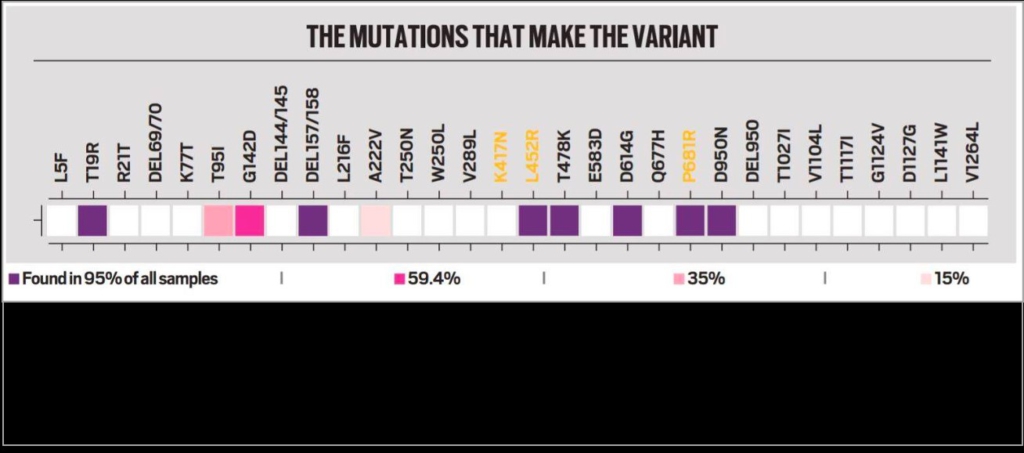
The B.1.1.7. contains 8 mutations in the spike protein (Fig. 1) and maintains the D614G mutation. Studies showed that the Delta is 40% to 80% more contagious than B.1.1.7.
Delta variant epidemiology
The Director-General of the World Health Organisation Dr Tedros Adhanom Ghebreyesus told a news briefing “Delta is the most transmissible of the variants identified so far. It has been identified in at least 85 countries and is spreading rapidly among unvaccinated populations.”
The German Chancellor Angela Merkel has warned that Europe is "on thin ice" as the Delta variant of Covid-19 spreads on the continent. Her warning came as EU health officials said the variant would account for 90% of the bloc's cases by late August.
Reports from France suggest the Delta variant is responsible for more than 10% of all new Covid-19 infections across the country.
The Russian capital, Moscow, has seen its highest number of daily deaths in June 2021 since the pandemic began - the Delta variant is responsible for 90% of new infections, according to the city's mayor. It is worth remembering that the Covid-19 Sputnik vaccine is produced in Russia.
In the last week of June 2020, authorities in several countries – from Bangladesh and Indonesia to Australia and Israel – are racing to contain the spread of the highly contagious Delta variant of the coronavirus according to Al Jazeera news.
Israel, which has one of the world’s most successful vaccination campaigns, has seen infections linked to Delta variant surge since dropping a requirement to wear masks in enclosed public places.
While vaccination campaigns have brought down infections in mostly wealthy and well-vaccinated nations, the rise of the Delta variant has stoked fears of new waves of a virus that has already killed nearly four million people.
At the time of submitting this article to the press, there was limited data of the Delta variant in Africa, the author is convinced the recent surge or ‘third wave’ of Covid-19 infections in many African countries including Ghana is caused by the Delta variant. The Delta variant of SARS-COV-2 described in this article as the ‘King of variants’ is predicted to dominate all new Covid-19 infections globally by the end of 2021.
Vaccines could be less effective if.
In 1918 the Spanish flu pandemic killed over 50 million people globally and that was caused by the Influenza A virus. Influenza A virus is an RNA virus just like the coronavirus and so mutates naturally as it moves among humans and animals.
Currently, Influenza A vaccines are updated every other year or so to keep up with the evolving variants. Similarly, it is very possible that next year Covid-19 vaccines composition would have to change in line with emerging variants.
India just reported that the Delta variant (B.1.617.2) has recently mutated to Delta plus variant (B.1.617.2.1), which is also a variant of concern. The efficacy of the current vaccines against the Delta plus variant is not known and many people are worried.
The speed at which the Delta variant and it’s sibling the Delta plus are evolving could render current vaccines less effective if an emergency global approach to controlling the spread of Covid-19 is not taken.
The author predicts that current vaccines might not be effective for SARS-COV-2 variants in 2022. Factors that could drive the low vaccine efficacy include (i) the huge > 95% unvaccinated population globally; (ii) geopolitical and population differences; (iii) emergence of more variants of concern; (iv) lack of vaccine efficacy testing to detect variants among nations especially the poor ones.
Solutions
Rapid global deployment of vaccines with the aim of attaining some level of “herd immunity’ whilst efforts are ongoing to develop other SARS-COV-2 vaccines is probably the solution. Also, cheaper therapeutic interventions including traditional medicines against SARS-COV-2 should be developed and made readily available globally.
******
The author Prof. Mutocheluh Mohamed is an Associate Professor in the Department of Clinical Microbiology.
of the School of Medicine and Dentistry, Kwame Nkrumah University of Science and Technology, Kumasi.
Email: mmutocheluh.chs@knust.edu.gh or mutocheluh@gmail.com
Latest Stories
-
TGMA controversy hasn’t affected my relationship with Diana Hamilton – Piesie Esther
2 minutes -
Cliff Cheqona to take TP Masterclass to Lagos and Abuja in 2027
4 minutes -
Bond market: Turnover rises 77% to GH¢2.76bn
5 minutes -
Be lovers of the environment – Archbishop Kwofie calls for stronger fight against environmental injustice
9 minutes -
BoG declares FX compliance “non-negotiable” as it moves to tighten rules
12 minutes -
Government to prioritise creation of decent jobs – Finance Minister
18 minutes -
Ghana’s ocean is not land under water: Why the Fisheries Commission is right to demand a proper assessment of offshore gold exploration
24 minutes -
Teacher unions maintain strike as FWSC, GES negotiations yield no deal
26 minutes -
Photos: Mahama Ayariga engages World Bank on sustainable cities development
31 minutes -
Foreign Affairs Minister warns embassies over long queues, ‘inhumane’ conditions for visa applicants
33 minutes -
Photos: AMA steps up enforcement to clear traders from BRT shelters
34 minutes -
Shortage of health information officers threatens quality of healthcare data – GHIMA
35 minutes -
Ghana’s National Chess Team, The Golden Knights return from Samarkand with gold and seven new international titles
36 minutes -
Northern Births and Deaths Director to face PAC over GH¢71k withdrawals
45 minutes -
Djokovic claims 102nd title of career with China Open win
49 minutes