

Audio By Carbonatix
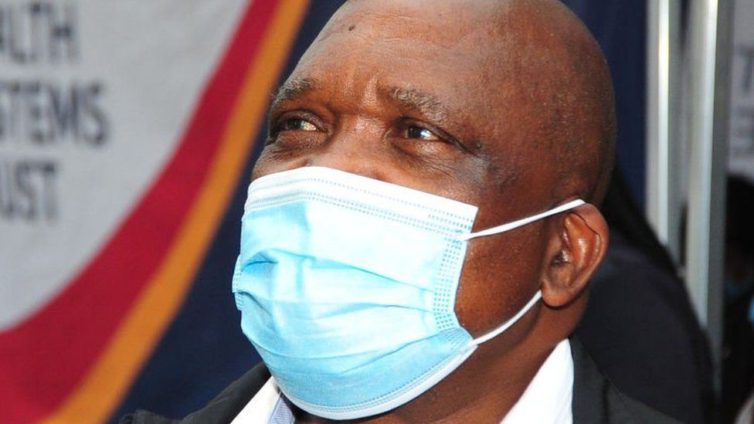
South Africa's health minister says there is "absolutely no need to panic" over the new coronavirus variant Omicron, despite a surge in cases.
"We have been here before," Joe Phaahla added, referring to the Beta variant detected in South Africa last December.
South Africa also condemned the travel bans imposed on the country, saying they should be lifted immediately.
Omicron has been classed as a "variant of concern". Early evidence suggests it has a heightened re-infection risk.
The heavily mutated variant was detected in South Africa earlier this month and then reported to the World Health Organization (WHO) last Wednesday.
The variant is responsible for most of the infections found in South Africa's most populated province, Gauteng, over the last two weeks.
The number of cases of "appears to be increasing in almost all provinces" in the country, according to the WHO.
South Africa reported 2,800 new infections on Sunday, a rise from the daily average of 500 in the previous week.
Government adviser and epidemiologist Salim Abdool Karim said he expected the number of cases to reach more than 10,000 a day by the end of the week, and for hospitals to come under pressure in the next two to three weeks.
Dr Phaahla said he wanted to "reiterate that there is absolutely no need to panic" because this "is no new territory for us".
"We are now more than 20 months' experienced in terms of Covid-19, various variants and waves," he added at a media briefing.
On Monday, Japan became the latest country to reinstate tough border restrictions, banning all foreigners from entering from 30 November.
The UK, EU and US are among those who earlier imposed travel bans on South Africa and other regional states.
UN Secretary-General António Guterres said he was "deeply concerned" about the isolation of southern Africa, adding that "the people of Africa cannot be blamed for the immorally low level of vaccinations available in Africa".
The bans and restrictions have left the plans of a huge number of travellers up in the air.
South African Annalee Veysey, who is getting treatment for cancer in South Africa, was expecting to be reunited with her family in the UK early in December.
She has been separated from them for the last 15 months because of earlier travel restrictions and her treatment.
"It's almost two years of my life I've missed out with my family. Especially if you've had a journey with cancer, you find what your family means to you," she told the BBC, adding that she felt "desperate".
Hannah Day is stuck in Pretoria. She flew to South Africa last week after she got news that her son, who lives there, was in hospital after being bitten by a snake.
He is now recovering but Ms Day needs to return to the UK for work. "I can self-isolate, but I cannot afford to pay for the quarantine," she told the BBC.
The WHO has warned against countries hastily imposing travel curbs, saying they should look to a "risk-based and scientific approach".
The world body's Africa director Matshidiso Moeti said on Sunday: "With the Omicron variant now detected in several regions of the world, putting in place travel bans that target Africa attacks global solidarity."
However, Rwanda and Angola are among African states that have announced a restriction on flights to and from South Africa.
South Africa's foreign ministry spokesman Clayson Monyela described their decision as "quite regrettable, very unfortunate, and I will even say sad".
In a speech on Sunday, South Africa's President Cyril Ramaphosa said the bans would not be effective in preventing the spread of the variant.
"The only thing the prohibition on travel will do is to further damage the economies of the affected countries and undermine their ability to respond to, and recover from, the pandemic," he said.
Current regulations in South Africa make it mandatory to wear face coverings in public, and restrict indoor gatherings to 750 people and outdoor gatherings to 2,000.
Mr Ramaphosa said South Africa would not impose new restrictions, but would "undertake broad consultations on making vaccination mandatory for specific activities and locations".
There are no vaccine shortages in South Africa itself, and Mr Ramaphosa urged more people to get jabbed, saying that remained the best way to fight the virus.
Health experts said that Gauteng, which includes Johannesburg, had entered a fourth wave, and most hospital admissions were of unvaccinated people.
Omicron has now been detected in a number of countries around the world, including the UK, Germany, Australia and Israel.
Latest Stories
-
Lawyers, prosecutors fume over abandoned 26-year-old Upper West High Court project
3 minutes -
At least two dead in blast at Bolivia military barracks
36 minutes -
Tate brothers officially indicted with trafficking and sex crimes in Romania
38 minutes -
US envoys arrive in Moscow ahead of Ukraine talks
42 minutes -
Health Minister to brief media on Free Primary Healthcare programme on Monday
55 minutes -
‘It was inappropriate to make that comparison’ – Dr Pumpuni Asante on CJ’s SOE comment
1 hour -
Photos: Final-day shopping continues at Joy FM Back-to-School Discount Fair
2 hours -
Darkey and Frimpong set up J30 Accra boys’ doubles final
2 hours -
When war takes more than territory: The human cost of conflict
2 hours -
Review SHS placement policy to give more BECE candidates access – Kwesi Kwarteng
2 hours -
Tano South Municipal Assembly moves to curb road carnage with speed ramps
2 hours -
Duvor Klu, Gakpo win J30 Accra girls’ doubles title
2 hours -
ITF Juniors Tournament: Duvor Klu claims with straight-sets victory over Gakpo
2 hours -
‘Decision to retire has been tough’ – Isaac Dogboe
2 hours -
Domelevo backs OSP probe into alleged GH¢70,000 payment to Appiagyei
2 hours