

Audio By Carbonatix
According to six leading international datasets consolidated by the World Meteorological Organization (WMO), 2021 was among the warmest seven years on record.
It was also the seventh consecutive year that world temperature exceeded pre-industrial levels by more than 1°C; nearing the limit of the 2015 Paris Agreement on Climate Change.
WMO stated that it has used six international datasets “to ensure the most comprehensive, authoritative temperature assessment”, and the same data are used in its authoritative.
Each decade, according to WMO, has been warmer than the previous one since the 1980s, and it is expected to continue.
WMO also used datasets based on monthly climatological data from observing sites and ships including buoys in global marine networks.
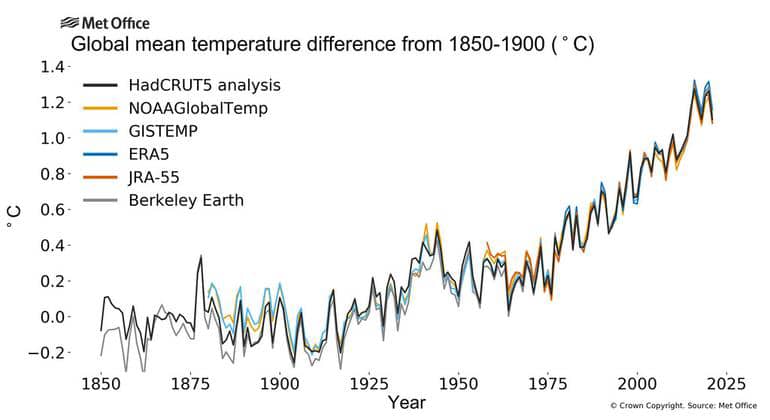
These are developed and maintained by the US National Oceanic and Atmospheric Administration (NOAA), NASA’s Goddard Institute for Space Studies (NASA GISS), the United Kingdom’s Met Office Hadley Centre, and the University of East Anglia’s Climatic Research Unit (HadCRUT) and the Berkeley Earth group.
The reanalysis datasets from the European Centre for Medium Range Weather Forecasts and its Copernicus Climate Change Service, and the Japan Meteorological Agency (JMA) are used by WMO.
As of 2015, the top three warmest years include; 2016, 2019 and 2020.
2016 was a result of an exceptionally strong El Niño event that contributed to record global average warming.
The average global temperature in 2021 was about 1.11 (± 0.13) °C above the pre-industrial era levels.
According to WMO Secretary-General, Prof. Petteri Taalas, "The overall long-term warming as a result of greenhouse gas increases, is now far larger than the year-to-year variability in global average temperatures caused by naturally occurring climate drivers”.
“The year 2021 will be remembered for a record-shattering temperature of nearly 50°C in Canada, comparable to the values reported in the hot Saharan Desert of Algeria, exceptional rainfall, and deadly flooding in Asia and Europe as well as drought in parts of Africa and South America”
He indicated that, "Back-to-back La Niña events mean that 2021 warming was relatively less pronounced compared to recent years. Even so, 2021 was still warmer than previous years influenced by La Niña."
The Paris Agreement calls on all countries to work toward a 1.5°C global warming limit through concerted climate action and realistic Nationally Determined Contributions.
Global warming and other long-term climate change trends are expected to continue due to record levels of heat-trapping greenhouse gases in the atmosphere.
"Climate change impacts and weather-related hazards had life-changing and devastating impacts on communities on every single continent”, Mr. Taalas said.
Latest Stories
-
Mohammed Kudus drops out of Ghana squad for AFCON 2027 qualifiers against Côte d’Ivoire and Gambia
16 minutes -
Africa World Airlines unveils first Embraer E190 as part of 10-aircraft fleet expansion
1 hour -
Civilian hospitalised after alleged machete attack by prison officers, inmates
2 hours -
Toobu rejects calls to recall Parliament over 3.9-tonne cocaine shipment
2 hours -
Residents in 5 Northern Regions warned of approaching rainstorm
2 hours -
Constituency Games still a work in progress – Sports Minister
3 hours -
Team Ghana set for historic Karting Africa Showrun in Angola
3 hours -
52-year-old South African arrested with suspected heroin after arriving from Accra
3 hours -
Shatta Wale challenges UPSA students to build entrepreneurial mindsets
4 hours -
Finance Minister advises African governments to strengthen regional tax cooperation
5 hours -
NPP accuses NDC of master-minding demolition of Ho regional office fence
5 hours -
Ghana plans stronger regional power trade with Nigeria
5 hours -
GRA Commissioner-General calls for stronger tax cooperation to boost regional revenue mobilisation
5 hours -
NACOC needs more personnel to tackle drug trafficking – Toobu
5 hours -
Railway workers resist KMA eviction order, demand consultation
5 hours