

Audio By Carbonatix
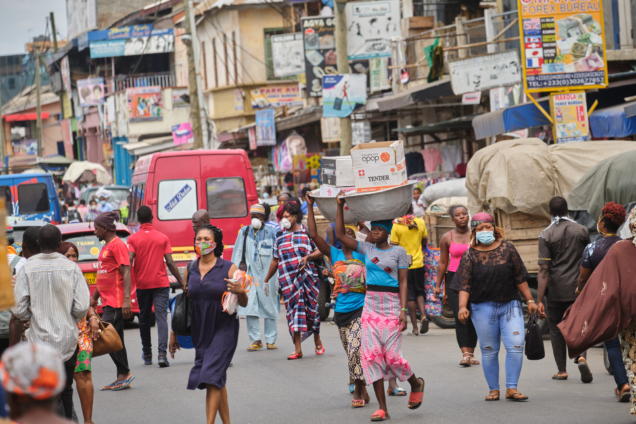
An alarming 5.4 million people out of the 12.3 million Ghanaian workforce are tagged as multidimensionally poor. This is according to the Ghana Statistical Service’s 2022 Labour Statistics report.
Multidimensional poverty encompasses the various deprivations experienced by poor people in their daily lives – such as poor health, lack of education, inadequate living standards, disempowerment, poor quality of work, the threat of violence, and living in areas that are environmentally hazardous, among others.
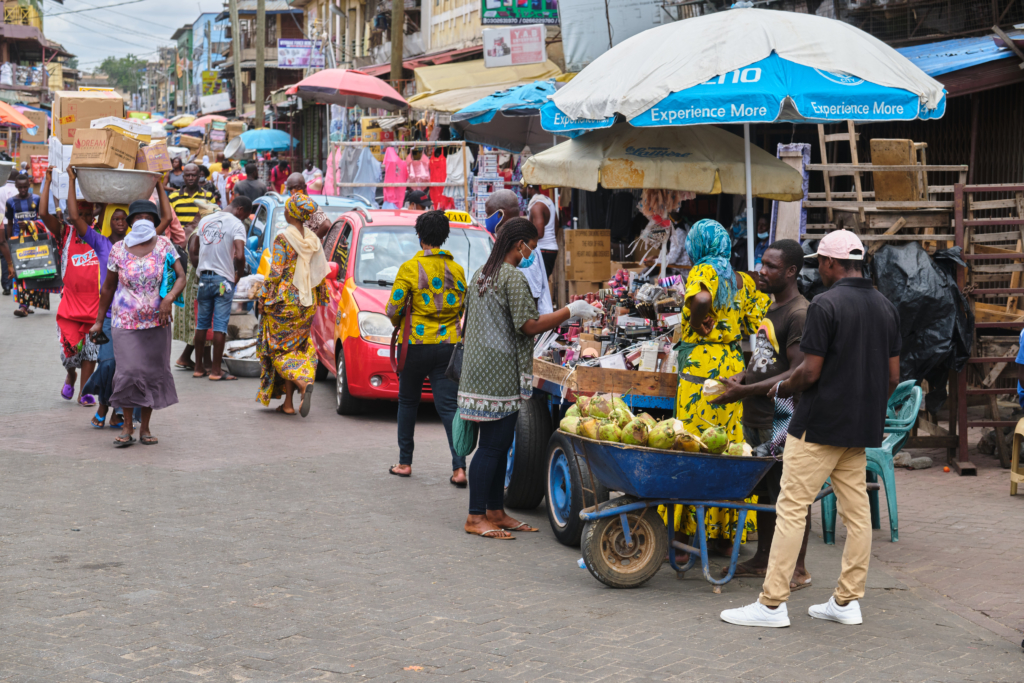
Details of the report indicated that 4.8 million out of the 5.4 million persons are employed, but surprisingly are not able to access good healthcare, education, or may be working under poor conditions.
This could have great repercussions on the productivity of the workforce as well as economic growth.
The majority of the multidimensional pool being employed explains that most of the employed people are receiving very low incomes and hence cannot afford the basic necessities of life.
Some are also being paid in kind, hence becoming monetarily poor, unable to afford proper healthcare, good education, and improved standards of living. 2.8 million people were also considered food insecure and among the multidimensional poverty pool.
National Scale
The Quarterly multidimensional poverty report 2022 by the Ghana Statistical Service (GSS) gives insights into the national multidimensional poverty state.
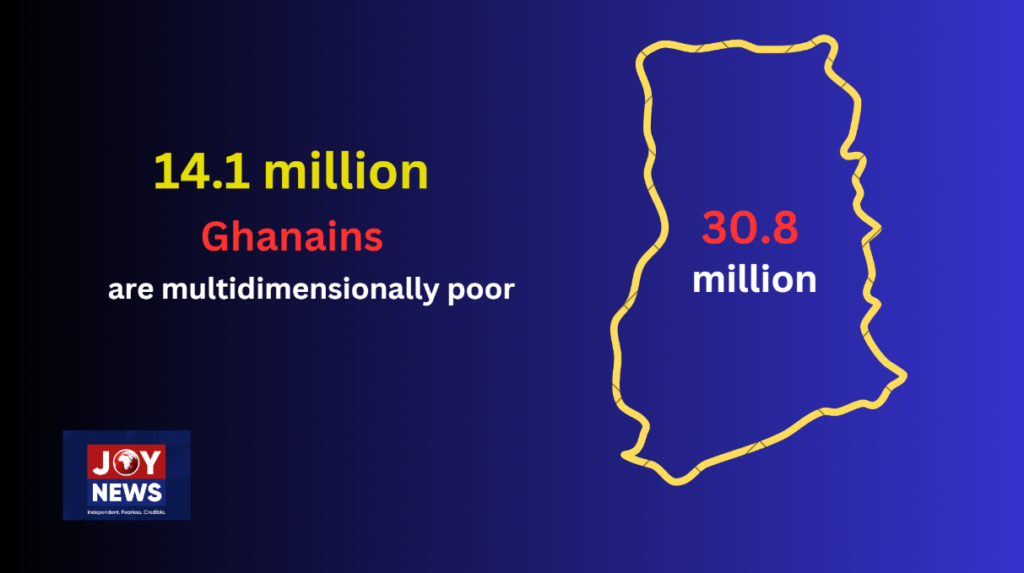
According to the report, as of the 2nd quarter, 46% representing 14.1 million of the entire Ghanaian population were multidimensionally poor.
The data revealed that there are relatively more multidimensionally poor persons in the Ashanti Region than in any other region with a sizable number of 2.1 million in Q2 of 2022.
The report stated that among the multidimensionally poor, deprivation in health insurance coverage and unimproved toilet facilities are the plausible drivers of poverty in Ghana.
Deprivation in health is the largest contributor to multidimensional poverty, with a 44.1% rate, followed by standard of living at 32.8%, and education at 23.1% as of Q2 2022.
Meanwhile, Global Multidimensional Poverty Index Report 2022 by the United Nations Development Programme (UNDP) indicates, that 24.6% of Ghana’s population based on a 2017/2018 survey, are multidimensionally poor. This means that about 6 million Ghanaians were multidimensionally poor in 2017/2018.
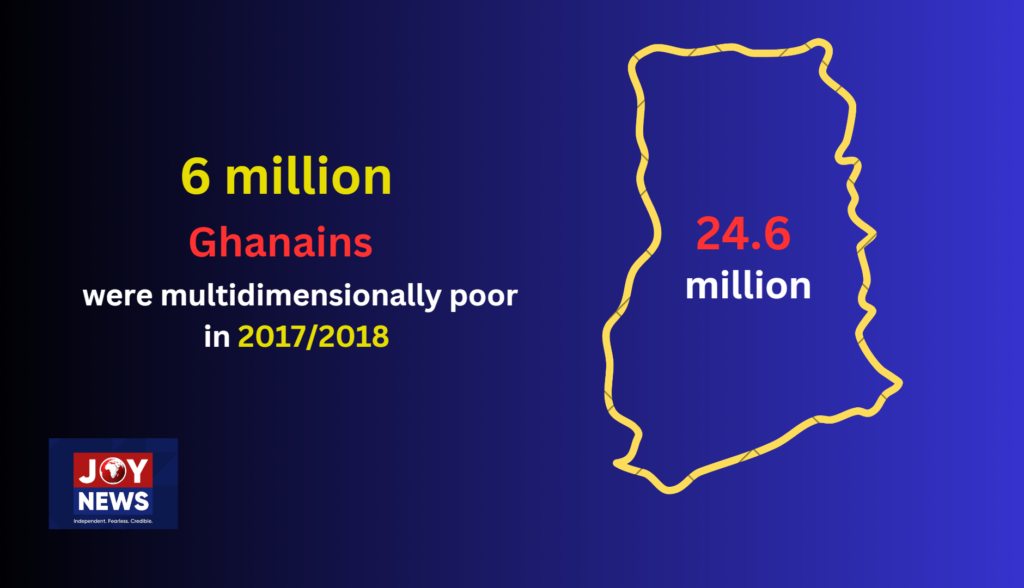
This suggests that multidimensional poverty in Ghana has increased tremendously over the years, and hence needs to be addressed.
The UNDP report cited health, education, and standard of living as the measures of the multidimensional poverty index, with health contributing 23.6%, education contributing 30.5%, and standard of living contributing 45.9%. Standard of living was considered to be the highest contributor to multidimensional poverty in Ghana in 2017/2018.
This explains that the highest contributing component to multidimensional poverty has shifted from standards of living to health over the years.
Some 12.7 million people representing 41.2% of the Ghanaian population were also tagged to be living below the international poverty line of $1.9 (GHS 22.42) per day.
Latest Stories
-
Mr President, Ghana was mentioned at the UN; why aren’t we talking about it?
3 hours -
Accra to convene Africa’s regulators and markets on tokenisation at AVAS 2026
3 hours -
The Paradox of Plenty — When every smartphone becomes a newsroom
4 hours -
GTA sensitises taxi drivers in ‘Know Ghana’ tourism campaign
5 hours -
Archbishop Agyinasare calls for responsible speech amid growing social media abuse
5 hours -
‘It will be inexcusable for gov’t not to honour payment of teachers’ arrears by 30th October’ – Haruna Iddrisu
5 hours -
Forbes’ World’s Best Employers 2026: No Ghanaian firm ranked among 900 companies
5 hours -
Electronic processing of teachers’ data: ‘The decision is the Controller’s’ – GES boss
6 hours -
Teachers’ Strike: Haruna Iddrisu questions paper-based processing of promoted teachers’ data
6 hours -
Savannah Region: Kunfusi bridge collapses again, leaving nearly 4,000 residents cut off
6 hours -
Teachers’ strike: GES targets Monday deadline to submit promotion data to Controller
6 hours -
Inflation to average 11.3% in 2027 – Fitch Solutions
6 hours -
‘I didn’t campaign for NDC to come and do this nonsense’ – Kpebu on EOCO’s conduct
6 hours -
Fitch Solutions maintains policy rate forecast of 14% by December 2026
7 hours -
Diaspora Nasara Caucus congratulates Mohammed Ali Suraj, new NPP executives
8 hours