

Audio By Carbonatix
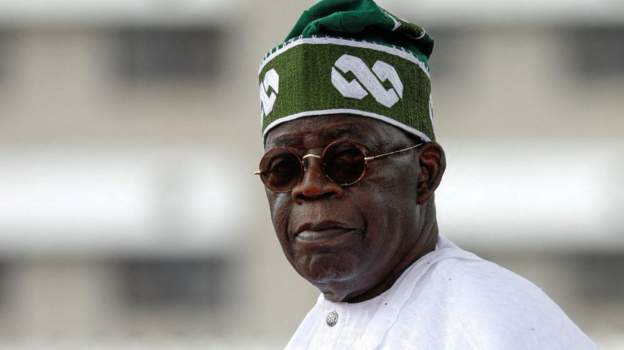
Nigeria's President Bola Tinubu is facing a huge backlash at home over his threat to use military force to reverse the coup in next-door neighbour Niger.
Local media report there was strong opposition to military intervention at a session of the upper chamber of parliament, the Senate, on Saturday, despite the fact that it is controlled by Mr Tinubu's party.
This was especially the case among lawmakers representing states along the more than 1,500km (930 mile)-long border with Niger, but there has also been countrywide condemnation of the possibility of war.
West African regional bloc Ecowas had set a deadline of Sunday for the junta to give up power - or face possible military action.
The decision was very much seen as Mr Tinubu's as he is Ecowas' current chairman, and Nigeria is its most influential member.
Although the junta has defied the ultimatum, Ecowas did not respond by immediately sending troops. This came as a relief to many Nigerians who prefer a diplomatic resolution to the crisis.
Some question whether a seven-day deadline was realistic given that Nigeria and other countries have to get parliamentary approval before deploying the military.
Many people are also appalled that electricity to Niger was cut on President Tinubu's orders, causing blackouts in Niger's capital, Niamey, and other cities.
Critics claim that this is in violation of a treaty that had enabled Nigeria to build a dam on the River Niger, though Mr Tinubu's supporters say the power cuts are aimed at pressuring the junta to hand back power to ousted President Mohamed Bazoum, without military confrontation.
Nigeria and Niger share strong ethnic, economic and cultural ties and any military intervention against Niger would affect northern Nigeria, already facing serious security challenges of its own.
An influential group of Muslim clerics in northern Nigeria said Mr Tinubu must not "rush into an avoidable conflict with a neighbour at the behest of global politicking".

Mr Bazoum was a key ally of the West, allowing former colonial power France and the US to keep military bases in the country to help in the fight against militant Islamists wreaking havoc across much of West Africa.
The military juntas in Mali and Burkina Faso have vowed to come to the defence of Niger's coup leaders if Ecowas does use force, raising the prospect of a major regional conflict.
All eyes are now on Mr Tinubu who has been the most vocal in condemning coups in West Africa, and said last month that Ecowas cannot be made up of "toothless bulldogs".
"We must stand firm on democracy. There is no governance, freedom and rule of law without democracy. We will not accept coup after coup in West Africa again," Mr Tinubu said, shortly after taking the leadership of the regional body.
Nigeria's constitution states that the president cannot deploy troops without the approval of the National Assembly - made up of both the upper and lower chambers of parliament.
It is unclear whether Mr Tinubu will get its support, given the opposition he is facing.
"Ecowas goofed, the Nigerian president also goofed," said Prof Khalifa Dikwa, an academic at the University of Maiduguri and a member of an influential group of elders in northern Nigeria.
In a cautious statement after Saturday's closed-door session, Senate leader Godswill Akpabio threw the ball into the court of the Ecowas parliament, saying it should provide "solutions to resolve this logjam as soon as possible".
President Tinubu's tough line against coups might be rooted in his own experience. He was barely a year in office as a lawmaker in the early 1990s before elections were annulled, parliament was dissolved and Gen Sani Abacha seized power.
He joined the pro-democracy movement that campaigned for a return to civilian rule, putting him in the crosshairs of the military that forced him into exile. He returned in 1998 after the death of Gen Abacha, one of Nigeria's most brutal and corrupt military rulers.
But there is a feeling among many Nigerians that Ecowas was too hasty in issuing an ultimatum to the junta, and President Tinubu had not given enough thought to the domestic implications of using force.
"Niger was a continuation of the northern part of Nigeria until the Berlin Conference [of 1884-1885, when foreign powers created Africa's current borders]. You expect the north to go to war against itself?" asked Prof Dikwa.

Unlike his predecessor Muhammadu Buhari, President Tinubu does not have a military background and neither does his national security adviser, Nuhu Ribadu, who is a former policeman.
Ecowas army chiefs issued their own statement last week, saying they saw military intervention very much as a "last resort".
Critics say Mr Tinubu has a history of rushing to make big decisions, pointing to the fact that he used his first speech as president in May to announce the ending of a decades-long fuel subsidy, in unscripted remarks which led to chaos.
Ecowas leaders will now hold a summit in Nigeria's capital Abuja on Thursday to decide on the next line of action.
Although some other West African countries have promised to take part in any military intervention, it is hard to see them doing so without Nigeria, if the National Assembly does not give its backing.
Mr Tinubu wears two hats - that of Ecowas chairman and Nigeria's president. The one necessitates acting in the regional interest and in defence of democracy, but it could prove very costly to the other hat.
Latest Stories
-
Drug bust case: Only Customs officers, MPS officials in scanning room – NACOC
29 minutes -
I don’t mind being insulted; I have a crocodile skin – President Mahama
42 minutes -
Samson’s Take: Verify the badge – and verify the story
53 minutes -
President Mahama explains why Ghana must rethink regulation of TikTok, other new media platforms
1 hour -
Rule of law must be protected – GBA condemns EOCO action against Baffour Awuah
3 hours -
950,000 barrels of Sankofa crude head to TOR as GNPC deepens domestic refining
3 hours -
Scales of deception removed – Annoh-Dompreh attacks new cocoa price
3 hours -
Young Positivist Writes : My Experience with GCLP
4 hours -
Strong Day 1 turnout sets tone for Day 2 of Republic Bank-JoyNews Habitat Fair Clinic
5 hours -
Ghana Army warns new soldiers against social media misuse, uniform abuse
5 hours -
AMA calls for science-led action to tackle environmental health risks in Accra
5 hours -
NPP Canada Organizer BigMo urges Diaspora to support Kodua Frimpong
6 hours -
He entered at eight; he is now 16: Ghana’s children growing up in prayer camps
9 hours -
‘Development must not always begin from Accra’ — Anwelle Foundation launched in Jirapa
9 hours -
PKO trio eye victories at Odwira Festival
12 hours