

Audio By Carbonatix
Burkina Faso's military leaders have signed a deal with Russia to build a nuclear power plant to increase electricity supplies.
It is the junta's latest move to align itself with Russia after falling out with most of its Western partners.
The junta has turned to Russia for economic and military support since it seized power last year.
Burkina Faso is one of the least electrified countries globally, with only 21% of people connected to power.
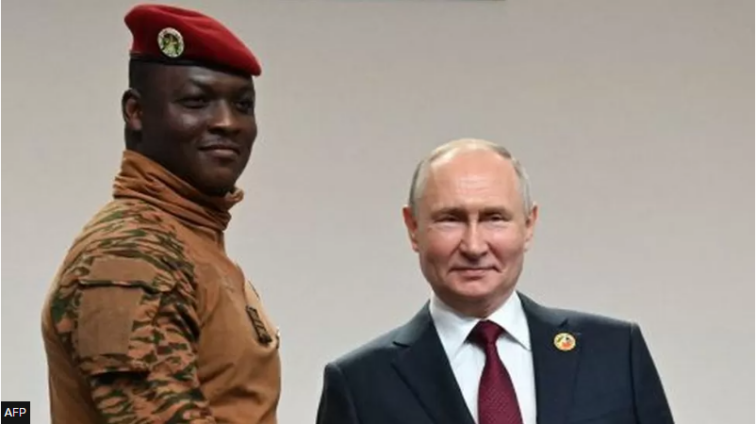
The new deal with Russia is a culmination of talks the Burkinabe military ruler, Capt Ibrahim Traore, had with Russian President Vladimir Putin in July during the Russia-Africa summit in Moscow.
Capt Traore requested President Putin's support in setting up a nuclear power plant in Burkina Faso, which he said would help meet the country's energy demands and those of neighbouring countries.
"We have a critical need for energy, this is an important point for me because we need, if possible, to build a nuclear power station in Burkina Faso to produce electricity," he was quoted as saying at the time.
"Our position is rather strategic because we are in the heart of West Africa and we have an energy deficit in the sub-region."
The deal is part of Burkina Faso's target to achieve 95% electricity access for urban areas and 50% for rural areas by 2030.
Burkina Faso gets most of its electricity from biofuels like charcoal and wood while oil products account for one-third of the total energy supply, according to the International Energy Agency.
According to the US development agency USAid, Burkina Faso also has one of the highest electricity costs in Africa.
South Africa is currently the only African state that produces nuclear power commercially, but increasingly more nations on the continent are moving in the same direction.
Russia is helping Egypt to build a nuclear power plant at cost of $30bn (£24bn) following a deal signed by President Abdel Fattah al-Sisi and President Putin in 2017.
Russia also signed a deal to build power plants in Nigeria in the same year, but the project is yet to begin.
Kenya has also announced plans to build its first nuclear power plant by 2027, but it is still to decide on its international partner.
In September this year, Rwanda announced that it had opted for Canadian-German company Dual Fluid Energy to build a nuclear reactor by 2028.
The Rwandan government said the reactor will be instrumental to meet the central African country's energy demands and "build resilience" as a result of climate change.
Although access to energy has increased in sub-Saharan Africa in recent years, it still remains low, with more than 50% of the region's population still lacking access to electricity, according to the United Nations Conference on Trade and Development (Unctad).
Latest Stories
-
The source of cedi appreciation matters more than the appreciation itself
6 minutes -
Ashanti cocoa farmers welcome new COCOBOD Bill, back key reforms
9 minutes -
‘GoldBod is a very big scandal awaiting us’ – Afenyo-Markin
10 minutes -
‘GoldBod is failing’ – Afenyo-Markin cites IMF report on $1.7bn losses
10 minutes -
Fire destroys ICT lab at Gushegu Midwifery Training School, threatens licensure exams
12 minutes -
Defence Ministry welcomes Kenneth Gilbert Adjei as new Defence Minister
12 minutes -
Bawumia charges NPP executives to rebuild party for 2028 victory
15 minutes -
Unite the region and deliver victory in 2028 – Dr. Bawumia to new Greater Accra NPP executives
15 minutes -
Ukrainian strikes kill six in Russia, acting governor says
15 minutes -
The goal is to win 2028 polls – Bawumia
16 minutes -
GoldBod secures 30% of large-scale gold output for Ghana’s strategic reserves
16 minutes -
FDA warns against unauthorised chemicals for ripening plantain
17 minutes -
‘If you sell gold at a loss, you’re not a good trader’ – Afenyo-Markin jabs Sammy Gyamfi
21 minutes -
Dr. Bawumia meets new Greater Accra NPP executives; charges them to bring all talents on board
24 minutes -
Before the Next Jason: When seniority becomes a weapon against young academics
37 minutes