

Audio By Carbonatix
During the University Teachers Association of Ghana voting in September 2023, a lecturer at the Kwame Nkrumah University of Science and Technology (KNUST), Dr. Amoah (not his real name) had cast his vote for his preferred candidate.
But as a scientist, he wanted to test the efficiency of the university-bred voting technology system, by trying to vote again, however, no matter the number of times he tried, he was met with the message: “You have already voted”.
But Dr. Amoah wasn't convinced enough, he then proceeded to ask his other colleagues to also try, but they also got the same message.
“I have voted and have tried again at four more PCs and at another polling station. I also asked non-UTAG members to try; that was unsuccessful,” he remarked.
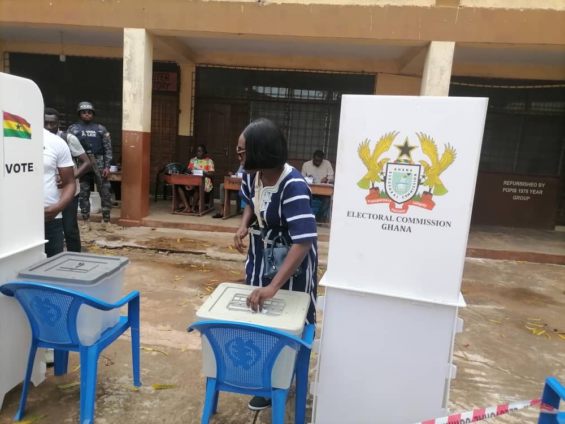
The current voting process at Ghana’s general elections is through paper base voting. This has been implicated in a myriad of problems from delay in voting, double voting, spoilt ballot, and result manipulations and results declaration delays.
E-Voting has garnered a high level of interest in the country as some universities have employed an iteration of it.
One of the e-voting systems which has been in use for more than five years at KNUST is the electronic thumb-print system.
A Systems Analyst at KNUST, Patrice Vasco Asamoah, revealed that the database can process more than 40 million votes and records in milliseconds; meaning it records 1,000 voters pressing their thumbs on the biometrics at the same time in a second.
One of the developers of the system, Prof. Reuben Tamakloe of the Physics Department added: “the App works in the 3 modes: Live, Point of Presence (PoP) and Stand-alone. The validation works excellently.’ In case of power outage and network break, the PoP keeps the data.
During this event if someone succeeded in voting twice or more, when power is restored that multiple votes are treated as rejected.
Prof. Tamakloe believes the system can be scaled up to cater for the nationwide presidential and parliamentary elections.
Speaking with the National Coordinator of the Coalition of Domestic Election Observers (CODEO), Mr. Kofi Arhin, he noted the success of a quasi-system in rural parts of India. He therefore recommended a broader discussion to assess the feasibility of the system.
"Somewhere in India, they are using this electronic voting. It's not counted manually. As soon you press a button, it counts everything. They even have batteries powering them. It'll be good for the EC to have a look at it," he said.
Nonetheless, logistical and monetary challenges can’t be overruled for effective operation of the system.
A study by Samuel Agbesi at KNUST had suggested the need to improve infrastructure in most parts of the country and the Electoral Commission should also embark on educating the people on e-voting and creating awareness.
He recommends that “e-voting for now should be implemented on pilot basis and run alongside paper voting until infrastructure is available nationwide.”
This report is produced under the DPI Africa Journalism Fellowship Programme of the Media Foundation for West Africa and Co-Develop.
Latest Stories
-
‘Africa exports its savings and imports expensive capital’ – Sir Sam Jonah
5 minutes -
NSMQ 2026: Amaniampong retains seeded status, sends Tepa and Ghanata packing
13 minutes -
AfCFTA faces ‘grave danger’ from protectionism, xenophobia and investor harassment – Sir Sam Jonah
19 minutes -
NSMQ 2026: Chemu SHTS snatches seed from Mankranso after outlasting Anglican SHS
24 minutes -
Opoku-Afari: IMF programmes unable to address political economy roots of debt accumulation
29 minutes -
Mahama invited for 65th anniversary of Non-Aligned Movement in Belgrade – Ablakwa
33 minutes -
Ghana’s debt sustainability challenges persisted for 12 years, breached DSA indicators over period – Opoku-Afari
52 minutes -
Black Stars will have new coach before AFCON qualifiers – GFA promises
54 minutes -
Parents must take control of children’s digital habits – Abla Masoperh
58 minutes -
“Our commitment is to strengthen healthcare delivery in Ghana” — Adann Benjamin Diaz, CEO ADB Ghana Medicals
1 hour -
Nalerigu youth give Health Minister two weeks to resolve nursing college principal’s suspension
1 hour -
Supreme Court to rule on Skytrain trial injunction bid August 31
1 hour -
Kenya police fire tear gas to disperse traders protesting import duty hike
1 hour -
Abanga promises massive youth votes for Bawumia in 2028 if elected NPP Youth Organiser
1 hour -
2026 U20 WWC: Black Princesses to face Mexico in pre-tournament friendly
2 hours