

Audio By Carbonatix
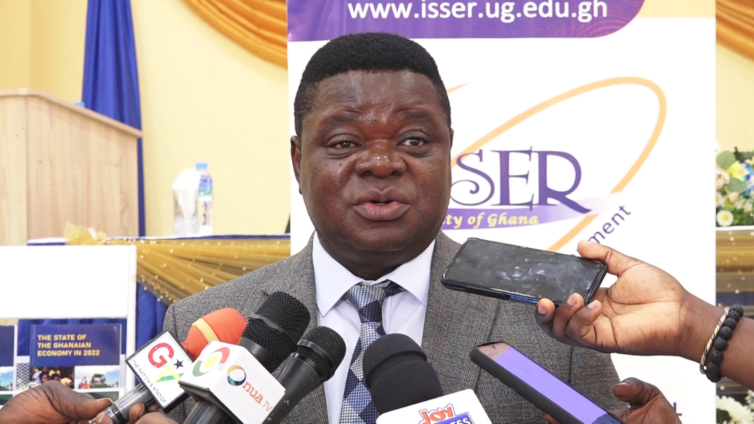
Director of the Institute of Statistical, Social and Economic Research (ISSER), Prof Peter Quartey has urged government to establish a sinking fund to ease Ghana’s repayment schedule at the end of the IMF moratorium.
The Finance Minister, Ken Ofori-Atta, has revealed on a yet-to-be-aired PM Express Business Edition that Ghana has been granted a four-year moratorium on debt repayment to allow the country some breathing space to focus on developmental projects.
This represents a departure from previous programmes, where all the cash disbursed under the IMF programme was directed towards supporting Ghana’s balance of payment needs.
“We should not rule out the fact that these funds coming in will help the Bank of Ghana improve its reserves, a move that will help stabilise the Ghana cedis,” he said.
According to Prof. Peter Quartey, while the moratorium is welcome news, government should not sleep on their oars but get to work saving money towards the end of the moratorium.
Speaking on Joy FM’s Super Morning Show on Tuesday, he said, “It does give us breathing space. But we should also note that it is not free, it is not debt forgiveness, so we need to prepare, we need to set aside some money to pay when it’s due and that’s very critical.
“If we don’t, and knowing our history, sometimes we tend to forget and do not do the needful then it comes to bite. But I think if there’s a sinking fund where annually we earmark funds and put it down so that when it’s due in 2027, we have the resources to pay. That is fine so that we get some good breathing space.”
The ISSER Director added that government does not need to reintroduce new taxes to pay the nation’s debts.
He called for enhanced efficiency in the collection of already existing levies and urged government to negotiate for interest rate cuts as well to give the country more breathing space.
"I’m yet to see the fine details of the term sheet. But I know for sure that there is going to be some interest rate cuts as well, and that will save us money.
"I’m speaking from the example of Zambia where there were interest rate cuts but not principal and that also helped to free some resources for the country.
“So there’ll be some benefit, but of course, these are debts we have accumulated in the past and we have to pay so we should brave ourselves to pay.
"We don’t need new taxes, we don’t need higher taxes, if we’re efficient in what we’re collecting I think we should be able to pay this without overburdening the already burdened Ghanaian,” he said.
Latest Stories
-
It’s Ghana’s shame to denigrate Nkrumah when the whole world honours him as African of the Century – Asiedu Nketiah
6 minutes -
No other nationalist can compare to Nkrumah – Asiedu Nketiah
13 minutes -
Collateral Registry: Foreign banks accounted for GH¢19.9bn of secured credit in quarter 2, 2026
13 minutes -
This government should expect scrutiny – Asiedu Nketiah
38 minutes -
Two-year-old girl dies in domestic fire at Cantonments
1 hour -
Asiedu Nketiah urges better working conditions for journalists
2 hours -
JoyNews’ Precious Semevoh wins climate change reporting award at Bono GJA Awards
2 hours -
Kumasi Central Market phase 2 to begin in October after years of abandonment
2 hours -
Sentuo offers fuel supply reassurance as NPA sees steady output through December
3 hours -
Ghanaian smock showcased at Lesotho Tourism Summit
3 hours -
Four pupils to one desk: The painful plight of schools in New Juaben North
4 hours -
Ipswich launch investigation into racist abuse of Abdul Fatawu
4 hours -
Arrest of Techiman nurse is purely political persecution – ‘Ghana Jollof’
4 hours -
Isak nets winner as Liverpool edge Bournemouth
5 hours -
I dare gov’t of Ghana to extradite me; they can never do it – ‘Ghana Jollof’ speaks
5 hours