

Audio By Carbonatix
Rural communities yet to be connected to the national grid are presented with a challenging environment that impacts adversely on the livelihoods of farmers.
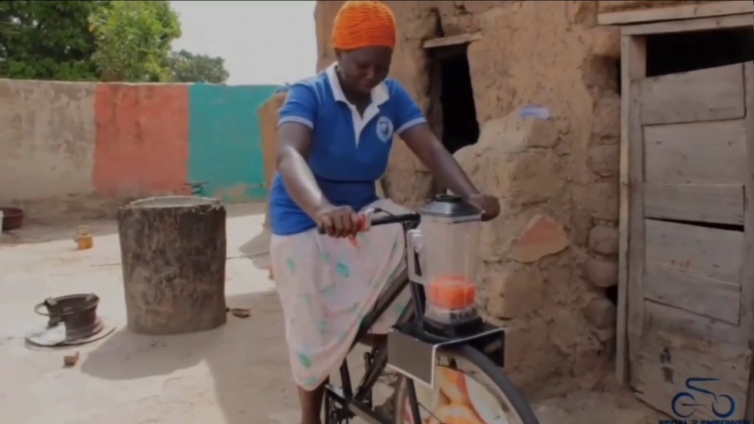
To ease their burden, a lecturer at the Takoradi Technical University developed blenders and shellers built on bicycles to support communities without electricity.
About 75% of households in Ghana’s regions of the north are farmers, but their inaccessibility to electricity makes it nearly impossible to live conveniently.

Women and children in such areas are heavily impacted by the lack of electricity.
Under the Pedal 2 Empower project, researchers at the Takoradi Technical University have designed a simple environmentally-friendly machine to aid residents in the Upper West Region.
The blenders and shellers are built on a bicycle frame which employs paddling to power the blades of the blender for cutting and shelling.
Team lead for the eco-friendly project, Kwadwo Asare Apori, explains the machine works efficiently by converting the energy from paddling into electricity.

“The machine employs the dynamo mechanism to power the blenders and sheller to function. The greater the force applied, the more efficient the machine works. This is actually sustainability designing,” he said.
Most residents in Ghana’s North are known for their adept skill in cycling as it is the major means of transport in most rural communities in the five regions.
“The bicycle blenders and shellers will be easily adopted by these communities,” Kwadwo Asare cites as one of the reasons for developing the machines.

The group built maize sheller, rice dehusker, and shea nut grinder for the communities including Mangu, Goli, Kperisi, and Manwe.
The pedal-powered machine not only provides convenience but a means to reduce carbon emissions.
“Because there’s no fossil fuel usage, the machine helps reduce greenhouse gas emissions. It helps in personal health improvement. This is a practical eco-friendly project. It can be used for educational purposes,” Kwadwo Asare added.

For users of the machine, this would ease the burden of grinding on stones and farming activities while boosting their health.
“This machine is a better alternative to the electric blenders. If have this machine at home, I will be able to prepare meals and blend spices. I sometimes have to hide or go to a friend’s place to use a blender,” one of the beneficiaries shared her experience with the machine.
The developers seek to extend the project to other regions as demand for the machine surges.
“If we have enough funding, we will be able to provide these machines freely to these communities to facilitate their domestic chores,” Kwadwo Asare appealed for support.
Latest Stories
-
Joyce Bawah Mogtari: Women must be given opportunities to grow into leadership
52 seconds -
A Montana man killed 8 relatives, including 4 kids, at Sunday dinner, family says
15 minutes -
Fidelity Bank completes renovation of multipurpose auditorium at Police Public Safety Training School
2 hours -
Oil prices slide 2% on Iran-Oman talks to reopen Strait of Hormuz
2 hours -
Telecoms operator MTN eyes banking licences as it pushes deeper into lending
2 hours -
Show us how allegations involving MPs end – Dr Dramani demands clear path from probe to resolution
2 hours -
Mass arrests in global crackdown on West African cyber-crime networks
3 hours -
Ethiopia submits official bid to host Afcon 2028
3 hours -
We need leaders with integrity – Dramani warns supermajority Parliament over Afenyo-Markin allegations
3 hours -
Parliament scrutinises govt but cannot scrutinise itself – Dramani challenges MPs to apply their own standards
3 hours -
Partisan solidarity overrides accountability – Dr Dramani accuses Parliament of protecting its own
4 hours -
This goes beyond Afenyo-Markin – CDD warns fresh allegations could damage Parliament
4 hours -
Parliament is in crisis of confidence – CDD’s Osae-Kwapong warns fresh allegations could ceepen public distrust
4 hours -
Nigeria’s president orders rescue after mass kidnapping exposes security failings
5 hours -
Meta, US states have discussed settling teen social media harm case, Bloomberg News reports
5 hours