

Audio By Carbonatix
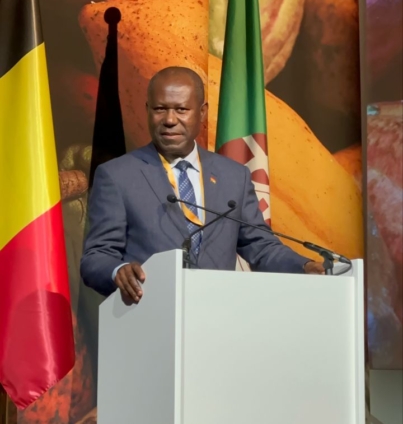
The Chief Executive Officer of Ghana Cocoa Board, Joseph Boahen Aidoo has raised critical concerns about the implementation of the new EU Regulations on Deforestation and its cost ramifications to farmers and producing countries.
The new EU Regulations on Deforestation requires amongst others, that producing countries comply with stringent measures aimed at protecting the environmental ecosystem, resulting in sustainable and ethically sourced cocoa.
Despite the noble intentions behind the promulgation of the regulations some of which were already being addressed, there are however huge ethical and economic concerns for countries like Ghana, Cote d’Ivoire and Cameroun, as to who bears the extra cost of compliance.
Ghana, for example, even before the advent of the EU Regulations, had already commenced and completed the Cocoa Management System (CMS), one of the critical requirements for the cocoa traceability system and will be ready for full roll-out in October this year.
But for the CEO of COCOBOD, the cost implications of compliance is a critical matter that must not be ignored, since it has the tendency to increase not only the cost of cocoa, but also presents social and economic challenges to farmers who are already reeling under general debilitating economic conditions in their respective countries.
“Ghana is very much aligned to implementing the European Union regulations but this will come at a cost to farmers and producing countries which is likely to increase the cost of cocoa from Ghana, Cote d’Ivoire and Cameroun”, Mr Boahen Aidoo emphasised on Tuesday during a panel discussion at the ongoing World Cocoa Conference in Brussels, Belgium.
Mr Boahen Aidoo averred that long before the EU considered the new regulations, steps had already been taken by producing countries, particularly in Ghana, to address the myriad of challenges associated with climate change and its consequences on production.
“Yes, the regulations are meant to enhance the awareness of sustainable production, but for us we were already bothered about the way climate change was affecting production and disrupting local activities, so even before the idea of the regulations were conceived, Ghana had already started mapping farms which is another element because without the polygon maps you cannot trace the source of the cocoa” he stressed.
He however observed that the new regulations failed to consider issues relating to costs and who bears responsibilities for the technologies and tools involved in implementing these programmes, which he said were very expensive and could not be borne by the individual farmers.
“So now the conclusion is that having done all that, who pays for the cost, right from the polygon maps, bringing in the technology and the training because you need real time data to make it work, which means that since this has not been factored in the new EU regulations, the operator has to pay and this is going to make cocoa from Ghana, Cote d’Ivoire and Cameroun very expensive”
Against this backdrop, some have argued that the liability of paying for the cost of compliance must partly be borne by the wealthy nations that consume majority of the cocoa produced.
Considering the substantial investments in resources involved in compliance and the fact that producing countries are already reeling under economic pressure, advocates of this position believe that EU and other developed countries should be prepared to support cocoa-producing countries for ethically and sustainably sourced cocoa.
Latest Stories
-
Power restoration fault suspected in Kumasi Central Market fire
5 hours -
The 7-foot giant of Ngleshie Amanfro: Seven-foot Ghanaian Ephraim Saawa dreams of joining the national basketball team
5 hours -
Government promises support for Kumasi Central Market fire victims
6 hours -
Vibes The Movie: Big Ghun’s Ghanaian film earns five nominations at 2026 REFFA
6 hours -
MamaCare CEO warns unresolved conflicts among health workers could undermine maternal and neonatal care
6 hours -
Health professionals urged to translate medical knowledge into practice to save mothers
7 hours -
Retired judge Justice Francis Korbieh charges 1,568 new lawyers to uphold integrity
8 hours -
Conflicts among care providers linked to maternal, neonatal deaths – Expert
8 hours -
GIS marks 10th TIME conference, champions improved teaching practices
8 hours -
BRICS Or Balance? What Ghana’s bid really means
9 hours -
GPRTU wants full TRAFFITECH-GH implementation to start in 2027
9 hours -
How 10-mile walks for basic education birthed a 50-year legal career for Justice Korbieh
9 hours -
Mahama announces plans to import electric wheelchairs for PWDs
9 hours -
KGL U17 Colts 2026: Western beat Prempeh Elite Academy to set up final final with Greater Accra Region
9 hours -
Late Solanke strike salvages 10-man Spurs draw at Man United
10 hours