

Audio By Carbonatix
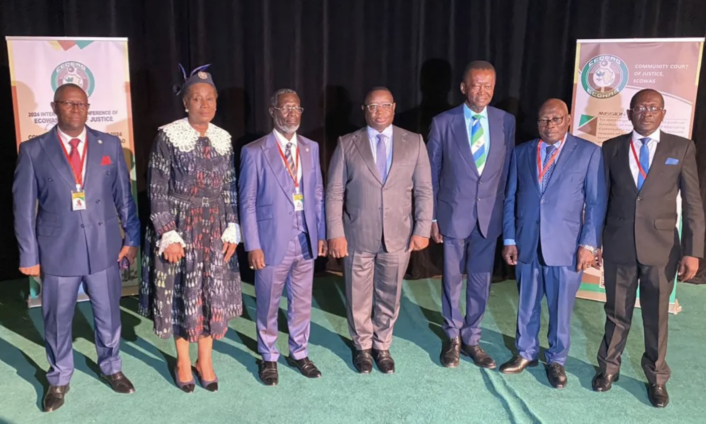
Sierra Leone’s President Dr Julius Maada Bio has formally opened a four-day conference of the ECOWAS Court of Justice with a call on member states to help deepen cooperation and integration within the sub-region.
He said such cooperation and integration, which required concerted and best efforts, were partly the key to the sub-region’s prosperity and the well-being of the people.
The conference is being held on the theme: “Enhancing the role, relevance, and effectiveness of the ECOWAS Court of Justice through the strengthening of synergies between the Court and National Stakeholders.”
President Bio said the establishment of the Court in 2001 was a welcome step by member countries toward fostering integration and cooperation and that the strides it had made since its inception were a testament to the importance of the great institution.
“The ECOWAS Court of Justice plays a pivotal role in advancing these noble objectives by upholding the principles of justice, fairness, and the rule of law across our region. As members of the ECOWAS, we are bound together by a shared vision of regional integration, cooperation, and promoting peace and prosperity for our people,” President Bio said.
President Bio commended the leadership of the ECOWAS Court of Justice for what he described as “progressive; the Court is succeeding in increasing its crucial role of providing additional justice delivery options and facilitating access to justice, and strengthening the rule of law in West Africa.
President Bio attributed the gains made by the court to its expanded jurisdiction, which is in line with the Amended Protocol of 2005, including the authority to adjudicate the alleged violation of the human rights of the community’s citizens.
“The added layer of checks that the Court provides will not only raise awareness of the human rights question but also ensure that Member States do more to uphold the human rights of our citizens,” he added.
President Bio urged all Member States to support the Court in its mandate fully and to implement its decisions in good faith.
He expressed delight at the choice of Sierra Leone as a destination for the 2024 conference and said the country as one of the founding members of ECOWAS in May 1975 had remained firmly committed to the ideals and aspirations of its treaty.
“We must also seize this opportunity to reflect on the progress we have made, identify the challenges that lie ahead, and chart a course towards a brighter future for the people of West Africa,” he said.
Vice President of the ECOWAS Court of Justice, Justice Gbéri-Bè Ouattara, in a speech read in behalf of the Court’s President Edward Asante, said in the light of the regional integration agenda of the Community, it was necessary for the Court and the national stakeholders to collaborate in order to achieve an integrated community legal order and the integration objectives of the Community.
He said the conference offered another golden opportunity to deepen the fraternal relations between the Court and the national stakeholders.
“The intention of the Court in choosing this theme is to generate constructive discussions around the strengths and weaknesses of the Court’s relationship with various national stakeholders and explore practical solutions that can be adopted to strengthen such relationships in the interest of the Community,” he said.
Professor Ernest Kofi Abotsi, who delivered the keynote address largely on the theme said the presence of the court was a means of perpetuating the rule of law within the community legal order.
He said the elaborate jurisprudence of the court served to develop community law but also ensured that the political decisions of ECOWAS, as a group, were tampered with and constrained by the rule of law.
On the other hand, he said, the failure of ECOWAS’ bodies to fully comply with the orders of the court showed a case of deeper inter-institutional statement of power, an authority which in the long term could only be settled in favour of the court, but this needed to be carefully managed to avoid weakening the institution.
“In terms of its role in non-explication, the ECCJ’s jurisdiction applying the Africa Charter of Human and Peoples’ Rights implies that the court stands in a unique position to localize broader regional rules contained in the ACHPR,” he said.
“The specific jurisdiction in view of the court will allow us to build jurisprudence of that treaty in a manner obviously superior to the much-chastised system that formerly prevailed.
By investing the court with jurisdiction to hear and determine cases on the abuses of human rights arising out of and under the ACHPR, the constituent treaty of the ECCJ has succeeded in reinforcing the external accountability of member states in their respect for human rights,” he said.
“Courts are not in the business of engaging with any constituencies, actual or perceived. Indeed, the idea of courts having to network constituents may seem at first odd and inconsistent, even with the juridical character of the judicial institution, one structured to be detached, neutral, and authoritative in pronouncement, unperturbed by the effects of their rulings and consequences of their actions”.
Professor Abotsi said the ECOWAS Court had a mandate to engage national actors in order to be effective.
Its own statute text or treaty compels the court to enforce its judgment through local courts and ensures that appropriate jurisdictional processes are initiated in order to enforce the judgment or decisions of the court.
Latest Stories
-
Hawa Koomson pledges experienced and mature leadership of NPP women’s wing
10 minutes -
Young woman found dead at Kasoa Peace Town
42 minutes -
Livestream: The Law examines lawful arrest in Ghana
1 hour -
Mahama urges African governments to treat healthcare as an investment, not budget cost
2 hours -
Bawumia congratulates John Boadu and new NPP executives, pledges support ahead of 2028
2 hours -
‘No talent should be left out’ – Bawumia pledges inclusive NPP campaign for 2028
2 hours -
Prof. Mike Oquaye recounts how he blocked Special Prosecutor’s attempt to arrest Bawku Central MP
2 hours -
Make health sovereignty a priority for Africa – Mahama
2 hours -
Dorimon Naa, Wa West DCE lead massive clean-up exercise; threaten sanctions against recalcitrant residents
3 hours -
Photos from Adom FM Y2K Jam
3 hours -
Praye Tiatia steals the show at Adom FM Y2K Jam [Watch]
3 hours -
Boakye Agyarko congratulates John Boadu, pledges support for NPP leadership
3 hours -
Antwi HiMight thrills fans with Antwi ne Antwi hits at Adom FM’s Y2K Jam [Video]
3 hours -
Amb. Edward Boateng congratulates Boadu, Kodua on election wins
4 hours -
John Boadu pledges to rebuild NPP from grassroots and restore ‘winning machinery’
4 hours