

Audio By Carbonatix
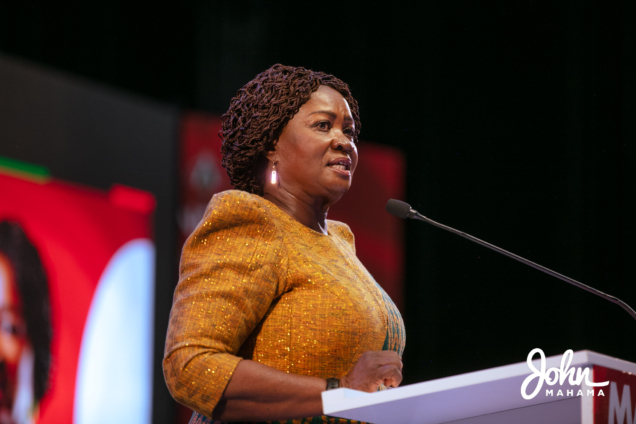
Professor Naana Jane Opoku-Agyemang, the running mate to the National Democratic Congress (NDC) flagbearer, John Dramani Mahama, has said the party's 24-hour economy policy is a comprehensive proposal designed to provide leverage for various segments of the population to enhance inclusiveness.
Professor Opoku-Agyemang said the dynamics of women's economic roles must be transformed through deliberate policies and programmes to leverage their perspectives fully.
“We are not just saying anything, the 24-hour economy is a thought-through proposal which will give leverage to all categories of the population, especially women, the flexibility to work and enhance their careers.”
Prof Opoku-Agyemang said this when she met some female journalists from public and private media houses in a policy dialogue as part of ongoing meetings with professional and citizen groups to solicit inputs into the party’s 2024 manifesto.
She said that rigid working schedules, where everyone must adhere to a specific time frame, may not be favourable for women who, in addition to their professional responsibilities, also have domestic duties to manage.
She encouraged female journalists to share stories about women, focusing "on how they climbed and how they broke the glass ceilings.”
She noted that the NDC is determined to present a people's manifesto that reflects the aspirations of the populace, and commended female journalists for their contributions and sacrifices towards nation-building.
On her part, a former Minister of State, Nana Oye Bampoe, said the meeting was historic and explained how the vice-presidential aspirant valued the role of female journalists.
A veteran journalist and gender advocate, Dr Charity Binka, also added that even though there were quite a few females in the media space, they were faced with challenges which inhibited their progression to the top.
She noted the absence of gender policies in media houses to address issues of sexual harassment and urged the Vice Presidential aspirant to prioritise the welfare of female journalists in their manifesto.
She said women’s representation at decision-making levels not only closed the gender gap but also enriched policies with their unique perspectives.
Latest Stories
-
‘I was born in South Africa’, says beauty queen Chidimma Adetshina facing legal bid to deport her
51 minutes -
Prince Harry and Meghan moving back to UK
1 hour -
Ghana’s output expansion largely driven by labour, capital rather than innovation – Opoku-Afari
1 hour -
Ghana is ready for nuclear power adoption – Gov’t affirms
1 hour -
GJA@77: Media-government partnership vital to Ghana’s democracy – Shamima Muslim
1 hour -
LUV FM High School Debate: Opoku Ware and St. Hubert Seminary book quarterfinal spots
1 hour -
Stronger research, industry linkages needed to build a competitive digital economy – Deloitte Technology Senior Manager
1 hour -
Economy experience high but unbalanced growth from mid-2000 to 2022 debt crisis – Former 1st Deputy Governor
2 hours -
Tell Your Story: Political, business and industry leaders to share journey with young Ghanaians
2 hours -
‘Gold cannot save you at 2am’ – Obuobia Darko challenges mining giants to invest in healthcare
2 hours -
Wontumi’s incarceration will not stop his chairmanship bid – Palgrave
2 hours -
Eurobond borrowings over 2007-2021 used for budget financing; Ghana borrowed US$15.59bn – Opoku-Afari
2 hours -
Newborn baby found in dustbin at Kasoa Main Station toilet
2 hours -
Ghanaian skincare brand KAEME wins DHL ESG Excellence Exporter of the Year award
3 hours -
Ho Communique: Democracy Not for Sale
3 hours