

Audio By Carbonatix
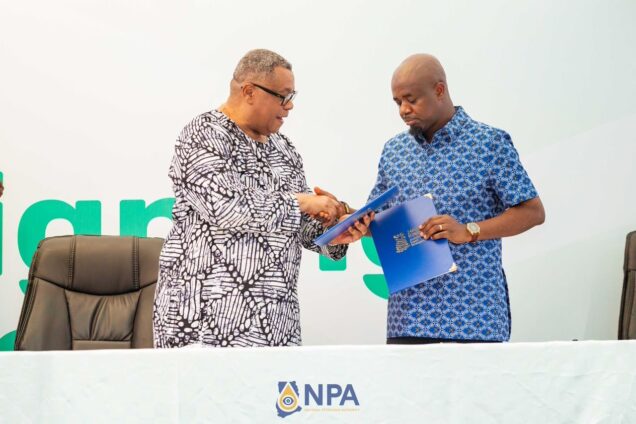
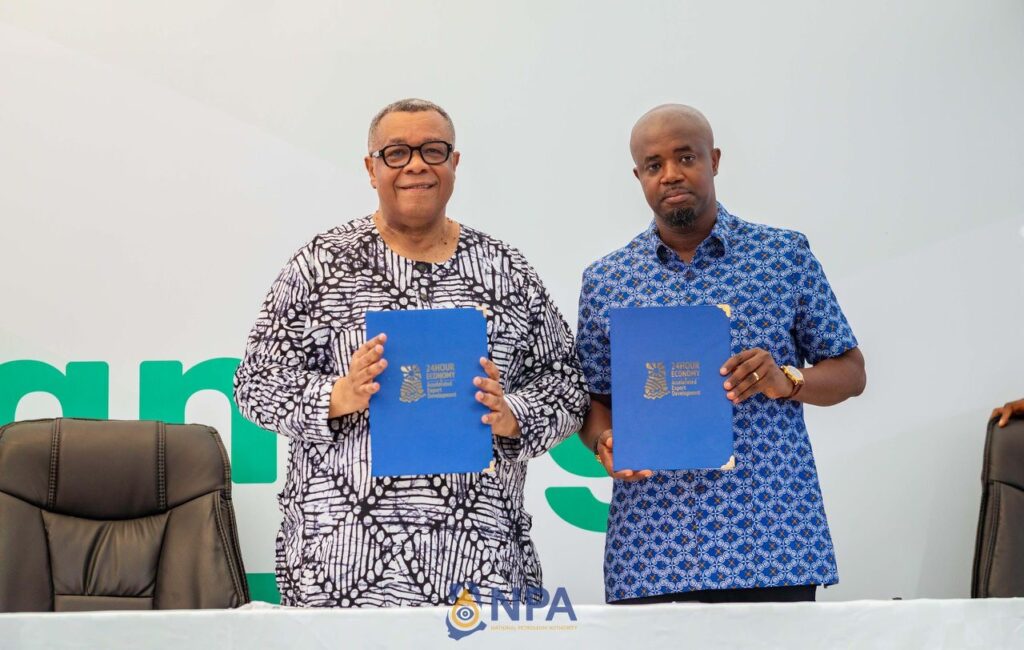
The 24-Hour Economy Authority and the National Petroleum Authority (NPA) have signed a Memorandum of Understanding (MoU) to support the expansion of 24-hour operations across Ghana’s downstream petroleum sector.
The agreement, signed in Accra on March 31, forms part of efforts to advance the country’s broader economic transformation agenda through reliable, round-the-clock fuel supply.
Under the terms of the MoU, the NPA will develop and enforce operational readiness standards for 24-hour service delivery across fuel stations, refineries, bulk storage depots, and bulk road vehicle operations.
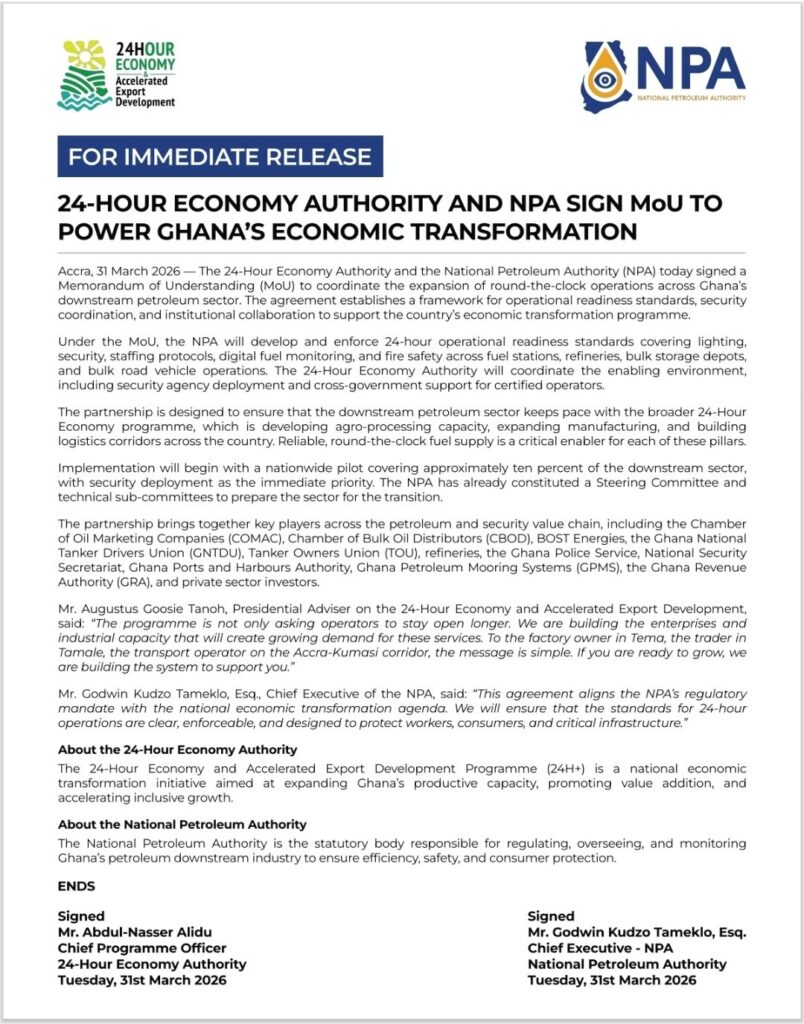
These standards will cover critical areas such as lighting, security, staffing protocols, digital fuel monitoring, and fire safety.
The 24-Hour Economy Authority, on the other hand, will coordinate the enabling environment, including the deployment of security agencies and cross-government support for certified operators.
The partnership is expected to align the downstream petroleum sector with the wider 24-Hour Economy programme, which seeks to expand agro-processing, boost manufacturing, and strengthen logistics corridors nationwide.
A reliable and continuous fuel supply is seen as a key enabler for these sectors, ensuring sustained productivity and economic activity across the country.
Implementation of the initiative will begin with a nationwide pilot covering about 10 percent of the downstream sector, with security deployment identified as an immediate priority.
The NPA has already set up a Steering Committee and technical sub-committees to oversee preparations for the transition.
The initiative will involve collaboration with key stakeholders, including industry players, security agencies, and regulators across the petroleum value chain.
Presidential Adviser on the 24-Hour Economy and Accelerated Export Development, Augustus Goosie Tanoh, described the programme as a strategic effort to build industrial capacity and stimulate demand.
Meanwhile, NPA Chief Executive, Godwin Kudzo Tameklo, said the agreement aligns the Authority’s regulatory mandate with the national transformation agenda, assuring that clear and enforceable standards will be implemented to protect workers, consumers, and critical infrastructure.
Latest Stories
-
The 7-foot giant of Ngleshie Amanfro: Seven-foot Ghanaian Ephraim Saawa dreams of joining the national basketball team
32 minutes -
Government promises support for Kumasi Central Market fire victims
38 minutes -
Vibes The Movie: Big Ghun’s Ghanaian film earns five nominations at 2026 REFFA
1 hour -
MamaCare CEO warns unresolved conflicts among health workers could undermine maternal and neonatal care
2 hours -
Health professionals urged to translate medical knowledge into practice to save mothers
2 hours -
Conflicts among care providers linked to maternal, neonatal deaths – Expert
3 hours -
GIS marks 10th TIME conference, champions improved teaching practices
3 hours -
BRICS Or Balance? What Ghana’s bid really means
4 hours -
GPRTU wants full TRAFFITECH-GH implementation to start in 2027
4 hours -
Mahama announces plans to import electric wheelchairs for PWDs
4 hours -
KGL U17 Colts 2026: Western beat Prempeh Elite Academy to set up final final with Greater Accra Region
4 hours -
Late Solanke strike salvages 10-man Spurs draw at Man United
5 hours -
Gender Ministry to monitor welfare of Nana Akua Addo’s children amid domestic violence case
5 hours -
Benedict Okyere Yeboah: Ghana’s football problem goes beyond sacking a coach
5 hours -
GPL 2026/27: Darkwah Wiafe’s winner sees All Blacks beat Kotoko
5 hours