

Audio By Carbonatix
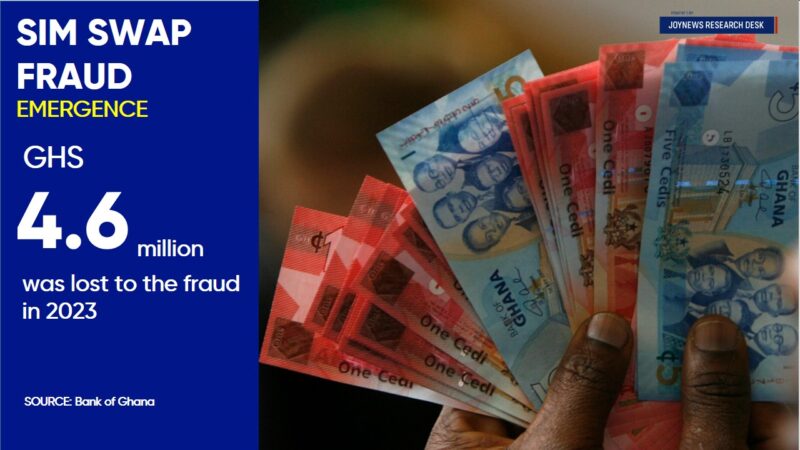
The Bank of Ghana has revealed a rapid emergence of SIM swap fraud targeting individuals with access to mobile banking channels. According to the apex bank, about GHȼ4.6 million was lost to this fraud in 2023, attributed to 15 recorded cases.

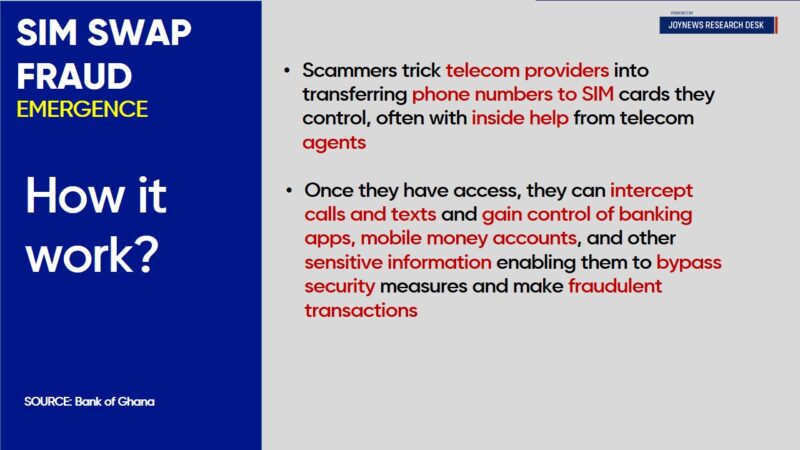
This type of fraud targets individuals with mobile banking access, including banking apps, WhatsApp banking, or any account linked to their mobile number. Scammers trick telecom providers into transferring victims' phone numbers to SIM cards they control, often with inside help from telecom agents.
Once they have access, they can intercept calls and texts and even gain control of banking apps, mobile money accounts, and other sensitive information, enabling them to bypass security measures and make fraudulent transactions.
Even in the event of cheque clearing, fraudsters can intercept mobile phone confirmations.
The threat extends beyond individuals to corporate institutions, where large sums of money can be stolen.
Ransford Nana Addo Junior, a Certified Fraud Examiner and Financial Crime & Fraud Lecturer at the National Banking College, says "It is not only individual accounts. When a SIM swap happens on corporate accounts, it's more dangerous. For instance, if the CFO of a hotel has his number swapped and a fraudulent transaction is initiated, the fraudsters will be the ones receiving the confirmation."
He also noted that SIM swap fraud extends beyond banking:
"It goes beyond just the mobile channels and even beyond banking. For instance, if somebody wants to intercept your medication information sent through SMS or your SSNIT records, it can be intercepted through SIM swap as well."
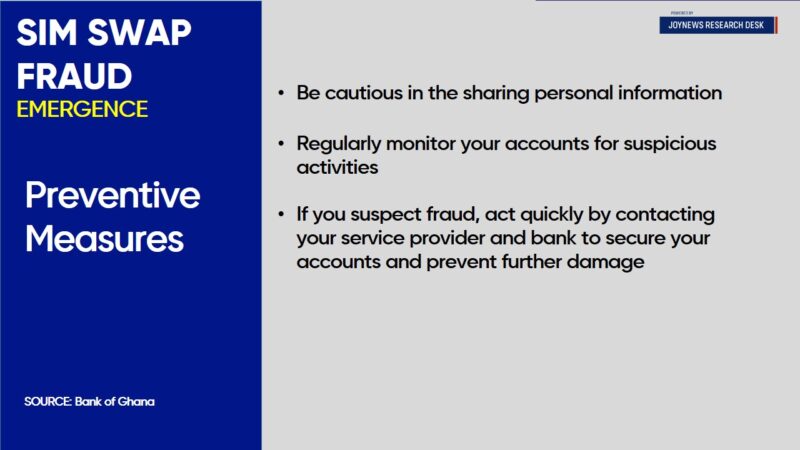
To protect yourself, be cautious in sharing personal information and regularly monitor your accounts for suspicious activities. If you suspect fraud, act quickly by contacting your service provider and bank to secure your accounts and prevent further damage.
For payment service providers, the Bank of Ghana has directed compliance with section 34(3)(a) and (b) of the Payment Systems and Services Act 2019 (Act 987). This requires the deactivation of a customer's electronic money account for two days when they swap or replace their SIM card. The account can be reactivated once the customer presents valid identification, mitigating SIM swap-related fraud.
Details of the report showed a 5% rise in the number of overall fraud cases reported leading to a loss of GHS 88 million in 2023.
Latest Stories
-
Forestry Commission arrests 12 illegal miners in Atewa Forest
7 minutes -
NPP National Treasurer aspirant involved in accident during campaign
29 minutes -
Treat coastal communities as partners in sea turtle conservation – Dr Agyekumhene
33 minutes -
The Chief Justice is not a Touring Minister: Baffoe-Bonnie’s SOE visits are unconstitutional officiousness
56 minutes -
Enforcing environmental laws carries political cost, while offenders go unpunished – Frimpong-Boateng
1 hour -
Galamsey fight collapsed after safeguards introduced in 2018 were abandoned – Prof Frimpong-Boateng
1 hour -
Jail officials who approve projects in wetlands and forest reserves – Prof Frimpong-Boateng
1 hour -
Ghana needs $21bn to restore lands damaged by illegal mining – Frimpong-Boateng
1 hour -
Law student killed in hit-and-run on Tema Motorway; family offers GH¢50,000 bounty
2 hours -
Gas explosion near Larteh school contained after fire outbreak
2 hours -
Nigerian-British businessman dies after penis enlargement procedure in Thailand
2 hours -
CHEAP JUSTICE? – Occasional Kwatriot Kwesi Yankah writes
2 hours -
WASSCE 2026: English performance decline requires urgent action – EduWatch
2 hours -
Old Tafo MCE pledges action as residents raise alarm over faulty drainage systems
3 hours -
Abossey Okai dealers reject spare parts cost as justification for 30% transport fare hike
3 hours