

Audio By Carbonatix
A new development in the anti-galamsey movement is the growing involvement of Ghanian student groups. The Katanga Hall from the Kwame Nkrumah University of Science and Technology (KNUST) has recently announced plans to join forces with sister halls from the University of Cape Coast (Casford Hall) and the University of Ghana, Legon (Unity Hall), in a series of demonstrations aimed at raising awareness and pushing for government action.
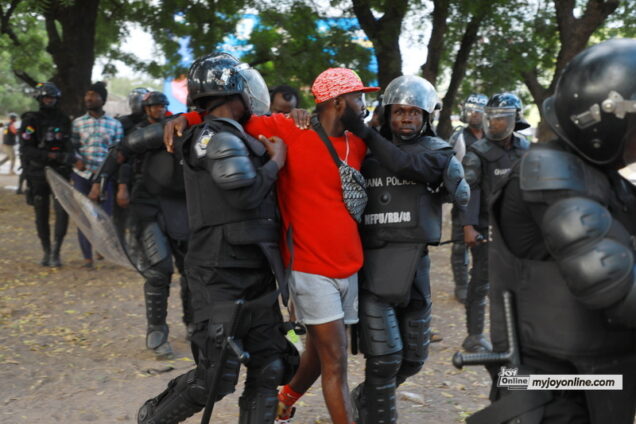
These student-led protests signal a new phase in the fight against “galamsey”. The youth are no longer content to wait for political leaders to act. Instead, they are mobilising themselves, organising demonstrations that could potentially draw thousands into the streets of Accra and other major cities.
If this collaboration materialises, it could mark a significant turning point in the anti-galamsey movement, further intensifying pressure on the government to act.
What Does This Mean for the 2024 Elections?
With elections fast approaching, the “galamsey” crisis is likely to be a major issue on the campaign trail. The government will have to defend its record on illegal mining and present a credible plan to address the problem if it hopes to win over an increasingly disillusioned electorate.
The opposition, meanwhile, will likely use the issue to criticise the government’s handling of environmental policies, positioning themselves as champions of the people’s interests.
However, the larger question is whether these protests and demonstrations will continue after the election. Will the new administration regardless of which party wins take meaningful steps to tackle the “galamsey” problem, or will it continue to be a political football, tossed back and forth without real progress?
The Way Forward
As Ghana prepares for its elections in December 2024, the nation finds itself at a crossroads. The fight against “galamsey” is not just a political issue; it is a national crisis with far-reaching implications for the environment, public health, and the economy. The youth-led protests, student movements, and calls for celebrity involvement highlight the deep frustration many Ghanaians feel toward their leaders’ handling of this issue.
The outcome of these protests and the upcoming election will determine the future of Ghana’s natural resources and, in many ways, the future of its youth. Whether driven by political interests or a genuine concern for the environment, the fight against “galamsey” is one that cannot be ignored any longer.
The time for action is now, and the decisions made in the coming months will shape the country for years to come.
Latest Stories
-
Mahama commissions Christian Tetteh Yohuno Ward Complex at Police Hospital
12 minutes -
Vice President calls for wider access to Ghana’s political party histories
12 minutes -
Republic Bank JoyNews Habitat Fair to connect prospective homeowners with exhibitors in Ho from October 16 to 18
22 minutes -
Obaasima Summit: ‘AI is not a spiritual attack’ — Rev. Dr. Ofori-Boateng urges young women to embrace technology
32 minutes -
GHS to distribute 80,000 pairs of locally-made protective footwear to health workers
39 minutes -
GoldBod boosts local jobs as 90% of gold undergoes refining in Ghana – Sammy Gyamfi
42 minutes -
The search for the politically unblemished: Are we asking the impossible of public appointees?
43 minutes -
Ghana seeks climate finance access for debt-restructuring countries
53 minutes -
Afenyo-Markin urges stronger media scrutiny of public institutions
53 minutes -
GoldBod recovers GH¢38.7m in legacy PMMC debts, targets remaining arrears
55 minutes -
62 out of every 100 commercial meters inspected missing from Ghana Water database – MD
56 minutes -
GoldBod gets BoG authorisation to sell forex, Sammy Gyamfi tells PAC
59 minutes -
Ghana Water revenue mobilisation below 50% of potential – MD
1 hour -
Ghana’s democracy must accommodate dissent and constructive criticism – Haruna Iddrisu
1 hour -
Fact check: Trump posts fake quote of Denzel Washington supposedly praising him
1 hour