

Audio By Carbonatix
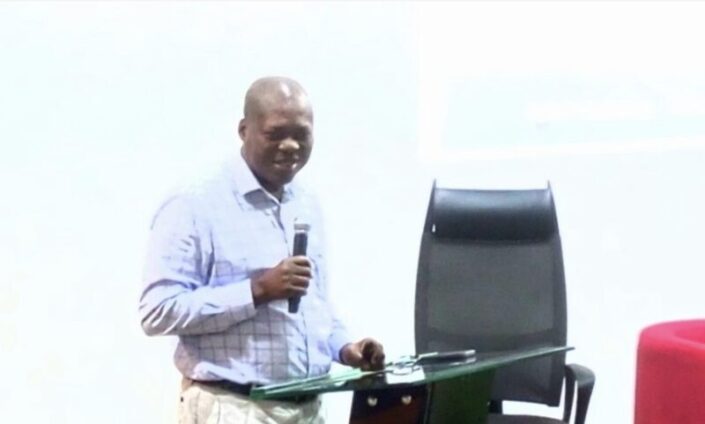
Professor John Gatsi, University of Cape Coast (UCC) has emphasised that Islamic banking and finance should not be viewed merely as a tool for promoting religion.
Instead, Ghanaians should consider Islamic banking and finance based on its ethical investment principles, practical benefits, and financial inclusivity.
Prof. Gatsi, speaking at the 24th Islamic Finance International Conference in Accra, urged Ghana to become a member of the Islamic Development Bank to attract direct investment from Islamic financial institutions through trade finance and technical cooperation.
He stated that by joining the Islamic Development Bank, Ghana would gain options for raising funds to develop its economy without the burden of interest payments.
“We need Islamic Banking to support the conventional banking system we have in the country. It will have an added opportunity to deepen financial inclusion and infrastructure finance for both government and private sector.
“If you go to the US, it is there as an alternative banking. If you go to the UK, it is there. If you go to Malaysia, most secular economies have Islamic banking as part of their structure.
"So that is what we should be aspiring to have in the country, to augment what we have, to promote other areas that we are not able to promote.,” he said.
The event, organised by the Islamic Finance Research Institute Ghana (IFRIG), was on the theme, “Should economies take advantage of non-interest banking?”
Unlike conventional banks, Islamic banking—also referred to as Abrahamic finance or non-interest banking—operates on principles of risk-sharing and prohibits interest or usury, which is deemed exploitative and unjust in Islam, making it considered unethical.
Prof. Gatsi, Dean of the School of Business at UCC, noted that while section 18(r) of Act 930, the Banks and Specialized Deposit-Taking Institutions Act of 2016, permits banks to offer non-interest banking services, there is currently no legislation governing the licensing process or governance structure for non-interest banks.
“The law is as if it allows Islamic banking, but the governance structures are not put in place, the regulations are not put in place, therefore it becomes very difficult for anybody to apply for Islamic banking licences,” he said.
Dr Mustapha Hamid, CEO of the National Petroleum Authority, urged proponents of Islamic Banking and Finance to actively engage with non-Muslim religious groups in the country.
He emphasized the importance of educating those groups, fostering understanding, and gaining support from various stakeholders.
“We have a huge section of our population that is nervous about anything called Islam. We will be deceiving ourselves if we think that is not the case. Therefore, our advocacy should not target only government and politicians,” he said.
Attahiru Maccido, a Board Member of IFRIG, pointed out that the principles of Islamic Banking and Finance can be traced back to the three Abrahamic faiths: Islam, Christianity, and Judaism.
He also warned that it would be misleading to justify the implementation of Islamic Banking and Finance solely based on the size of a country’s Muslim population.
“United Kingdom has Islamic Bank of Britain since 2004… South Africa with less than two per cent of the Muslim population issued Sukuk (sharia-compliant bond) and they have so many Islamic Banks and Insurance companies,” he said.
Latest Stories
-
NDC threatens sanctions over oversized campaign posters, gives aspirants 5 days to comply
43 minutes -
Star Oil paid GH¢2.7bn in taxes, levies in nine months of 2026
57 minutes -
Samson’s Take: The rule of law is cheaper before the bulldozer
58 minutes -
GRA blames system failure for delay in issuing receipt over passenger’s customs duty
1 hour -
Livestream: Newsfile discusses World Cup visa scandal, beach demolitions, education strikes, BRICS bid
1 hour -
NC-PTAs welcomes end of teachers’ strike, urges parents to prepare children for Monday
2 hours -
Government procures over 2,000 transformers as Ghana’s electricity access hits 89.13% – Energy Minister
2 hours -
UTAG-UG threatens strike on October 19 over unpaid allowance
2 hours -
Let The Constitution direct Chieftaincy to deliver “All Development Is Local”
3 hours -
John Jinapor outlines renewable energy, nuclear power priorities for 2027
4 hours -
Ghana explores centre of excellence for hearing, communication and cochlear implant care
5 hours -
Schizophrenia-related disorders lead mental health cases recorded in Ghana
5 hours -
Dutch authorities enlist Ghana in hunt for fugitive drug lord Bolle Jos
5 hours -
Ghana housing finance conference adopts communiqué to improve affordable housing access
10 hours -
Special Initiatives Minister urges Wa Technical Institute to enrol more girls as EU-backed solar training lab opens
10 hours