

Audio By Carbonatix
The Savanna Agricultural Research Institute of the Council for Scientific and Industrial Research (CSIR-SARI) has introduced farmers in Manwe and Goripie in the Wa East District to stress-tolerant and hybrid maize varieties.
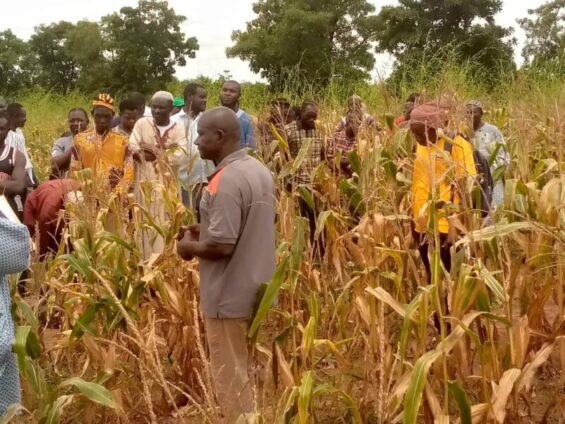
This introduction took place during a farmers' field day organised by CSIR-SARI in Manwe, where the farmers were acquainted with the benefits of these improved maize varieties. The demonstration fields showcased climate-resilient maize hybrids as part of the “Participatory On-Farm Testing of Stress-Tolerant Maize in the Upper West Region of Ghana” project, funded by the International Institute of Tropical Agriculture (IITA).
Addressing the farmers, Dr Mahama G. Yakubu, a Senior Research Scientist at CSIR-SARI, Wa station, noted that these demonstration fields were designed to facilitate the testing, promotion, and eventual adoption of the maize varieties by farmers. He emphasised the importance of adopting climate-smart maize varieties and hybrids to improve economic gains.
“Due to climate change, it is crucial to develop climate-smart hybrids. Climate-smart means the variety matures early, is stress-tolerant, high-yielding, and also meets consumer preferences to enhance livelihoods,” Dr Yakubu explained.
He added that the hybrids possess built-in tolerance mechanisms for water shortage, allowing them to produce more than traditional maize varieties during drought conditions. Additionally, several of these improved varieties have shorter maturity periods, which are better suited to the increasingly erratic rainfall in northern Ghana.
“With a stress-tolerant maize genotype, farmers are more likely to achieve food security, allocate less land to maize, and invest in other crops, promoting a more balanced diet, higher incomes, and improved soil fertility,” he stated.
However, Dr Yakubu, who is also an agronomist, advised that the yield potential of the hybrid maize varieties could only be realised if farmers adhered to good agronomic practices (GAPs), such as proper land preparation and timely weeding. Other essential GAPs he mentioned included the “4Rs” of nutrient stewardship (right source, right rate, right time, and right place), pest control, and timely harvesting.
Some farmers, who spoke to the Ghana News Agency (GNA) during the field visit, expressed optimism that the improved maize varieties would help them address the challenges posed by irregular rainfall patterns.
Latest Stories
-
NAGRAT urges gov’t to communicate early if September deadline cannot be met
11 minutes -
We trust government to meet September deadline on teachers’ promotions – NAGRAT
23 minutes -
“We dare not fail” – Gov’t promises to honour teachers’ promotion pay deal
29 minutes -
The GH¢19.8 billion mirage: Inside Ghana’s state enterprise turnaround
37 minutes -
Luv FM High School Debate: KNUST SHS and Osei Adutwum SHS set up thrilling final after dramatic semi-finals
44 minutes -
KNUST AI Coordinator urges structured adoption of AI in teacher education
58 minutes -
Nepal rescuers blast hillside in search of hydropower workers as families wait anxiously
1 hour -
Teachers who pass promotional exam to get January 2026 start date after gov’t resolves promotion dispute – Dr Apaak assures
1 hour -
NSMQ 2026: St. John’s School rally from slow start to book semi-final spot
1 hour -
Promotion pay row: Gov’t gives teachers September 2026 to complete salary adjustments
1 hour -
Financial irregularities plummet by 62.9% as state tightens fiscal controls
1 hour -
DVLA to expand mobile services to underserved communities in Ghana’s Eastern Corridor of the Northern Region
2 hours -
GUTA urges GPHA to act swiftly to end Tema Port congestion to avert rising business costs
2 hours -
Port congestion could undermine 24-hour economy policy – GUTA
2 hours -
NSA opens three-day window to resolve national service biodata mismatches
2 hours