

Audio By Carbonatix
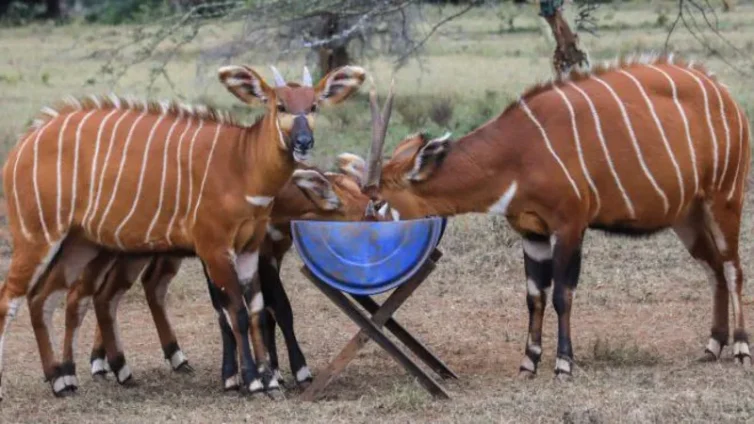
Kenya has received 17 mountain bongos – a very rare type of antelope – from a conservation centre in the United States.
The antelopes are third-generation descendants of mountain bongos taken from Kenya in the 1960s.
The return of the critically endangered animals, from the Rare Species Conservation Foundation in Florida, was hailed as a "monumental step" in Kenya's conservation efforts.
From about 500 in the 1970s, less than 100 mountain bongos are estimated to remain in the wild in Kenya, according to the Kenya Wildlife Service.
The KWS said this was due to habitat loss, poaching, illegal activities, disease, and small fragmented populations.
Tourism Minister Rebecca Miano described the arrival of the bongos at the country's main airport on Sunday night as "emotional and so cool", and a benefit for Kenya's tourism and conservation sectors.
The animals were taken to wildlife sanctuaries in Meru county near Mount Kenya, where they will be nurtured before they are gradually introduced to their natural habitat.
Ms Miano said the mountain bongo, "a species originally only found in Kenya, has suffered untold grief over the decades... dwindling to alarming proportions".
She said the plan was to grow the population to 700 by 2050.
The mountain bongo, which has a bright chestnut-red colour with narrow white stripes, is the largest African forest-dwelling antelope, according to the KWS.
It is listed by the International Union for Conservation of Nature (IUCN) as a Critically Endangered species - with more individuals in captivity than in the wild.
The first repatriation to Kenya was in 2004 when 18 mountain bongos were flown into the country.
KWS director-general Erastus Kanga said Kenya was expecting another batch of the mountain bongos from zoos in Europe in the next three months.
From captivity, the bongos have to go through a series of adaptation phases for them to build the immunity needed to survive in the wild.
In 2022, the head of conservancy at Mount Kenya Wildlife Conservancy (MKWC) told a Kenyan TV station that some of the bongos repatriated in 2004 had successfully been integrated into the wild and had started breeding.
The MKWC official, Robert Aruho, however, said that other had died from tick-borne diseases, adding that building immunity takes time.
Latest Stories
-
ECG procurement is where politicians ‘milk’ the company – Ben Boakye
21 minutes -
IPPs’ contractual arrangements partly to blame for energy sector problems – TUC’s Dr Otoo
32 minutes -
Like Benzema & as good as Haaland – Alonso on Joao Pedro
35 minutes -
Check out 41 countries Ghanaians can visit without a visa on ordinary passports
45 minutes -
I disrupted pre-season travel plans to prepare players – Arteta
53 minutes -
Richarlison’s move to Vasco da Gama falls through
1 hour -
Dictator meme shows lack of human awareness – Mbappe
1 hour -
2030 World Cup: Moroccan official told to stop making 2030 final promise
1 hour -
Mourinho compares Mbappe and Vini Jr to fruit trees after boos
1 hour -
Lewis Hall signs new contract with Newcastle until 2031
2 hours -
Signed instead of Rashford, Gordon is proving worth at Barca
2 hours -
2026 BECE automatic placement rate hits 87.3%, highest since 2021 — CSSPS data
2 hours -
Ghanaian youngster Zayan Omar joins Spanish side Málaga
2 hours -
New Man City signings desperate to win – Dias
2 hours -
Morocco rejects Spain blame game, warns against using kingdom as political pawn
2 hours