

Audio By Carbonatix
The Attorney-General's office has filed an urgent motion seeking to strike out suspended Chief Justice Gertrude Torkornoo's supplementary affidavit ahead of tomorrow's crucial Supreme Court hearing.
The proceedings could determine the fate of the controversial impeachment process against the nation's top judge.
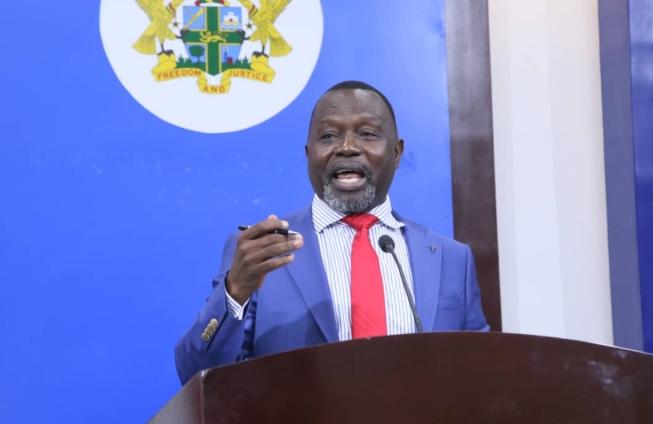
In legal documents filed yesterday, Deputy Attorney-General Dr. Justice Srem-Sai argued that Chief Justice Torkornoo's affidavit - which contains shocking allegations of "mental torture" and constitutional violations during her impeachment proceedings - should be expunged from court records.
The AG says the said depositions violate Article 146(8) of the Constitution.
The embattled Chief Justice's affidavit paints a disturbing picture of her treatment, detailing invasive security checks, denial of access to legal counsel, and what she describes as unconstitutional handling of the impeachment process.
Particularly controversial is her claim that the choice of Osu Castle as the hearing venue constitutes deliberate intimidation, given that such proceedings are typically held in judicial facilities.
Background
On May 26, the suspended Chief Justice filed a damning supplementary affidavit at the Supreme Court.
She painted a harrowing picture of her treatment in the ongoing impeachment inquiry, which she describes as "a mockery of justice, an assault on judicial independence, and worse than the treatment meted out to persons accused of treason."
Justice Torkornoo said the process she’s being subjected to constitutes “a complete desecration of my basic constitutional rights to a fair trial, violation of my dignity and subjection to inhuman and degrading treatment, of a kind not meted out to even accused persons on trial for treason.”
The affidavit, filed in support of her motion for an interlocutory injunction to halt the proceedings, outlines a series of alarming developments since she first took legal action on May 21.
She revealed that despite informing the committee of the suit she filed at the Supreme Court and providing copies of the processes, the committee proceeded with the inquiry the very next day.
“Notwithstanding receipt of the processes filed… the members of the committee indicated their resolve to proceed,” she states, adding that she still has not been informed of the legal basis for determining that a prima facie case had been established against her.
“I do not know the specific allegations I am to answer to. I cannot even begin to prepare a defence,” she lamented.
Justice Torkornoo described what she views as a calculated series of violations.
She recounted how, on May 15, her lawyer appeared before the committee in her absence, only to be ignored and sidelined by the same committee that had served him with hearing notices a day earlier.
“The committee shockingly refused to recognise my counsel… and proceeded to fix subsequent hearing dates without involving him,” she said.
Even more troubling, according to her affidavit, is the committee’s decision to allow the petitioners to call third-party witnesses instead of testifying themselves.
She argues that this undermines the principle of direct accountability and flies in the face of rules that require petitioners to testify under oath and be subjected to cross-examination.
“This is completely offensive to known rules of procedure,” she insists.
But the procedural irregularities are not the only focus of her protest.
Justice Torkornoo speaks of deeply personal humiliations—body searches, denial of access to phones and laptops for herself and her legal team, while allowing full access to petitioners’ counsel.
Her husband and children, she adds, were barred from entering the hearing room.
She also denounced the venue of the hearings—the Osu Castle, a high-security zone—as intentionally intimidating.
“All Article 146 proceedings, with the exception of the one I am being subjected to, have been held in a judicial facility. The location of proceedings affecting me in a cordoned high-security facility boggles the mind,” she wrote.
The Chief Justice warns that what is playing out is not just a personal attack but an institutional crisis.
“The persistent violations of my constitutional rights show that the whole proceedings… are a mockery of justice and a ruse to unjustifiably remove me from office,” she declared, calling on the Supreme Court to intervene immediately.
In her plea, she argues that this case is not merely about her survival in office, but about protecting the constitutional independence and security of tenure for all judges of the superior courts.
Latest Stories
-
New health training facility at Ampoma-Jema to address admission shortfalls, but Minister flags missing amenities
5 minutes -
Black Challenge unveiled with sights set on Amputee World Cup glory
25 minutes -
Pay striking teachers before expressway spending, Dr Kingsley Agyemang tells government
1 hour -
Customs intercepts assault rifle, two pistols and 610 rounds of ammunition at Tema Port
1 hour -
PKO boxers secure wins at Odwira Festival
2 hours -
South Tongu Records Rise in Teenage Pregnancy
2 hours -
Cabinet threw out US health compact faster than anything I’ve seen – Mahama
2 hours -
MoFA urges Finance Ministry to reverse World Bank food programme withdrawal over GH¢643m commitments
2 hours -
NAGRAT demands signed timelines before calling off strike
2 hours -
National Investment Quiz: West Africa SHS, St. Louis SHS advance to semi-finals
3 hours -
Shatta Wale appeals to Mahama for balanced framework to tackle social media abuse without stifling free speech
3 hours -
Education Ministry urges data-driven talks to resolve teacher impasse
3 hours -
‘What we wanted was money to buy medications’ – Dr Nawaane on US health support
3 hours -
Osman Ayariga leads NDC team to vet constituency aspirants in Central Region
3 hours -
‘We shouldn’t allow their drugs in just because they’re giving us $100m’ – Dr Nawaane
3 hours