

Audio By Carbonatix
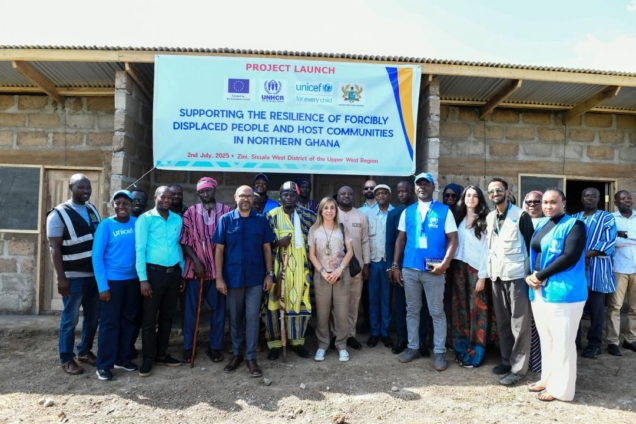
The European Union (EU), UNICEF and UNHCR, the UN Refugee Agency, launched a €2.7 million multi-donor initiative in northern Ghana to significantly strengthen the resilience and improve the lives of forcibly displaced persons and their host communities.
The two-year Supporting the Resilience of Forcibly Displaced People and Host Communities in Northern Ghana programme, known as the UNITE project, is co-led by UNICEF Ghana and UNHCR.
Implemented in the Tarikom and Zini communities of Ghana’s Upper East and Upper West regions, the project will address the urgent needs of women and children while strengthening national systems for inclusive development.
This collaborative effort, delivered in partnership with the Ministry of Gender, Children and Social Protection; Ghana Health Service; Ghana Education Service; National Identification Authority; and local government authorities, seeks to improve access to essential services, foster social cohesion for forcibly displaced persons and other vulnerable groups, and promote long-term sustainable development, with the objective of aligning with national strategies and complementing existing efforts like the Gulf of Guinea Social Cohesion (SOCO) programme.
"Prolonged conflict in the Gulf of Guinea has forced thousands to flee their homes, with over 17,000 asylum seekers estimated to be living in the Upper East and Upper West regions of Ghana. Through the UNITE project and other initiatives, the EU is supporting forcibly displaced people and the communities generously hosting them as they start their lives afresh. The EU will continue to play its role on the global stage and in Ghana to uphold refugees' rights, in line with EU and international law." said Irchad Razaaly, EU Ambassador to Ghana.
“This initiative, profoundly supported by the European Union, is about restoring dignity, strengthening community resilience and building a future where every child and family has equitable access to the services and opportunities they deserve in a dynamic and changing environment” stated Osama Makkawi Khoghali, UNICEF Ghana Representative.
“UNHCR is committed to ensuring that forcibly displaced persons and their host communities in Northern Ghana have the protection and support to not only survive but thrive. This comprehensive program, with the generous backing of the European Union, allows us to work collaboratively to build sustainable solutions that empower these communities and foster peaceful coexistence,” added Needa Jehu-Mazou, Head of the UNHCR Office in Ghana.
The project is also being replicated in Côte d’Ivoire, Togo, and Benin, highlighting a concerted regional approach with a total financing amount of € 12 million (€10 million from the EU and €2 million from four UN agencies: World Food Programme (WFP), International Organization for Migration (IOM), UNICEF and UNHCR)
Latest Stories
-
US immigration officials defend ICE agents who shot man in same car as child
2 minutes -
Commentator Katie Zacharia picked as new White House press secretary
5 minutes -
Drone strike by Sudan paramilitary kills 41 near Ethiopian border, rights group says
12 minutes -
King warns malicious online actors are evolving tactics
19 minutes -
Several injured as Saudi capital airport reportedly hit again
21 minutes -
Christa Pike discharged from hospital and returned to prison, her lawyers say
23 minutes -
Ghana’s BRICS move requires clear strategy to manage risks – Godfred Bokpin
2 hours -
Pay teachers realistic income – Duncan Amoah to gov’t
2 hours -
Bechem to become chicken capital of Ghana – Mahama projects
2 hours -
Gov’t targets recruitment of 16,500 health professionals in 2026
3 hours -
Two-week strike will not derail academic calendar – GNAT President
3 hours -
Headmaster detained after BBC investigation into alleged sexual abuse of students
3 hours -
GNAT pushes for clear implementation procedures of teachers’ conditions of service
3 hours -
Recurrent strikes threaten quality of education and academic calendars – Prof Bokpin
4 hours -
‘Cockroach’ group leaders among hundreds detained in Delhi protest
4 hours