

Audio By Carbonatix
The Minority Leader, Alexander Afenyo-Markin, has questioned claims by the Finance Minister, Dr Cassiel Ato Forson, that the recent appreciation of the cedi is unprecedented, insisting that the previous New Patriotic Party (NPP) administration had already stabilised the local currency before leaving office.
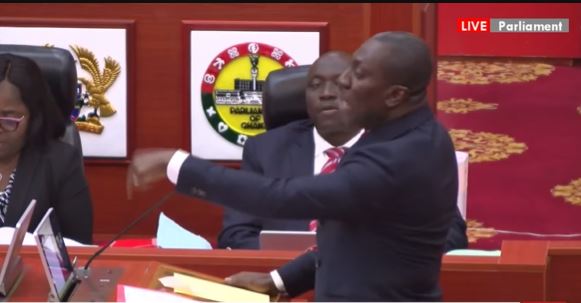
Speaking on the floor of Parliament on Thursday, July 31, during the debate on the 2025 Mid-Year Budget Review, Mr. Afenyo-Markin said while the cedi’s current performance is commendable, the context behind its recent gains must be properly understood.
“Mr. Speaker, the Mid-Year Review makes much of the Ghanaian Cedi’s performance, with the Minister jubilantly declaring ‘cedi no apicki’. He even claims the recent appreciation has never happened in the history of the country,” the Minority Leader said.
“Let’s analyse this carefully. Yes, in early 2025, the cedi strengthened against major currencies, a positive development, we admit. But what are the underlying causes, and is this sustainable?”
Mr. Afenyo-Markin stated that the Finance Minister’s Mid-Year Budget Review presentation failed to acknowledge the global economic challenges that led to the Cedi’s steep depreciation in 2022.
He noted that during that year, the Cedi was among the worst-performing currencies in the world, having lost over half its value at one point. However, he argued that the situation was not unique to Ghana.
“In 2022, virtually all emerging economies saw their currencies fall sharply against a surging US dollar,” he said.
“Aggressive interest rate hikes by the US Federal Reserve strengthened the dollar, while the Russia-Ukraine conflict drove up oil and commodity prices, draining foreign reserves in countries like ours.”
The Effutu legislature further explained that Ghana suffered a temporary loss of investor confidence before securing a deal with the International Monetary Fund (IMF), which compounded the Cedi’s troubles.
Despite those setbacks, Mr. Afenyo-Markin maintained that the NPP government was able to stabilise the Cedi by the end of 2023.
He cited policy initiatives such as the IMF agreement, debt restructuring efforts, and the Gold-for-Oil programme as contributing factors.
“After reaching its weakest point in late 2022, the Cedi’s slide was arrested and partially reversed,” he said.
“By the end of 2024, the depreciation had slowed dramatically, only 19% year-on-year against the dollar. That was a marked improvement from the earlier free-fall.”
He added that the governing NDC administration, led by President John Mahama, inherited a recovering currency rather than a collapsing one.
“So when the new government took over the reins of affairs in January 2025, they inherited a stabilising currency, not a perpetually dwindling one,” Mr. Afenyo-Markin stated.
Latest Stories
-
John Boadu pledges unity, reconciliation as he takes over as NPP National Chairman
9 seconds -
‘Whatever the personal cost, I will not abandon my duty’ – Baffour Awuah assures Salomey Bafoh
2 minutes -
Government to increase funding for Houses of Chiefs to speed up dispute resolution
4 minutes -
Govt’ to introduce digital property rate system to boost MMDAs’ revenue – Mahama Ayariga
5 minutes -
Traditional Medicine Practice Council closes three unlicensed spa and massage centres in Ashanti Region
8 minutes -
Let’s accept the reality and move along – Mike Oquaye on NPP’s decision to make flagbearer party leader
10 minutes -
Early presidential primary helped cool tensions in NPP – Prof. Mike Oquaye
28 minutes -
NDC congratulates new NPP executives, urges national interest above party interests
30 minutes -
NPP implementing 2024 election review recommendations in stages – Prof Mike Oquaye
31 minutes -
Ghana Rugby Union announces managerial changes
32 minutes -
US removes all bombers from RAF Fairford base
33 minutes -
France closes up to 500 schools Monday over student protests
33 minutes -
Girl, 12, fatally shot in US during ‘dispute over parking space’
34 minutes -
NPP is a party for all classes – Prof. Mike Oquaye
35 minutes -
Chief Justice urges Judiciary to strengthen foundations of justice
35 minutes