

Audio By Carbonatix
Community leaders from Ghana’s key cocoa-producing regions are pioneering collaborative approaches to sustainable farming through peer-to-peer learning exchanges designed to reduce deforestation while maintaining agricultural productivity.
This has been made possible through the Hotspot Intervention Areas (HIAs) under the Ghana Cocoa Forest REDD+ Programme, aimed at reducing deforestation, enhancing sustainable cocoa production, and improving community livelihoods.
The recent peer-learning programme was through the instrumentality of the United Nations Development Programme (UNDP) with support from the Forestry Commission of Ghana.
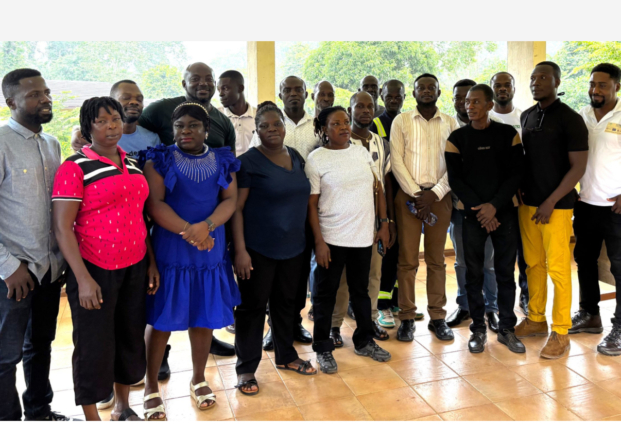
It saw HIA executives from Atewa in the Eastern Region and Sefwi-Wiawso, Western North Region, visit their counterparts in Asunafo-Asutifi in the Ahafo Region and Juaboso-Bia, Western Region, to observe their sustainable cocoa-forest management strategies.
At the Ayum Forest Reserve in the Asunafo South District, participants witnessed the Modified Taugya System (MTS) in action, an integrated agroforestry approach that allows farmers to combine traditional farming practices with native tree planting.
A highlight of the visit was the Bia Soap Processing Factory, a community-based enterprise established by the Bia West Cooperative Union, an economic model of diversification and providing additional income streams for cocoa farmers and forest conservation.
The initiative receives funding from the Swiss State Secretariat for Economic Affairs (SECO) through the Green Commodities Programme, reflecting international recognition of Ghana’s community-driven approach to sustainable cocoa production.
“This peer exchange is helping us to see what is possible when communities are organised and supported. The soap factory, for instance, is more than a business; it’s a model of how livelihood empowerment and environmental stewardship can go hand in hand,” said Ms Henrittah Kyerewaa, the Atewa East Akim Secretary.
“We are committed to building a greener cocoa future, and these learning visits give us the tools and networks we need to make that happen,” Mr Sylvester Mensah, the Chairman of Sefwi-Wiawso HIA, said.
Mr Forbah Fabian Ebuley, the Director of Bia West Cocoa Health and Extension Division (CHED), explained that the collaborative approach emphasised the importance of respecting indigenous farming knowledge while introducing climate-smart technologies.
“To us, we do not condemn straight ahead the indigenous practices the farmers are used to, we work with them together to also take on board new technologies, and that has proven to work. We also innovate a lot,” Mr Ebuley said.
The recent exchanges involved support from UNDP and Ghana’s Forestry Commission, highlighting the multi-stakeholder approach necessary for sustainable landscape transformation.
Latest Stories
-
GNFS contains fire outbreak at Teshie Lekma Road near Lekma Hospital
3 hours -
Samia Nkrumah rejects the narrative that Ghanaians were happy after Nkrumah’s overthrow
4 hours -
A Mother’s pain: Tribute by Ivan Baidoo’s mother
4 hours -
‘Forgive us for staying away’ — Samia Nkrumah leads family back to Nkroful, pledges to preserve Nkrumah’s legacy
5 hours -
Ernest Nuamah scores twice as Lyon beat Rennes
5 hours -
‘My dear Ivan’ – A father’s tribute to a son tragically killed
5 hours -
GNPC Explorco advances Voltaian Basin drilling preparations with 13.5km access road
5 hours -
Cabinet approves facility manager for Borteyman Sports Complex – Kofi Adams
6 hours -
Sanitation is improving; critics may be ‘living in another world’ – Salaga South MP replies Bekwai MP
6 hours -
Government must do more to tackle sanitation crisis – Bekwai MP
6 hours -
World Cleanup Day: GFF begins sanitation education in local communities
6 hours -
EU Ambassador, IGP discuss stronger cooperation on policing and security
6 hours -
Africa Nations Volleyball Championship: Ghana set up quarterfinal clash with Cameroon after beating Chad
6 hours -
Meet Dr Benjamin Appiah Osei — Ghana’s three-time tourism awards winner
7 hours -
UEFA & CONCACAF demand Fifa pays $10m to all 211 members
7 hours