

Audio By Carbonatix
Can the government realistically meet its target of training 300,000 people under the One Million Coders Programme by December 2026, after training less than 1% of applicants in Phase One and needing to scale delivery capacity nearly 350 times to reach the goal?
This staggering mathematical hurdle, combined with a lack of transparency regarding actual budget disbursements, defines the current challenge facing the government’s ambitious digital agenda.
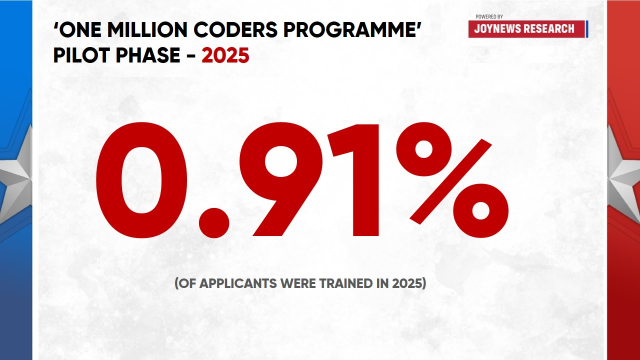
The programme began in 2025 with a surge of nearly 92,000 applications within 48 hours. From that pool, 1,000 were selected for training, and 859 completed the pilot phase across four regions. That outcome represents nearly 1% of total applicants, reflecting the limited scale of the initial rollout relative to demand.
To move from training 859 participants in the pilot phase to 300,000 trainees by the end of 2026, the programme has extended its coverage from 4 to all 16 regions of the country, with one face-to-face centre established in each region.
This expansion is visible because as of May 10, 2026, Phase Two has recorded nearly 120,000 registrations, with about 30,000 already admitted and enrolled.
This expanded rollout is reflected in the 25% enrolment rate in Phase Two, compared to 1% of applicants who were selected for training during the pilot phase.
The enrolment process for Phase Two is structured in multiple stages. After applicants register and provide their biographical data, they undergo an initial assessment. Based on the assessment, courses are suggested to them, although participants retain the flexibility to choose any available course. After selecting a course, applicants choose a training centre, complete Ghana Card verification, and then select a learning slot. Training options include online sessions, self-paced modules with allocated time frames, and scheduled face-to-face classes. 16 physical training centres operate nationwide, one per region, to support in-person delivery.
The programme offers 30 courses, with durations ranging from 10 to 250 hours depending on the course. All of which are to equip the Ghanaian workforce with digital skills.
The design allows participants to complete a course, receive certification, and make room for new enrolees in a rotational system intended to maximize available training slots.
Registration and tuition remain free, with participants potentially covering incidental costs such as transportation for physical sessions.
But, beyond scale and structure, funding remains a central analytical consideration.
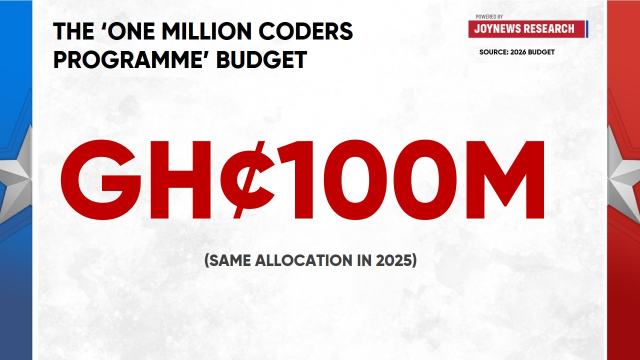
In 2025, the communication ministry overseeing the programme was allocated ¢838 million. Within that budget, ¢100 million was directed to the One Million Coders Programme through combined goods-and-services and capital expenditure lines.
In 2026, the picture looks the same. The Ministry’s total budget increases to ¢1.2 billion, with another ¢100 million earmarked for the programme.
However, there is no publicly available confirmation detailing how much of these allocations have actually been disbursed. While the budget lines exist on paper, the lack of detailed breakdown or actual release figures makes it difficult to verify if the programme is being funded at the level required to sustain a 350-fold expansion.
Alongside government allocations, private sector participation has strengthened the programme’s resource base. MTN has contributed $2 million in support. Additional partnerships include certification commitments with global technology firms such as Google and Telecel, alongside collaborations with Huawei, Cisco, and HP.
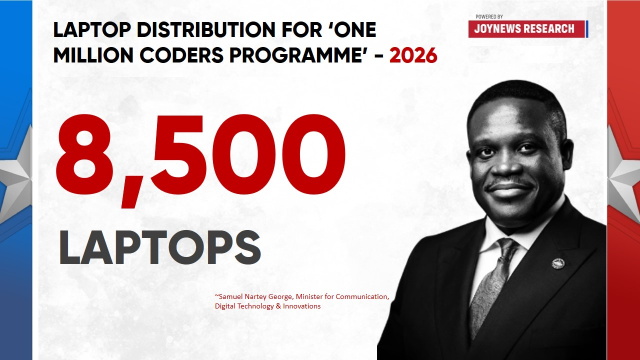
Infrastructure reports indicate the procurement of 20,000 laptops and some projectors. Sam Nartey George, Minister for Communication, Digital Technology & Innovation confirmed 8,500 laptops already distributed to some regions. Also, 1,000 laptops already split between University of Ghana and Kwame Nkrumah University of Science and Technology.
The programme is operating at a much larger scale than its pilot phase. However, it remains to be seen if the current funding clarity and delivery capacity realistically support a 300,000 trainee target within the stated timeline.
Latest Stories
-
Hawa Koomson pledges experienced and mature leadership of NPP women’s wing
10 minutes -
Young woman found dead at Kasoa Peace Town
42 minutes -
Livestream: The Law examines lawful arrest in Ghana
1 hour -
Mahama urges African governments to treat healthcare as an investment, not budget cost
2 hours -
Bawumia congratulates John Boadu and new NPP executives, pledges support ahead of 2028
2 hours -
‘No talent should be left out’ – Bawumia pledges inclusive NPP campaign for 2028
2 hours -
Prof. Mike Oquaye recounts how he blocked Special Prosecutor’s attempt to arrest Bawku Central MP
2 hours -
Make health sovereignty a priority for Africa – Mahama
2 hours -
Dorimon Naa, Wa West DCE lead massive clean-up exercise; threaten sanctions against recalcitrant residents
3 hours -
Photos from Adom FM Y2K Jam
3 hours -
Praye Tiatia steals the show at Adom FM Y2K Jam [Watch]
3 hours -
Boakye Agyarko congratulates John Boadu, pledges support for NPP leadership
3 hours -
Antwi HiMight thrills fans with Antwi ne Antwi hits at Adom FM’s Y2K Jam [Video]
3 hours -
Amb. Edward Boateng congratulates Boadu, Kodua on election wins
4 hours -
John Boadu pledges to rebuild NPP from grassroots and restore ‘winning machinery’
4 hours