

Audio By Carbonatix
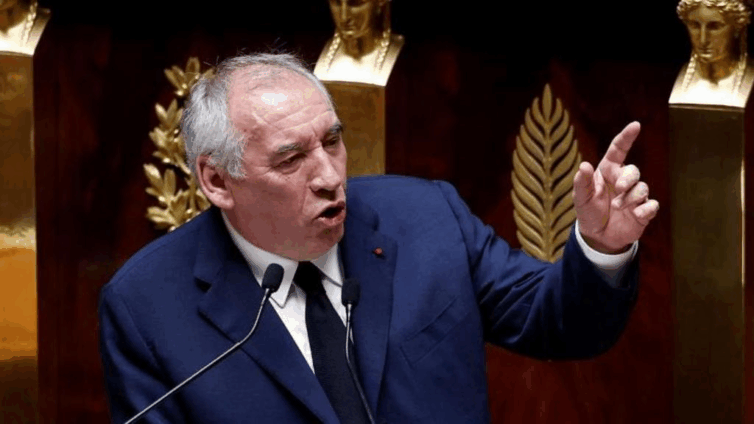
France has been plunged into a new political crisis with the defeat of Prime Minister François Bayrou at a confidence vote in the National Assembly.
The defeat – by 364 votes to 194 – means that Bayrou will on Tuesday present his government's resignation to President Emmanuel Macron, who must now decide how to replace him. Macron's office said this would happen "in the coming days".
The options include naming a new prime minister from the centre-right, pivoting to the left and finding a name compatible with the Socialist Party; and dissolving parliament so new elections are held.
Macron's bitter enemies in the far-left France Unbowed party are calling for him personally to resign, but few commentators think it likely.
France is thus on its way to getting a fifth prime minister in less than two years - a dismal record that underscores the drift and disenchantment that have marked the president's second term.
Bayrou's fall came after he staked his government on an emergency confidence debate on the question of French debt.
He spent the summer warning of the "existential" threat to France if it did not start to tackle its €3.4 trillion (£2.9 trillion) liability.
In a budget for 2026 he proposed to scrap two national holidays and freeze welfare payments and pensions, with the aim of saving €44 billion.
But he was quickly disabused of any hope that his prophesies of financial doom would sway opponents.
Party after party made quite clear they saw Monday's vote as an opportunity to settle accounts with Bayrou - and through him Macron.
Lacking any majority in the National Assembly, Bayrou saw the left and hard-right uniting against him - and his fate was sealed.
Some commentators have described Bayrou's fall as an act of political suicide. There was no need for him to call the early confidence vote, and he could have spent the coming months trying to build support.
In his speech beforehand, Bayrou made clear that he had his eyes set more on history rather than politics, telling MPs that it was future generations who would suffer if France lost its financial independence.
"Submission to debt is the same as submission to arms," he said, warning that current debt levels meant "plunging young people into slavery".
"You may have the power to bring down the government. But you cannot efface reality," he said.
There was no sign that Bayrou's warnings have had any impact on parliament or on France as a whole. Deputies from the left and hard-right accused him of trying to mask his own and Macron's responsibility in bringing France to its current state.
In the country, there has also been little echo to Bayrou's analysis – with polls showing that few regard debt control as a national priority, as opposed to the cost of living, security and immigration.
A movement calling itself Bloquons Tout (Let's Block Everything ) has promised a wave of sit-ins, boycotts and protests against Macron's policies from this Wednesday. On 18 September several unions are also calling for demonstrations.
Most economic analysts agree that France faces a huge financial challenge in the years ahead, as the projected cost of servicing its debt rises from the €30bn spent in 2020 to more than €100bn in 2030.
The need for financial restraint comes as Macron promises extra funds for defence, and as opposition parties of left and hard-right demand the repeal of the latest pension reform that raised the retirement age to 64.
Bayrou took over from Michel Barnier last December after Barnier failed to get his budget through the Assembly.
Bayrou managed to pass a budget thanks to a non-aggression pact with the Socialists, but their relations plunged when a conference on the latest pension reform failed to take account of Socialist demands.
Some speculated that Macron would turn now to a left-wing prime minister, having failed with the conservative Barnier and the centrist Bayrou.
However the Socialist Party says it wants a total break from Macron's pro-business policies as well as a repeal of the pension reform - which would be tantamount to undoing the president's legacy.
It therefore seems likely Macron will look initially to another figure from within his own camp, with Defence Minister Sébastien Lecornu, Labour Minister Catherine Vautrin and Finance Minister Éric Lombard all said to be in the running.
Latest Stories
-
Today’s front pages: Tuesday, August 18, 2026
34 minutes -
Banks’ sustainable success will be defined less by interest margins – PwC
2 hours -
Baffoe-Bonnie was part of ‘grand conspiracy’ against Torkornoo – Afenyo-Markin
2 hours -
The GIPA Act: Resetting Ghana’s investment framework
3 hours -
GIPA secures investor leads at Invest Fest 2026
3 hours -
Ghana’s missing billions: What 16 years of Auditor-General reports show
3 hours -
Police disown viral flyer on AirPods, earphones use while driving
3 hours -
Stop using media to challenge judicial decisions – Thaddeus Sory to lawyers
3 hours -
The next generation expects more than degrees from universities
3 hours -
Ebenezer Dwomoh to stage fourth stand-up comedy special in Kumasi
3 hours -
Central Regional Minister urges traditional leaders to hold public officials accountable
3 hours -
Ada Traditional Council suspends four members for defying cancellation of 2026 Asafotufiami durbar
3 hours -
Association of Small-scale Industries, GEA strengthen artisans through mentorship, coaching
3 hours -
Two arrested over alleged galamsey activities in Tanoso
3 hours -
Ghana rises to sixth-largest gold producer globally after record 2025 output
3 hours