

Audio By Carbonatix
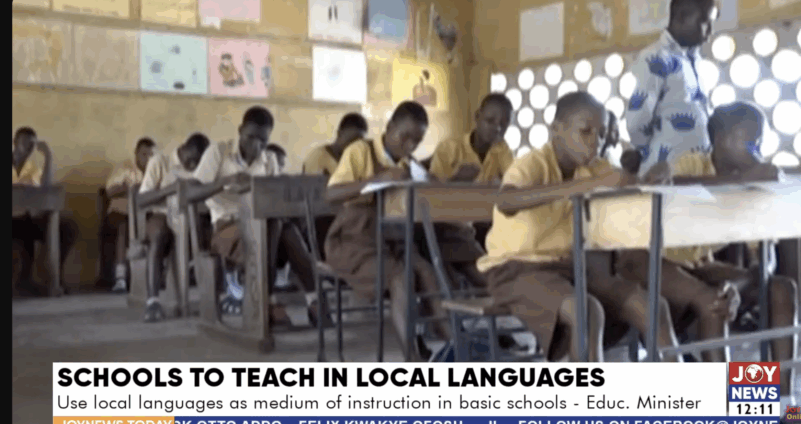
The Ghana National Association of Teachers (GNAT) has welcomed the Education Ministry’s directive to enforce mother-tongue instruction in schools, but says the policy must be accompanied by deliberate measures to train and appropriately deploy teachers.
Speaking on JoyNews, GNAT's president, Isaac Owusu, said simply declaring local language instruction compulsory is not enough if teachers are not adequately prepared to teach in the languages spoken in the communities they are assigned to.
“But for us, what we are looking at is not just a declaration of making the local language compulsory,” he stressed.
“There should be a deliberate policy so that the teachers we train from the colleges of education and the universities have ample time to study and teach these languages.”
He noted that there are currently several Ghanaian languages that are not taught in teacher training colleges, making it difficult to implement the policy effectively.
Beyond training, he said, teacher postings must also consider linguistic relevance to avoid communication barriers in the classroom.
“You don’t post a teacher who speaks Ewe to Mankranso and place a Mankranso teacher in Anloga,” he explained.
“The teacher will find it difficult in terms of the language barrier. These are the things we want the Ministry and GES to collaborate on and take step by step.”
His comments come after the Minister of Education, Haruna Iddrisu, directed the Ghana Education Service (GES) to strictly enforce the use of local languages as a medium of instruction in schools.
According to the Minister, the move is aimed at improving comprehension and learning outcomes, especially at the basic level.
Haruna Iddrisu announced the launch of the Free Tertiary Education Programme for Persons Living with Disabilities, stating that the initiative forms part of broader reforms to strengthen foundational learning.
Isaac Owusu agreed the policy is “in the right direction,” but said its success will depend on coordinated planning among the Education Ministry, GES, and colleges of education.
“We believe this is achievable if the right measures are put in place,” he added.
“We support it, but it must be done properly to benefit the children.”
Latest Stories
-
51,000 teachers’ promotion arrears to be validated for October payment – Education Minister
27 minutes -
Kwabena Boamah appointed Board Chair for Impact Investing Ghana
34 minutes -
Striking teacher unions to meet Fair Wages and Salaries Commission on October 6
48 minutes -
EOCO working with AG to arraign Nana Baffour Awuah before weekend court
51 minutes -
Duraplast reassures customers after fire, announces October 5 reopening
60 minutes -
Call off strike, gov’t will not renege on promotion arrears pledge – Haruna Iddrisu appeals to teacher unions
1 hour -
Committee set up to validate teachers eligible for 20% deprived-area allowance – Education Minister
1 hour -
Five-member committee to search for new Black Stars coach after Sports Ministry-GFA meeting
2 hours -
Pinktober: Breast cancer survival exceeds 90% when detected early – Breast Society of Ghana
2 hours -
TCDA to adopt Upper West’s MATCO mango farm as northern prototype, issues warning against felling shea trees
2 hours -
‘Fear delegates’ tag: Afoko touts genuineness among delegates ahead of NPP delegates conference
2 hours -
John Boadu: The leader our party needs at this time – Amb. Edward Akwasi Boateng
2 hours -
Baffour Awuah: EOCO arrested, detained MP after hours of waiting, questioning – Afenyo-Markin
2 hours -
EOCO court warrant authorised search of Baffour Awuah’s law firm, not residence – Afenyo-Markin
3 hours -
NPP delegates conference: 3,000 to 4,000 police personnel deployed for security in Kumasi – Anthony Karbo
3 hours