

Audio By Carbonatix
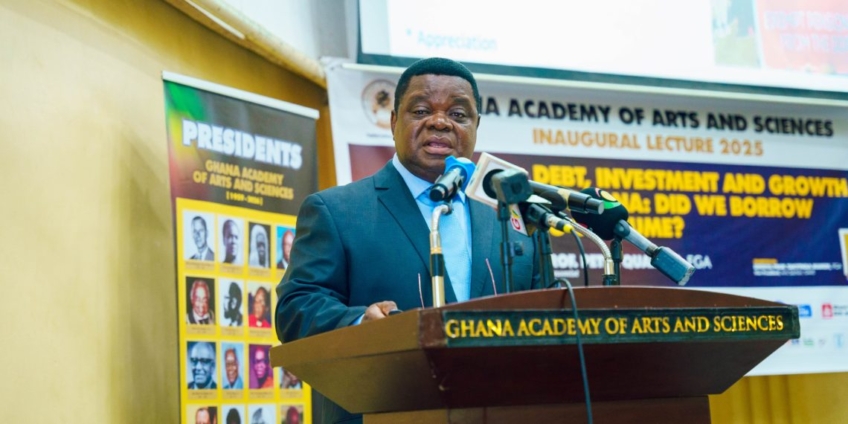
The immediate past Director of the Institute for Statistical, Social and Economic Research (ISSER), Prof. Peter Quartey, says Ghana must urgently restore road tolls and reinforce its public–private partnership (PPP) framework if it hopes to mobilise the financing required for the 198.7-kilometre Accra–Kumasi Expressway.
He argues that sustainable funding, not political commitment, will ultimately determine whether the expressway becomes a transformative national asset or yet another stalled infrastructure promise.
His remarks come after the Finance Minister reiterated the government’s commitment to completing the expressway within three years to improve mobility, reduce logistics costs, and boost trade between Ghana’s two largest urban centres.
But according to Prof. Quartey, the government simply does not have the fiscal space to execute such a major project on its own, making private-sector participation essential.
“Government cannot construct every important road in this country alone. That is where public-private partnership is important; you can get funding, construct, toll and pay. If that is the concept, then I fully support this expressway because we need better roads,” he said.
He warned that Ghana undermined its infrastructure financing credibility when it abolished road tolls, a standard cost-recovery mechanism used globally and a key signal for investors.
“So for me, when road tolls were scrapped, I was very disappointed because you are sending the wrong signal to the private sector,” he added.
Prof. Quartey said tolling must return quickly, supported by improved road quality and efficient electronic systems, to help rebuild investor confidence. Citing Kenya’s modern toll expressways, he noted that well-structured PPPs can accelerate project delivery, enhance maintenance and relieve long-term fiscal pressure.
He stressed that without credible financing reforms, Ghana risks delaying a project that could unlock economic growth, strengthen regional competitiveness and transform the country’s transport economy.
Latest Stories
-
Every year, the lawyers come out, and so does the nonsense! – Ace Ankomah writes
56 seconds -
Digital transformation without an ownership culture can digitise poor service
4 minutes -
Fishing communities demand revocation of offshore gold exploration licences over livelihood concerns
7 minutes -
How Ghanaian tycoon Manoj Lakhiani built a water and plastics empire from a $25,000 loan
9 minutes -
GoldBod recovers GH¢38.7m of GH¢55.8m outstanding receivables; remainder subject to legal action – Sammy Gyamfi
15 minutes -
GEXIM Bank donates GH¢200,000 worth of medical equipment to Korle-Bu Child Health Department
18 minutes -
Majority rejects Minority’s claims over GH¢49.7m South Africa evacuation
20 minutes -
GEXIM urges banks to support refurbishment of Korle-Bu Teaching Hospital’s Child Health Department
23 minutes -
Don’t appoint your cheerleader as referee
27 minutes -
Ghana needs stronger international cooperation to fight cybercrime – CSA
30 minutes -
CSA warns of growing cyber threats as Ghana’s digital dependence increases
36 minutes -
USTED dean warns GAUA strike could disrupt Ghana’s restored academic calendar
49 minutes -
Bechem meat processing factory 50% complete, set for March 2027 completion – Kwakye Ofosu
1 hour -
NDC can appoint whoever they want to EC, but Ghanaians will make a decision in 2028 – Titus Glover
1 hour -
GoldBod initiative has created over 1,300 public and private sector jobs – Sammy Gyamfi
1 hour