

Audio By Carbonatix
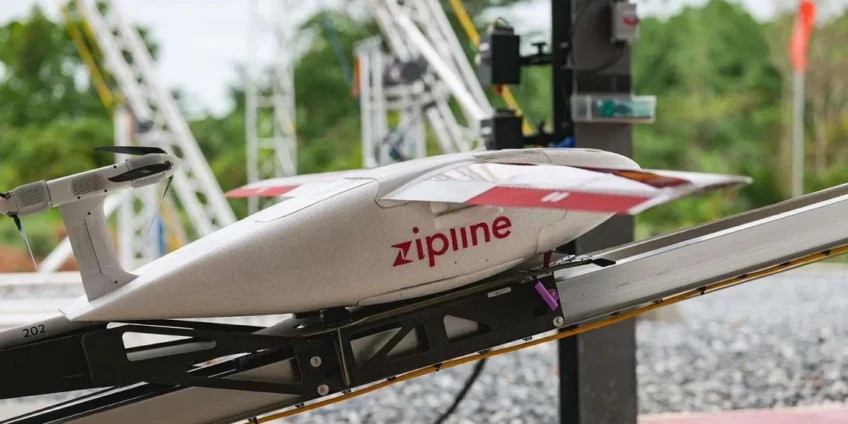
The United States Government has pledged up to $150 million to support Zipline International Inc. in scaling up its drone-enabled medical delivery operations across five African countries—Côte d’Ivoire, Ghana, Kenya, Nigeria and Rwanda.
The investment will help extend access to blood, vaccines, and other essential health supplies to as many as 15,000 health facilities.
The announcement was made during a U.S. Embassy digital press briefing on December 2, outlining the initiative as part of the U.S. Department of State’s new America First Global Health Strategy.
The strategy aims to boost the value of U.S. foreign assistance by reducing waste, avoiding dependency, and aligning global health investments with U.S. policy goals.
Speaking at the briefing, Jeff Graham of the State Department said the partnership prioritises reaching remote and underserved communities with critical health commodities.
He explained that working with Zipline—an American robotics and drone-technology firm—is central to modernizing the U.S. approach to global health logistics.
Under the agreement, U.S. support will drive the deployment of Zipline’s advanced, American-made autonomous aircraft to tackle slow and unreliable delivery systems that hinder timely access to medical supplies.
Graham described the investment as a significant step toward strengthening health systems’ capacity to respond swiftly to disease outbreaks and medical emergencies.
He emphasised that while the U.S. is providing initial capital, partner governments will ultimately assume operational responsibility for their national health delivery networks.
Zipline will open new distribution centres across the participating countries, with Rwanda expected to double its daily delivery capacity, enabling the network to eventually serve up to 130 million people across Africa.
Caitlin Burton, CEO of Zipline Africa, noted that the company’s autonomous, all-weather drones already operate around the clock to maintain a responsive, on-demand medical supply chain—often outperforming traditional delivery systems.
Supported by partners such as the Elton John AIDS Foundation, Zipline has demonstrated that its model is both impactful and cost-effective.
Burton said the new U.S. partnership will help Zipline reach nationwide scale in all five countries, creating an estimated 1,000 jobs and contributing more than $1 billion in annual economic gains.
She stressed that Zipline’s mission goes beyond logistics, aiming to equip health systems to end preventable deaths—from HIV transmission to maternal mortality and severe malnutrition.
“This system is meant to operate nationwide and at a scale that truly changes health outcomes,” she explained.
“We now know how to solve challenges like maternal mortality and malnutrition, and the network is built to meet those goals.”
Burton added that while the U.S. may provide seed capital, governments will cover predictable long-term operating costs, enabling them to replace multiple vertical health programmes with one unified national delivery system.
“You’re not funding a single programme or one-off intervention,” she said.
“You’re ensuring essential medical products reach patients everywhere—including communities where distance or stigma might prevent people from seeking care.”
Latest Stories
-
Promotion pay row: Gov’t gives teachers September to complete salary adjustments
8 minutes -
Financial irregularities plummet by 62.9% as state tightens fiscal controls
8 minutes -
DVLA to expand mobile services to underserved communities in Ghana’s Eastern Corridor of the Northern Region
24 minutes -
GUTA urges GPHA to act swiftly to end Tema Port congestion to avert rising business costs
24 minutes -
Port congestion could undermine 24-hour economy policy – GUTA
25 minutes -
NSA opens three-day window to resolve national service biodata mismatches
35 minutes -
Abu Jinapor highlights increased gold exports after Domestic Gold Purchase Programme
39 minutes -
NPP UK branch calls for independent audit into gold purchasing operations and parliamentary probe
1 hour -
Zanetor Agyeman-Rawlings pledges decisive action on climate change, galamsey and environmental degradation
1 hour -
Bawumia was brainchild behind Domestic Gold Purchase Programme – Samuel Jinapor
1 hour -
Fuel prices set to go up from September 1, Petrol to sell at GHC 16.69 and Diesel, GHC 17.90 – COMAC
1 hour -
Our World Our People withdrawn due to curriculum duplication, not politics – Adutwum’s spokesperson
1 hour -
GANRAP is essentially a rebranding of Domestic Gold Purchase Programme – Abu Jinapor
1 hour -
I am tired of being in opposition, my goal is to win in 2028 – Boakye Agyarko
2 hours -
Ghana’s road maintenance funding gap deepens as only 37% of needs met – World Bank
2 hours