

Audio By Carbonatix
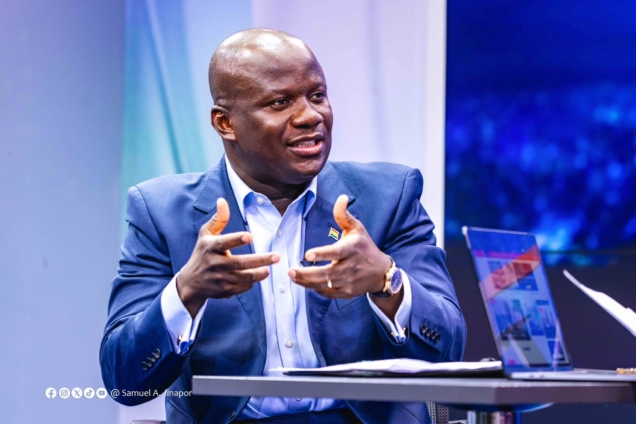
Former Lands and Natural Resources Minister Samuel Abdulai Jinapor has highlighted Ghana’s significant gold export earnings in 2024 as evidence of the impact of policies introduced under the Domestic Gold Purchase Programme.
Mr Jinapor, who is now the Member of Parliament for Damongo, said the government introduced a series of measures to strengthen the programme and ensure that gold produced by licensed operators contributed directly to Ghana’s reserves and foreign exchange position.
He said the Ministry of Lands and Natural Resources engaged the Ghana Chamber of Mines and the Ghana National Association of Small Scale Miners before invoking the government’s pre-emptory right under Section 7 of the Minerals and Mining Act, 2006 (Act 703).
According to him, directives issued in November 2023 required large-scale mining companies to sell 20 per cent of their refined gold to the Bank of Ghana in Ghana cedis before exporting the remainder.
He said Community Mining Schemes and licensed small-scale miners were also required to sell their gold to the government through the then Precious Minerals Marketing Company (PMMC), with the relevant licences containing clauses to that effect.
Mr Jinapor said the measures were deliberately focused on licensed and responsible small-scale miners because the government did not want illegally sourced gold to enter the programme.
He said the Minerals Commission, PMMC and Bank of Ghana coordinated and enforced the directives with support from the Ghana Chamber of Mines and the Ghana National Association of Small Scale Miners.
He also noted that the government subsequently directed the Minerals Commission and PMMC not to process gold export licence applications without the express written approval of the Minister.
The measures, Mr Jinapor said, resulted in Ghana’s gold exports reaching US$11.6 billion in 2024, compared with US$7.6 billion in 2023 and US$6.6 billion in 2022.
He argued that the figures demonstrated the importance of the gold sector to Ghana’s economy and the effectiveness of measures introduced to strengthen domestic gold purchasing and reserve accumulation.
The Damongo MP also maintained that the reserves accumulated through the Domestic Gold Purchase Programme had become an important pillar of Ghana’s economy.
Citing Bank of Ghana Governor Dr Johnson Asiama, Mr Jinapor said the programme had “strengthened external buffers and macroeconomic stability” and had been “crucial to the stabilisation goal of the Bank of Ghana.”
He concluded that the public record should recognise Dr Mahamudu Bawumia as the originator of the programme.
Latest Stories
-
IMF raises Ghana’s 2026 growth forecast to 5.7%, sees inflation falling to 4.8%
2 minutes -
Ablakwa urges Africans not to view immigrants as threat to national progress
6 minutes -
Ghana’s economic salvation lies not in shifting geo-political allegiances – Dr Atuahene
10 minutes -
BoG proposes tougher rules on loan repayment assessment
15 minutes -
Government plans mandatory drug tests for public service jobs — Muntaka
20 minutes -
Media urged to intensify awareness campaigns on breast cancer
25 minutes -
Interior Minister urges public to share drug intelligence
31 minutes -
Afadzato South DCE commissions water projects, teachers’ bungalow
36 minutes -
Council of State urges sustained dialogue, negotiations as teachers resume work
41 minutes -
We are committed to leaving a legacy in Mandari – Bole-Bamboi MP
45 minutes -
Greater Accra teachers resume work after strike suspension
53 minutes -
Education Minister assures teachers of salary adjustments by October 16
58 minutes -
Abass Osabutey declares bid for NDC Deputy National Organiser position
60 minutes -
Education Minister inaugurates NDU Governing Council, announces $25m seed funding
1 hour -
THE LAW 101: La Beach Demolitions – The State’s own documents, the courts’ orders – and the bulldozers
1 hour