

Audio By Carbonatix
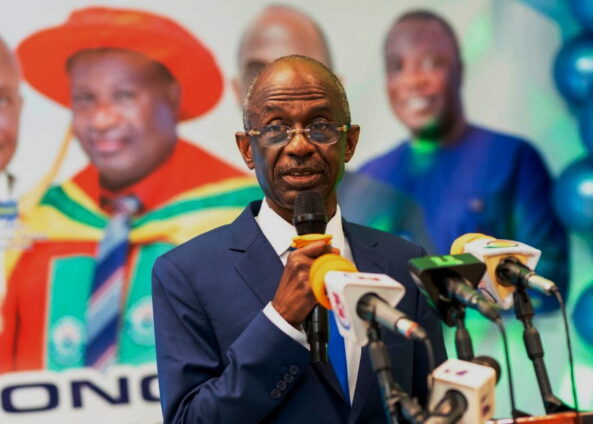
The National Chairman of the National Democratic Congress (NDC), Johnson Asiedu Nketiah, has criticised Ghana’s tendency to discontinue or substantially alter development programmes whenever political power changes hands, saying the practice undermines long-term national development.
He said Ghana needs to develop a culture of institutional and policy continuity in which successive governments build on what is working rather than repeatedly starting afresh.
“A serious country cannot start afresh every four years,” Mr Asiedu Nketiah said while speaking at the 4th Bono Regional Ghana Journalists Association (GJA) Awards in Sunyani on Saturday, September 19, 2026.
Mr Asiedu Nketiah said Ghana has developed a political culture in which programmes associated with a previous administration can become difficult to continue simply because of their political origins.
He said a new government can change the name or structure of an existing programme and sometimes spend additional public funds to arrive at substantially the same destination.
While acknowledging that governments needed to discontinue policies that were not working, he said effective programmes should be improved and maintained for the benefit of citizens.
“Of course, a government must change policies that are failing, and nobody should continue a bad programme for the sake of continuity,” he said.
“But where something is working and public money has already been invested in it, the sensible thing is to improve it and allow the country to receive the benefit.”
Mr Asiedu Nketiah said the principle should extend beyond individual projects to national economic planning.
He said Ghana had experienced severe economic difficulties in recent years, which had constrained government's ability to finance development and placed pressure on households and businesses.
He said the country should learn from that experience rather than repeatedly moving through cycles of crisis and recovery.
“Every government must understand that economic discipline is part of development because the people who eventually pay for indiscipline are ordinary citizens,” he said.
The National Chairman said the improving economic indicators provided an opportunity for Ghana to focus on long-term development rather than merely repairing past difficulties.
The Ghana Statistical Service reports that the economy grew by 6.0% in the second quarter of 2026, while consumer inflation stood at 5.0% in August.
Mr Asiedu Nketiah said the next phase should involve determining how to use improved economic stability to expand productive jobs, strengthen businesses, support agriculture, develop industry and provide the infrastructure required by a growing population.
He said Ghana could predict many of the pressures it would face, including population growth, urban expansion, increased demand for energy, transport and housing, and changing requirements in the labour market.
“Much of this is predictable, which means government has the opportunity to prepare for it,” he said.
He called for forward-looking investments in industrial land, skills development, infrastructure and agriculture before shortages and other pressures became crises.
Mr Asiedu Nketiah also cited infrastructure development in the Bono Region as an example of the need to link public investment to broader economic outcomes.
He said government had committed approximately GH¢4.12 billion to road projects covering about 252 kilometres in the region, including the Jinijini-Sampa corridor, Wenchi-Nsawkaw-Debibi-Sampa, Berekum-Seikwa and the Sunyani Outer Ring Road.
He said such investments should be accompanied by measures to promote agricultural processing, storage, logistics and market access so that communities could derive greater economic benefits from improved connectivity.
Mr Asiedu Nketiah said Ghana's development required consistency over time and urged political leaders to use their accumulated experience to improve future decisions.
“We have tried many things. Some have worked and others have not. We should know enough by now to avoid repeating every mistake before accepting that it was a mistake,” he said.
He also urged journalists to contribute to long-term accountability by tracking government commitments and maintaining accurate records of projects, expenditure and outcomes.
According to him, such records would enable citizens and future generations to establish what governments promised, what they spent and what they ultimately delivered.
“Development is easier to sustain when governments know that somebody is keeping track,” he said.
Latest Stories
-
TraffiTech-GH pilot reduces road crash injuries, fatalities
8 minutes -
IMF Chief identifies 2 major threats posed by AI to global economy
13 minutes -
Go back to the hand washing days – Ghanaians told
18 minutes -
GoldBod commits GH¢35m to reclaim galamsey-damaged Tano Nimri Forest Reserve
23 minutes -
Afenyo-Markin reflects on loneliness of public service, says survival is largely spiritual
30 minutes -
Achimota Court designated to handle petroleum diversion cases – NPA CEO
38 minutes -
Bekwai court jails mine worker 14 years for defiling 8-year-old girl
43 minutes -
CHASS conference calls for collective action to tackle indiscipline in schools
47 minutes -
Oil edges down as investors weigh possible US sanctions on ‘shadow fleet’
60 minutes -
Netflix names former Disney executive Peter Rice as new content chief as Bajaria departs
1 hour -
India’s ‘cockroach’ protesters set to return despite police crackdown
1 hour -
Porn showing choking or incest to be banned from early November, UK government says
1 hour -
Russell Brand accuser says he turned ‘monster-like’ before alleged rape
2 hours -
US police identify remains of man found in barrel in shrinking reservoir
2 hours -
My uncle told me I will never make it in music – Lojay
2 hours