

Audio By Carbonatix
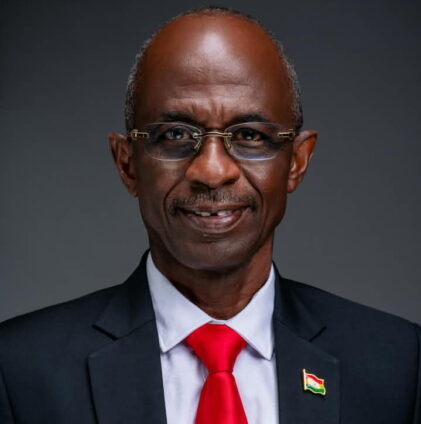
National Chairman of the National Democratic Congress (NDC), Johnson Asiedu Nketiah, has called for greater policy continuity in Ghana, urging successive governments to improve programmes that are delivering results instead of abandoning them because they were initiated by their predecessors.
He said although governments had a responsibility to discontinue policies that were failing, there was little justification for scrapping effective programmes simply because political administrations had changed.
Mr Asiedu Nketiah was speaking at the 4th Bono Regional Ghana Journalists Association (GJA) Awards in Sunyani on Saturday, September 19, 2026.
“There is another habit we have developed in our politics that we should correct. We abandon too much,” he said.
According to him, a change of government could sometimes result in an existing programme being renamed or restructured, with additional public funds spent to achieve almost the same objective.
He said such an approach deprived the country of the full benefit of investments already made.
“Of course, a government must change policies that are failing, and nobody should continue a bad programme for the sake of continuity. But where something is working and public money has already been invested in it, the sensible thing is to improve it and allow the country to receive the benefit,” he said.
Mr Asiedu Nketiah said Ghana needed to use the improving economic conditions as an opportunity to think beyond recovery and determine what should be built on the stability being achieved.
The Ghana Statistical Service currently reports 6.0% annual GDP growth for the second quarter of 2026 and inflation of 5.0% for August 2026.
Mr Asiedu Nketiah said the significance of economic improvement would ultimately depend on whether it translated into better incomes, stronger businesses and improved living conditions.
He said infrastructure investments should also be assessed according to the economic activity they were expected to generate.
“If we borrow money to construct a road, our interest should continue after the road has been commissioned. We should know what economic activity the road is expected to support and whether that activity is actually developing,” he said.
Using the Bono Region as an example, he said investment in roads should be complemented by measures to improve agricultural processing, storage, logistics and access to markets so that farmers could retain more value from their produce.
He said the same principle should apply to other sectors, with government planning ahead for population growth, urbanisation, energy demand, housing, transport and the changing skills requirements of the labour market.
Mr Asiedu Nketiah said Ghana had experienced situations where good policies were abandoned and bad policies were defended for too long because admitting mistakes was difficult in politics.
He therefore urged political leaders to learn from previous experiences and make decisions based on what worked for the country rather than political ownership.
“We should also have enough confidence as a country to preserve what works, regardless of who started it,” he said.
He said continuity did not mean preserving every programme or policy indefinitely, but maintaining useful interventions while improving areas that required change.
Mr Asiedu Nketiah said such an approach was particularly important because Ghana had already spent considerable public resources on development programmes and could not afford to repeatedly start from the beginning.
He said journalists also had an important role to play by tracking government programmes over time and establishing whether commitments made by administrations translated into results.
He urged the media to keep records that would allow citizens to assess development commitments years after their announcement. “Five years from now, it should be possible for somebody to go into the archives of the media in Bono and reconstruct what happened to the major development commitments being made today,” he said.
Latest Stories
-
Challenging Heights welcomes Ghana’s Tier 1 ranking, calls for more anti-trafficking funding
16 minutes -
Cedi extends depreciation against dollar; going for GH¢12.10 at forex bureaus
18 minutes -
ECG cannot keep lending electricity for free
20 minutes -
No trader will be evicted from Aboabo Market after redevelopment – Mahama Ayariga assures traders
28 minutes -
GAUA to communicate decision on strike suspension after Tuesday
32 minutes -
Moody’s upgrades Ghana’s credit ratings to B3, but changes outlook to stable
38 minutes -
‘I want to raise well-rounded individuals, not just men’ – Kate Addo on parenting boys
42 minutes -
Yaa Konadu Agyeman’s ‘Exceptionally Yours’ is the perfect romance read for the holiday season
51 minutes -
‘You have to man up’ – Kobby Kyei on the hidden cost of silence for Ghana’s boys
55 minutes -
DVLA extends regional office hours to 10pm under 24-Hour Economy
59 minutes -
‘Ghanaians are becoming like Kweku Ananse’ – Agyinasare warns against culture of lies
1 hour -
‘The nation failed us’ – Okada Riders’ PRO defends young riders caught between survival and the law
1 hour -
DVLA plans demerit point system, real-time monitoring of testing stations
1 hour -
Health Committee Chair lauds NHIA’s swift disbursement of insurance claims
1 hour -
Okada Association says it’s preparing training centre as gov’t works on new regulations
1 hour