

Audio By Carbonatix
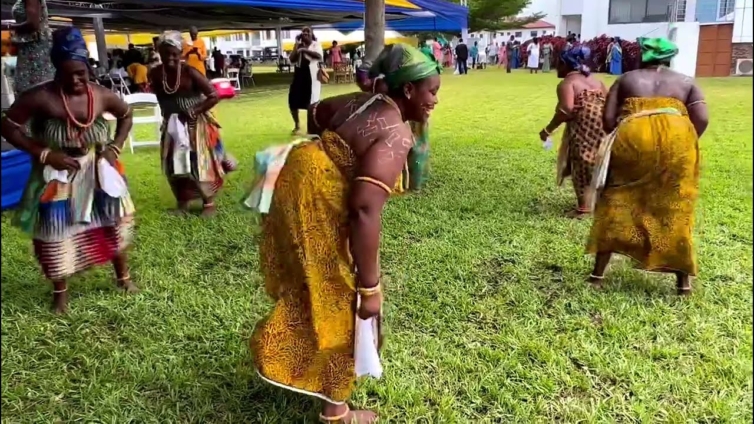
Borborbor is irresistible. It gathers bodies into motion, pulls spectators into participants, and turns communal space into rhythmic dialogue. Its power lies not only in sound and dance, but in instruction, memory, and social commentary carried through drums that speak as clearly as any human voice. Yet for all its popularity, the story of Borborbor’s beginnings has been simplified, smoothed, and, over time,e detached from its earliest creative ground. To understand Borborbor fully, one must look beyond the places that later popularised it and return to where its rhythmic intelligence first cohered. That place is Wusuta, in today’s North Dayi District of the Volta Region.
This is not an attempt to diminish Kpando’s undeniable role in spreading Borborbor across Eweland and beyond. Rather, it is a call to restore sequence, proportion, and historical accuracy. Long before Borborbor became a district-wide and later regional phenomenon, Wusuta stood as a vibrant cultural hub, surrounded by expansive farming communities, dense social networks, and sustained youth musical activity. Before the disruption of the Akosombo Dam, Wusuta’s geography and economy placed it at the crossroads of movement, interaction, and creativity. It was precisely these conditions that allowed older recreational and social music forms to flourish, mutate, and eventually reorganise into what would later be recognised as Borborbor.
At its core, Borborbor did not emerge from a vacuum. It evolved from earlier Ewe musical traditions, most notably Tuidzi, Gbolo, and Akpese. These were not merely dances; they were systems of social instruction, youthful expression, satire, and communal bonding. Their rhythms carried coded meanings, their movements instructed the body, and their drum texts communicated moral advice, humour, caution, and desire. Borborbor inherited this entire expressive vocabulary. What it did was to reframe it, streamline it, and present it in a form that could travel further, last longer, and accommodate new influences without losing its internal logic.
This continuity becomes especially clear when one listens closely to the drums. Those who actually know how to play these instruments will tell you something fundamental. While Borborbor songs and choral lyrics have changed over time to reflect new events, new language, and new sensibilities, the underlying drum patterns have remained remarkably stable. The beats driving Borborbor today are, in many cases, the same rhythmic structures drawn directly from Tuidzi and Gbolo. The lyrics have evolved, but the drums have remembered. This is why older drum texts still sit comfortably within contemporary Borborbor performances. The master drum, the ʋugã, does not invent these rhythms from nothing. It reactivates them, introduces variations, and cues dancers and singers through call and response, functioning much like a talking drum. The survival of these beats is living evidence that Borborborreorganised an existing musical language rather than replacing it.
A classic example of such drum-text, often misunderstood as song lyrics, is rendered correctly in Ewe as “Zɛnkpe doɖa, bɔbɔ dedzi; zãdo na le hɔtru.” This is not sung by the chorus. It is spoken by the drum. Interpreted plainly, it means, “Bend low and stick your buttocks out; when it is night, hold fast to the door.” The phrase instructs dance posture and movement while simultaneously invoking social caution and youthful vigilance. Such earthy didacticism is characteristic of Tuidzi and Gbolo, genres associated with exuberance, courtship, and moral instruction. Their presence inside Borborbor rhythms confirms inheritance, not coincidence.
The question then arises: how did Kpando come to dominate the Borborbor narrative? The answer lies less in invention and more in visibility. The then Kpando District stretched across a wide swathe of Eweland, incorporating many communities, including Wusuta. Over time, administrative naming, population concentration, and political prominence allowed Kpando to become the shorthand reference point for developments that were in fact distributed across the district. When Borborbor gained momentum, it was natural for the name of the district capital to eclipse smaller but earlier creative sites. This was not malice. It was structural absorption.
Francis Kɔdzo Nuatrɔ’s role must also be situated accurately within this broader continuum. Nuatrɔ, a member of the Police Band, played a critical role in popularising Borborbor during the Nkrumah era, particularly through public performances, state functions, and national exposure. His background in the Kokomba or Konkoma tradition and his engagement with brass band culture allowed Borborbor to incorporate elements of parade, spectacle, and later wind instrumentation. Nkrumah’s cultural nationalism provided the political climate in which such hybrid forms could travel widely and be celebrated as modern Ghanaian expression. Yet popularisation is not the same as origination. Nuatrɔ’s contribution sits atop an already existing rhythmic and social foundation, one that communities like Wusuta had long cultivated.
This pattern of historical absorption is not unique to Borborbor. Cultural history repeatedly shows how communities with greater commercial reach and institutional visibility come to dominate narratives that began elsewhere. A contemporary parallel can be seen in the Afrobeats debate, where global branding has reignited questions about the foundational role of Highlife and earlier Ghanaian musical forms. What began as layered exchange and mutual influence has gradually been simplified into a single national story, producing tension where nuance once existed. Borborbor’s historiography reflects a similar process. As larger towns and administrative centres became reference points, earlier creative sites such as Wusuta were folded into broader regional identities, not because they lacked originality, but because they lacked the power to project it outward.
If one wants to encounter Borborbor in its most unfiltered form, stripped of excessive ornamentation and returned to its rhythmic core, one should go to Wusuta. There, the dance still breathes with the logic of Tuidzi, Gbolo, and Akpese. There, the drums still speak before the chorus responds. There, Borborbor reveals itself not merely as entertainment, but as an archive of movement, memory, and meaning.
Restoring Wusuta to the Borborbor story is not an act of rivalry. It is an act of historical repair. It reminds us that culture is cumulative, that popularity often follows invention at a distance, and that the smallest communities can carry the deepest roots. Before Borborbor became a regional emblem, before it marched with bands and echoed through state ceremonies, it lived in places like Wusuta, where rhythm came first, and the body learned before the name travelled.
Latest Stories
-
Power restoration fault suspected in Kumasi Central Market fire
4 hours -
The 7-foot giant of Ngleshie Amanfro: Seven-foot Ghanaian Ephraim Saawa dreams of joining the national basketball team
5 hours -
Government promises support for Kumasi Central Market fire victims
5 hours -
Vibes The Movie: Big Ghun’s Ghanaian film earns five nominations at 2026 REFFA
5 hours -
MamaCare CEO warns unresolved conflicts among health workers could undermine maternal and neonatal care
6 hours -
Health professionals urged to translate medical knowledge into practice to save mothers
6 hours -
Conflicts among care providers linked to maternal, neonatal deaths – Expert
7 hours -
GIS marks 10th TIME conference, champions improved teaching practices
7 hours -
BRICS Or Balance? What Ghana’s bid really means
8 hours -
GPRTU wants full TRAFFITECH-GH implementation to start in 2027
8 hours -
How 10-mile walks for basic education birthed a 50-year legal career for Justice Korbieh
8 hours -
Mahama announces plans to import electric wheelchairs for PWDs
8 hours -
KGL U17 Colts 2026: Western beat Prempeh Elite Academy to set up final final with Greater Accra Region
9 hours -
Late Solanke strike salvages 10-man Spurs draw at Man United
9 hours -
Gender Ministry to monitor welfare of Nana Akua Addo’s children amid domestic violence case
9 hours