

Audio By Carbonatix
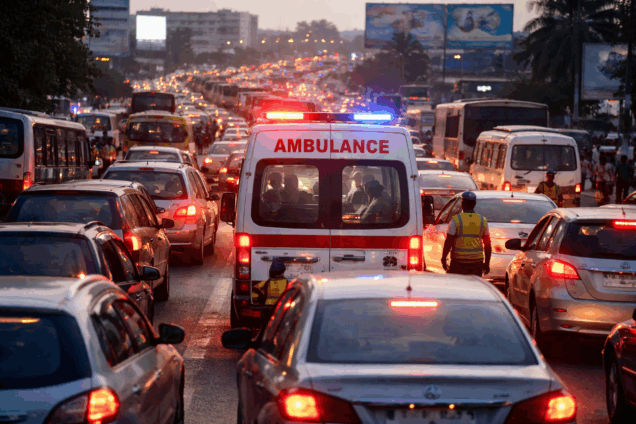
Listening to my Bishop recount his ordeal trapped in the now familiar Accra traffic while desperately trying to reach a hospital was deeply unsettling. It was not just a testimony; it was a warning. A warning that we must stop allowing ourselves to be bullied into normalising dysfunction.
Our cities are choking. Congestion is no longer a nuisance; it is a public safety emergency. When traffic stands still, lives are lost. Emergency response time is often the difference between survival and tragedy, and in our cities, that difference is too frequently decided by gridlock.
Improving emergency response efficiency must therefore be treated as a national urban policy priority. While technological innovations offer opportunities for smarter coordination, a dangerous gap persists between research, policy, and on-the-ground implementation. Dedicated emergency infrastructure remains absent, mainly, despite overwhelming evidence of its life-saving potential.
This is no longer an academic debate. Policy must now respond decisively. We need:
- Legally protected and enforceable emergency lanes on major urban corridors;
- Clear national and metropolitan standards for emergency access in road design, traffic management, and urban redevelopment;
- Institutional coordination among transport authorities, emergency services, metropolitan assemblies, and enforcement agencies;
- Targeted investment in context-appropriate intelligent transport systems that prioritise emergency vehicles; and
- Strict enforcement and public education, so emergency access is respected, not negotiated.
Our transportation engineers, planners, and scholars must work hand in hand with policymakers to deliver solutions that are practical, scalable, and grounded in our realities. Research must move beyond publications into pilot projects, regulations, and implemented systems.
Above all, we must act with urgency. Every delay carries a human cost. Avoidable deaths on our roads and in our traffic must no longer be accepted as inevitable. This is a matter of policy, planning, and political will.
It is too much and far too scary to ignore.
Emmanuel Adinyira (PhD)
Professor and Dean
Faculty of Built Environment
KNUST
Latest Stories
-
Gold edges lower with focus on Fed minutes, rate path clues
57 minutes -
Oil prices rise as storms and air strikes threaten supply
1 hour -
Nigeria nears 2,000 repatriations from South Africa after latest evacuation flight
1 hour -
‘I never gave up’ – Abanga Fusani reflects on journey to NPP Youth Organiser victory
2 hours -
World Bank maintains Ghana’s growth rate forecast at 4.8% in 2026
2 hours -
Cedi was worst African currency in quarter 2, 2026 – World Bank
2 hours -
US death row inmate Christa Pike awake and speaking after failed execution, lawyers say
2 hours -
AI gains can lift three times as many people out of poverty in Ghana – World Bank
3 hours -
Scammers target ECG customers with fake meter sales and MoMo payment calls
4 hours -
Abanga Fusani credits hard work and consistency for NPP Youth Organiser victory
4 hours -
We did not take security issues seriously – Abanga Fusani reflects on NPP’s 2024 election loss
5 hours -
Nigeria’s Dangote refinery aims to draw more retail investors than Aramco IPO, CEO says
5 hours -
Banker in court for allegedly stealing GH¢1 million
5 hours -
Police arrest suspect over jewellery theft during fire outbreak
5 hours -
EOCO returns Hanan’s £6,700, GH¢2,750 and devices after defence challenge
5 hours