

Audio By Carbonatix
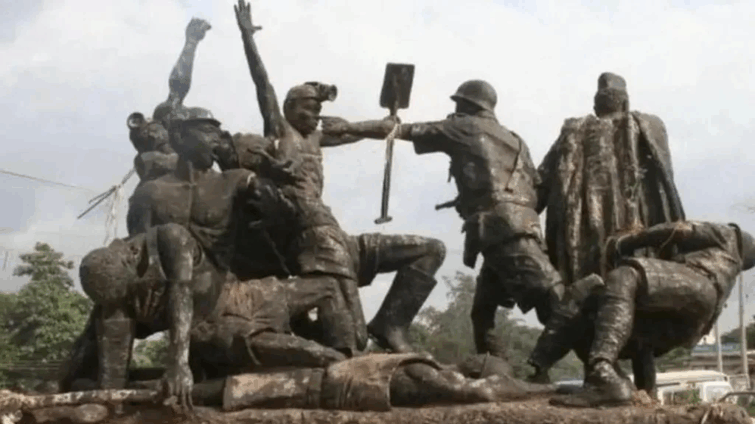
A Nigerian court has ordered the British government to pay $27m (£20m) to each of the families of 21 coal miners killed in 1949 by the colonial administration in the south-east of the country.
The colonial police, made up of Nigerians and Europeans, shot dead workers striking for better conditions. Dozens more were injured in what the state-run News Agency of Nigeria described as one of the most notorious acts of repression under British rule in Nigeria.
Historians say the killing helped galvanise support for the burgeoning anti-colonial movement that led to independence 11 years later, in 1960.
The BBC has asked the British Foreign Office for comment.
Families and rights groups have led a decades-long campaign for official acknowledgment and compensation.
The ruling, delivered by Justice Anthony Onovo in Enugu, described the massacre as unlawful and extrajudicial violation of the right to life, NAN reports.
According to him, the British government must be held accountable and must make reparations to the victims' families.
"These defenceless coal miners were asking for improved work conditions, they were not embarking on any violent action against the authorities, but yet were shot and killed," Onovo told the Enugu High Court.
The workers at the Iva Valley coal mine were protesting against harsh working conditions, racial disparities in wages and unpaid back wages.
When their demands were not met, they adopted a "go-slow" protest and occupied the mine to prevent management from locking them out, NAN reports.
The suit was brought by human rights activist, Mazi Greg Onoh, who listed the British and Nigerian governments as respondents.
"This ruling represents a significant milestone in the pursuit of historical accountability and justice for colonial-era violations, affirming that the right to life transcends time, borders, and changes in sovereignty," said the applicants' lawyer, Prof Yemi Akinseye-George.
The killings took place on 18 November 1949 in Enugu, which was the administrative capital of the Eastern Region of British-administered Nigeria at the time.
Historian Damola Adebowale told the BBC it was a "trigger-point" for the independence movement.
"Calls for independence already exist[ed] and talks [were] ongoing. The massacre was a reference point for people outlining the need for the colonialists to go," he said.
During an official investigation at the time, the police defended the shootings by saying they feared being overwhelmed.
But among those that the inquiry blamed were the colonialists in charge of the police for inflaming the situation.
Those killed are now celebrated in the region as heroes.
Latest Stories
-
SEC to develop Social Bond Guidelines; over half of listed firms report on ESG indicators
6 minutes -
Insurance firms have up till January 2027 to incorporate ESG in financial reporting
11 minutes -
High Court throws out Afenyo-Markin’s GH¢15m defamation suit against Sammy Gyamfi
22 minutes -
Rollover cost of T-bills reduced substantially, one-year bill yield drops 19% since December 2024
22 minutes -
Daily Insight for CEOs: Preparing for 2027 Board and Executive Conversations
45 minutes -
World Cup Visa Scandal: There is no ‘justification’ to dismiss me – Kofi Adams
56 minutes -
2028 Olympic Games qualification ‘really tough’ – Black Queens coach Björkegren
1 hour -
GRFU, GOC Women’s Commission hold breast cancer awareness, expresses gratitude to Sunda International Ghana
1 hour -
COCOBOD raises GH¢3.4bn as Cocoa Capital PLC lists inaugural commercial paper on GFIM
2 hours -
No Party Card, just a Party Microphone! A Ghanaian story of Elections, Referees and Convenient Amnesia
2 hours -
Minority welcomes suspension of teachers’ strike, demands timely payment of promotion arrears
2 hours -
Customary ownership accounts for 80% of land; it complicates land administration – Lands Commission
2 hours -
NRSA to auction vehicles of non-subscribers who fail to pay towing charges within 21 days
2 hours -
WAFU B U17: Black Starlets target AFCON slot after booking semi-final place
2 hours -
Ghana faces $6.1bn debt-service burden from 2027 to 2029 due to Akufo-Addo’s DDEP – Haruna Iddrisu
2 hours