

Audio By Carbonatix
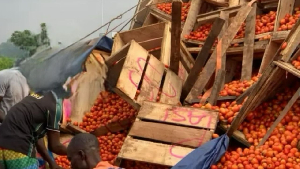
The Peasant Farmers Association of Ghana (PFAG) has condemned the tragic killing of Ghanaian tomato traders in Burkina Faso, describing the incident as a stark warning that exposes the country's vulnerability to food imports and the urgent need to achieve self-sufficiency in vegetable production.
In a press statement issued on February 18, 2026, the Association expressed profound sorrow over the deaths while using the moment to draw attention to what it calls a national security and economic sovereignty crisis.
According to PFAG, Ghana currently spends over $22.3 million on tomato imports annually, with more than 90 per cent coming from Burkina Faso.
The numbers paint a troubling reality. Ghana's annual tomato consumption stands at approximately 800,000 metric tonnes, yet domestic production languishes between 370,000 and 420,000 metric tonnes. This deficit, PFAG argues, is not an act of nature but a failure of policy and prioritisation.
"This is not merely a supply chain issue; it is a national security and economic sovereignty issue," the statement read. "While the catalyst is unfortunate, it serves as a stark and urgent wake-up call for the nation to fundamentally reassess our agricultural trajectory."
The Association noted that despite possessing the climate, arable land, and human resource potential to become a net exporter in West Africa, Ghana remains the 43rd largest importer of tomatoes globally.
PFAG attributed the chronic production shortfall to several interconnected challenges. Farmers remain overly dependent on rain-fed agriculture due to grossly inadequate irrigation facilities, leaving production vulnerable to climate change. Average yields currently stand at a dismal 7.5 metric tonnes per hectare, far below the potential 20 metric tonnes.
The post-harvest catastrophe is equally devastating, with 30 to 50 per cent of harvests lost after cultivation due to poor storage, lack of processing facilities, and deplorable road networks connecting farming communities to market centres.
"The nation watches helplessly as this post-harvest waste represents a crushing blow to farmers' incomes, traders' livelihoods, and national food security," PFAG stated.
Beyond the tomato sector, the Association raised alarm about growing despair among grain and tuber farmers who are currently counting staggering losses from a recent market glut. Rice, maize, soya, yam, and cassava farmers reportedly have produce still sitting on fields or rotting in warehouses, with no buyers in sight.
"The appetite to cultivate for the upcoming planting season is very low," PFAG revealed. "Their plight is a national emergency in its own right."
The group implored the government to immediately activate direct purchases and strategic storage to provide relief, warning that farmers' resilience has been stretched to breaking point.
Despite the grim assessment, PFAG expressed confidence that with decisive interventions, Ghana can drastically reduce vegetable imports by 2030 and achieve complete self-sufficiency in tomato production by 2036.
The Association proposed a five-point plan including a radical shift in irrigation development with completion of the Pwalugu Multi-Purpose Dam, establishment of strategic agricultural enclaves with essential infrastructure, reduction of production costs through support for research institutions and fertiliser pricing reviews, and a declared war on post-harvest losses.
"The government must view these interventions not as favours to farmers, but as critical investments in the nation's future," PFAG emphasised.
The call comes just days after the Chamber of Agribusiness Ghana (CAG) unveiled a National Tomato Production Strategy (2026–2030) requiring an estimated GH¢3.2 billion investment. That strategy aims to create 200,000 jobs and reduce tomato paste imports from over $100 million annually to $20 million by 2030.
Anthony Morrison, CEO of CAG, had earlier described the sector's inefficiencies as "devastating," noting that Ghana loses approximately GH¢5.7 billion annually—about 1.2 per cent of GDP—due to import dependence and post-harvest losses.
"We're not just losing money; we're losing an entire generation's employment opportunities," Morrison said at the strategy launch on February 16. "The recent security incident involving Ghanaian tomato traders is a wake-up call."
Latest Stories
-
Peace, security practitioners tasked to deepen stakeholder collaboration
2 minutes -
Public pay system must balance fair wages with fiscal sustainability – Government
7 minutes -
Niharika Handa makes history as King Faisal’s first female Board Chair
10 minutes -
Gov’t disburses GH¢23.1bn to clear road contractors’ arrears – Roads Minister
14 minutes -
Massive crowd turns out for Brock Royal Family’s Osu Duku Walk
15 minutes -
Aboboyaa Group donates two motorcycles to NACOC Ashanti Command
20 minutes -
Sexual harassment has no place in educational institutions – Education Ministry
27 minutes -
Rev Prof Amevenku elected 15th EPCG Moderator, pledges servant leadership
33 minutes -
Military leaders urged to prepare for emerging security threats
38 minutes -
Ghana to expand pharmaceutical manufacturing capacity – Mahama
44 minutes -
Ghana to hold referendum on proposed constitutional amendments in 2027 – Mahama
51 minutes -
Social clubs must become engines of national development – Ace Ankomah
57 minutes -
GTA closes Elmina Beach Resort, three other facilities over regulatory violations
1 hour -
Sustained peace will restore Bawku to its former glory – Mahama
1 hour -
15% of maternal mortality deaths in Kumasi are ‘imported’- Health Director
1 hour