

Audio By Carbonatix
Ghana’s licensed cocoa buyers owe banks as much as $750 million, the association that represents them said, leaving the financial sector starved of cash for bean purchases at a time when lenders are straining to recover from the country's deepest economic crisis in a generation.
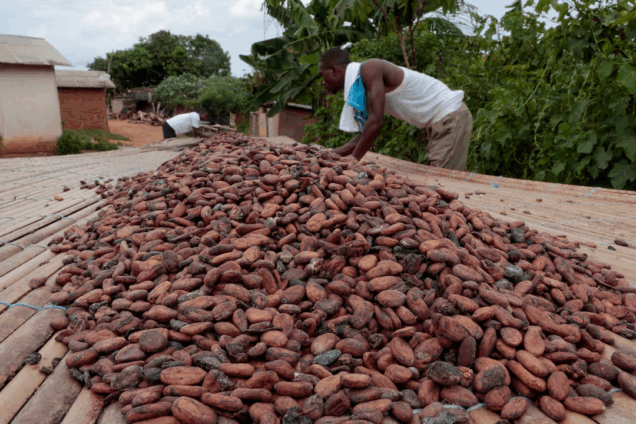
The cocoa sector in Ghana, the world’s second largest producer, has suffered two consecutive poor harvests due to crop disease and inclement weather.
Globally, cocoa prices have collapsed due to weak demand, leaving an abundance of unused supply in Ghana and neighbouring Ivory Coast, which together produce half of the world's cocoa.
London cocoa futures fell to near a three-year low on Tuesday.
Samuel Adimado, president of the Licensed Cocoa Buyers Association of Ghana, said debts were accumulating because Cocobod, the country's cocoa regulator, has been spending more on non-core activities like road construction. As a result, buyers have taken out bank loans to pre-finance bean purchases.
In all, buyers owe banks around 7 billion to 8 billion cedis ($650 million to $750 million), and 2.2 billion to 2.5 billion cedis to farmers, he told Reuters. "Interest keeps piling up," he said.
Ghana's government has taken steps this month to boost demand, including slashing the fixed price it pays for bean purchases and announcing plans for a cocoa financing scheme to raise funds, which buyers hope will provide badly needed cash.
Cocoa buyers delivered around 580,000 metric tons to Cocobod this season but are still awaiting payment, while 70,000 metric tons of beans are still in the field, Adimado said. The reduced cocoa producer price will apply to around 100,000 metric tons of cocoa.
Cocobod has said it is working with the government to address its strained finances.
BANKING SYSTEM UNDER STRAIN
The Ghana Association of Banks (GAB) confirmed that lenders across the cocoa sector are exposed to the accumulating debts.
Association CEO John Awuah declined to provide a total but said the growing figures had forced some loan restructurings and may result in losses.
Ghana’s banks are still recovering from the government's decision in 2023 to restructure nearly all domestic bonds under the Domestic Debt Exchange Programme (DDEP), an exercise that nearly wiped out capital cushions, forced recapitalisations and triggered record losses.
The exercise saw Cocobod’s short-term cocoa bills — used to finance annual bean purchases — forcibly converted into longer-dated bonds with lower coupon rates.
Awuah said the system appears resilient but requires careful management to remain in compliance with Ghana's International Monetary Fund programme.
Latest Stories
-
MTN set to deploy 5G services after winning spectrum licenses worth US$202m
27 minutes -
NPP national elections: 3,000–4,000 police to handle security, traffic in Kumasi – Karbo
3 hours -
Atta Akyea fumes as Manhyia MP is to spend another night in EOCO custody
3 hours -
SSNIT says La Beach clearance was to protect hotel investments, beaches to remain public
4 hours -
APSU congratulates St Augustine’s College after back-to-back National Investment Quiz wins
4 hours -
Renewed flood intervention at Mallam Junction raises hopes among residents, businesses
5 hours -
St Augustine’s College retain National Investment Quiz title after nail-biting grand finale
5 hours -
Education infrastructure investment will drive Banda’s development – Ahmed Ibrahim
5 hours -
Teacher unions strike: Gov’t presents fresh proposals as talks end inconclusively
6 hours -
51,000 teachers’ promotion arrears to be validated for October payment – Education Minister
6 hours -
Kwabena Boamah appointed Board Chair for Impact Investing Ghana
6 hours -
Striking teacher unions to meet Fair Wages and Salaries Commission on October 6
6 hours -
EOCO working with AG to arraign Nana Baffour Awuah before weekend court
6 hours -
Duraplast reassures customers after fire, announces October 5 reopening
7 hours -
Call off strike, gov’t will not renege on promotion arrears pledge – Haruna Iddrisu to teacher unions
7 hours