


Audio By Carbonatix
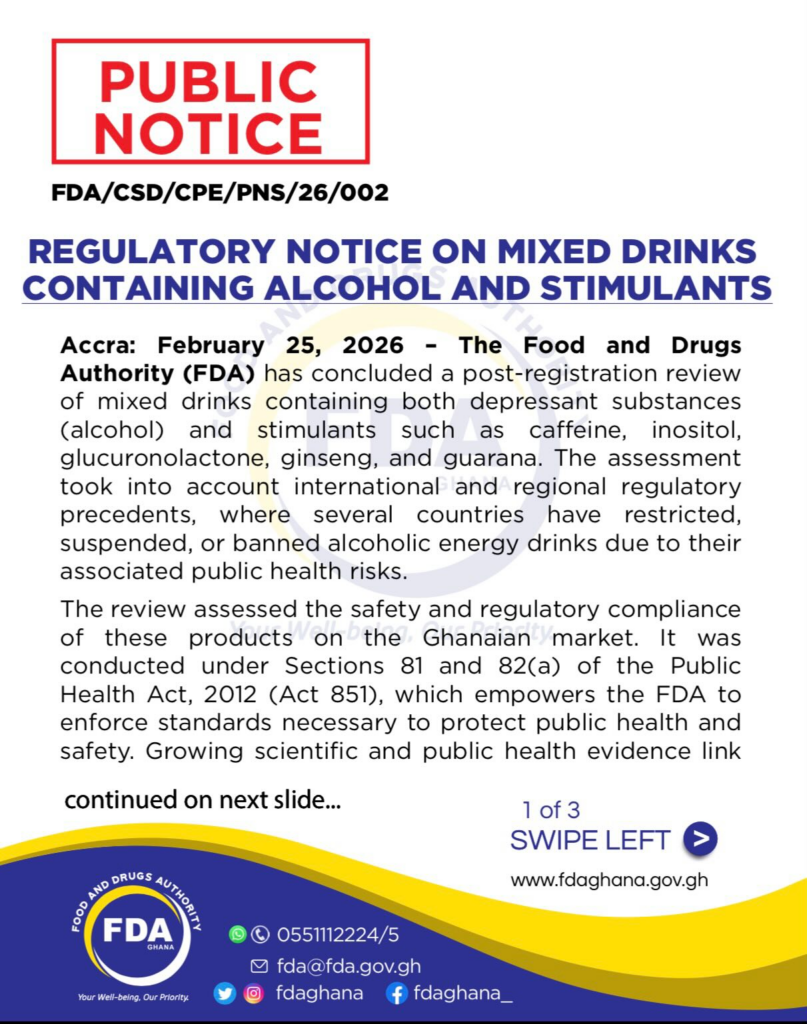
The Food and Drugs Authority (FDA) has directed all importers, manufacturers and distributors of alcoholic energy drinks to remove such products from the Ghanaian market by the end of March 2026.
The decision follows a regulatory review, which the Authority says identified significant public health risks linked to the drinks.
In a public notice issued on February 25, the FDA said its post-registration review focused on mixed drinks containing alcohol and stimulants such as caffeine, inositol, glucuronolactone, ginseng, and guarana.
The review was conducted under Sections 81 and 82(a) of the Public Health Act, 2012 (Act 851), which gives the Authority the power to enforce standards to protect public health and safety.
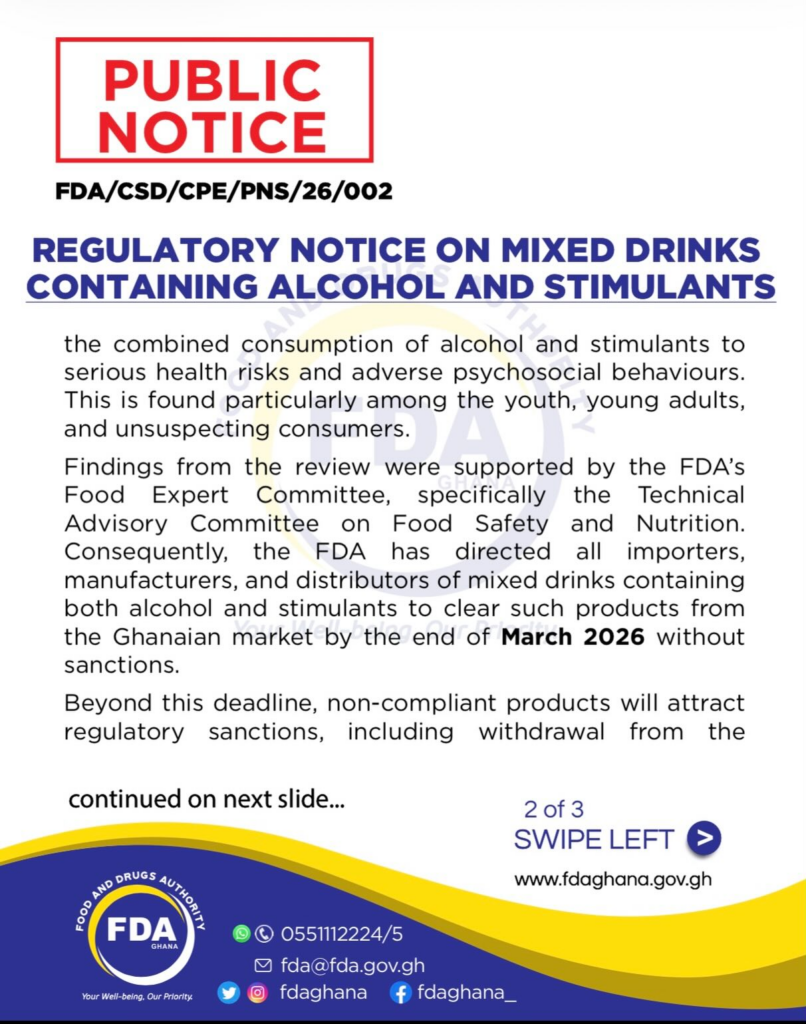
According to the FDA, growing scientific evidence shows that combining alcohol with stimulants can lead to serious health risks and harmful psychosocial behaviour, especially among young people and unsuspecting consumers.
The findings were validated by the FDA’s Food Expert Committee, including its Technical Advisory Committee on Food Safety and Nutrition.
As part of the directive, companies have been given up to the end of March 2026 to voluntarily clear affected products from the market without facing penalties.
“Consequently, the FDA has directed all importers, manufacturers, and distributors of mixed drinks containing both alcohol and stimulants to clear such products from the Ghanaian market by the end of March 2026 without sanctions,” the Authority stated.
However, the FDA warned that any products that remain on sale after the deadline will face strict action.
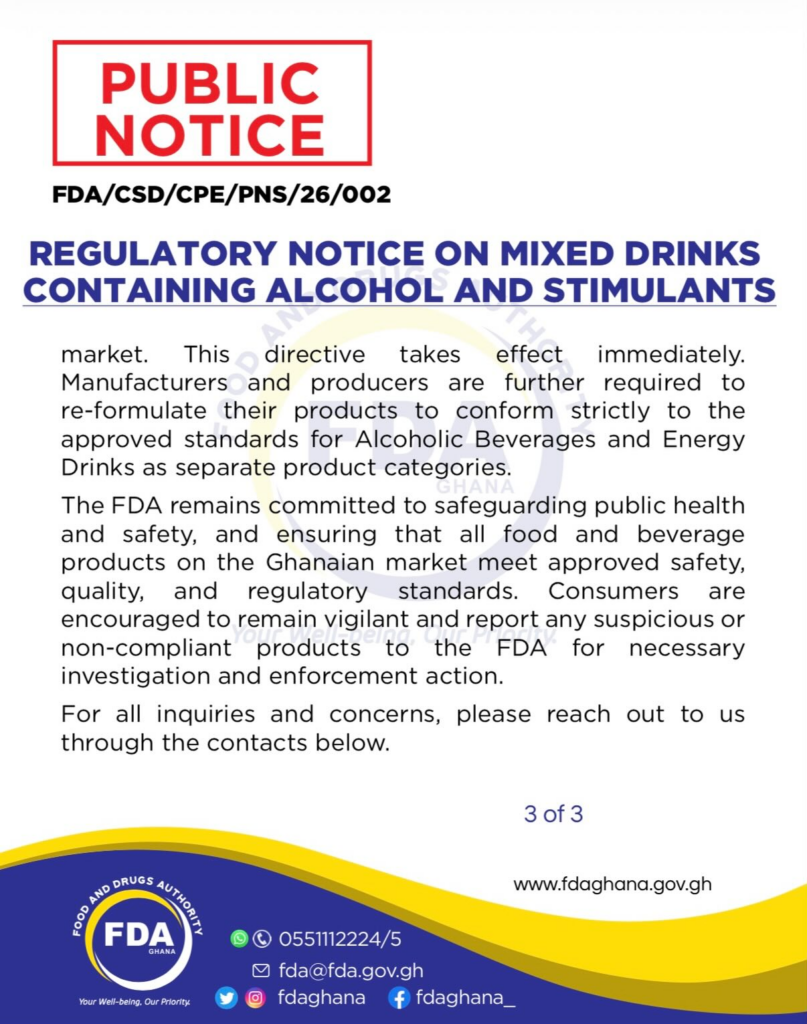
“Beyond this deadline, non-compliant products will attract regulatory sanctions, including withdrawal from the market,” the FDA cautioned.
The Authority also instructed manufacturers to reformulate their products to meet approved standards by separating alcoholic beverages and energy drinks into distinct product categories.
The FDA reaffirmed its commitment to protecting public health and ensuring that all food and beverage products sold in Ghana meet the required safety and quality standards.
It urged consumers to remain vigilant and report any suspicious or non-compliant products to support enforcement efforts.
Latest Stories
-
Challenging Heights rescues 25 trafficked children from Lake Volta in weekend operation
10 minutes -
‘Nobody has any video of me embarrassing myself’ – Afenyo-Markin on ‘extortion’ allegation
16 minutes -
Government listening to ordinary Ghanaians with diesel relief – Duncan Amoah
17 minutes -
Photos: Manya Krobo Ngmayem Festival turns 133
28 minutes -
Government must go beyond short-term fuel relief – COPEC
28 minutes -
‘Revive traditional values to fight plastic pollution’ – EPA CEO
32 minutes -
Mahama’s administration is Ghana’s worst ever – Amin Adam
41 minutes -
BSIFF 2026 puts local language cinema at the centre of African film conversation
46 minutes -
MMFL makes strong showing at 2026 JoySports Invitational
48 minutes -
NPP vetting was candid and went beyond routine questions – Afoko
48 minutes -
CIIG 6th Insurance Excellence Awards highlights need to protect professional standards
54 minutes -
GEXIM Bank’s interest income surges 90% to GH¢153.9m – SIGA report
55 minutes -
GNFS rescues man trapped beneath loaded truck after it overturns at Kibi
56 minutes -
African Union backs Sudanese-led dialogue to end conflict
57 minutes -
VRA reverses GH¢106m loss to record GH¢88m profit in 2025
59 minutes