

Audio By Carbonatix
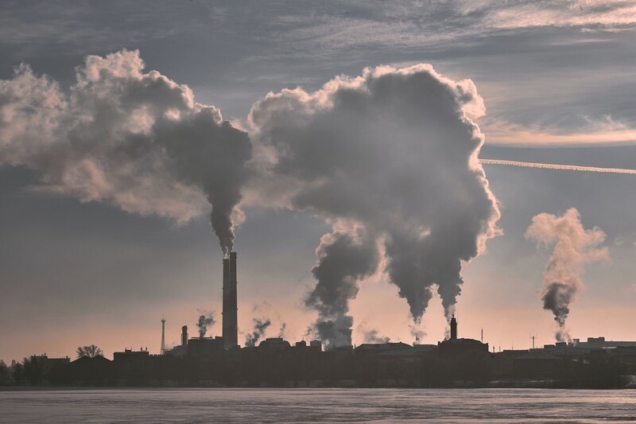
Ghana’s Environmental Protection Authority (EPA) has intensified surveillance of industrial facilities across the country, introducing a real-time monitoring system aimed at cutting emissions and improving compliance with environmental standards.
The following mounting evidence suggests that air pollution remains one of Ghana’s most pressing public health threats. In 2019, the country’s annual average concentration of fine particulate matter (PM2.5) was 11 times higher than the World Health Organisation’s 2021 recommended guideline. Air pollution is now ranked as the second-highest health risk factor for death and disability in Ghana.
According to Selina Amoah, Director of Air Quality at the EPA, industrial activities remain a major contributor to pollution levels.
“Yes, the sources of air pollution in the country have been identified first from industrial activities,” she said in an interview. “Industrial activities making reference to both the formal and the informal industrial activities.”
She explained that emissions come from a wide range of operations: “If you take the cement industry, for instance, because it is gravel that they are grinding, the grinding of the gravel itself generates emissions.” She added that wood processing industries, boiler operations, generator sets, forklifts, spraying in metal fabrication and carpentry shops, and even small-scale food processors using firewood all release pollutants into the air.
Under Ghana’s updated Environmental Assessment Regulations, LI-2504, industries are required to obtain environmental permits and comply with strict conditions, including emissions monitoring.
“As part of the permit conditions, they are required to conduct monitoring,” Amoah noted. “You may have the system in place. How do you know whether the system is working or is not working? It is only the data that can tell.”
However, she acknowledged that previous monitoring systems had limitations. “The results that we get from industry is mostly passive,” she said. “Passive, I mean that by the time they bring the results to us, the pollution episode would have passed.”
To address this gap, the EPA has introduced the Ghana Online Continuous Emission Monitoring System (GOCEMS), which enables real-time tracking of emissions from industrial stacks.
“This is a real-time monitoring from industrial operations,” Amoah explained. “And that gives the pollution levels as and when the activity is going on.”
The system allows regulators to detect spikes instantly and intervene quickly. “When you look at the results, and then you see the spikes, you can quickly check what is causing the pollution level,” she said, adding that timely mitigation measures can then be enforced.
Industry accounts for an estimated 11 per cent of air pollution in Accra, alongside emissions from road transport, open waste burning, biomass cooking, and energy generation. A World Bank report estimated that environmental degradation cost Ghana US$6.3 billion in 2017, about 11 per cent of GDP, with air pollution alone accounting for over US$2.4 billion.
Although Ghana is one of only seven African countries with real-time air quality monitors, access to comprehensive data has remained limited. EPA officials believe GOCEMS marks a significant shift toward transparency, accountability, and proactive enforcement — a critical step in reducing industrial emissions and protecting public health.
This story was a collaboration with New Narratives. Funding was provided by the Clean Air Fund, which had no say in the story’s content.
Latest Stories
-
UMB S.P.E.E.D. Stars lift Bankers Football Gala trophy
3 minutes -
MMFL makes strong showing at JoySports Invitational 2026
19 minutes -
MTN Media Republic, Ghana Wildlife Society embark on bird, butterfly walk
25 minutes -
Fuel Prices: Star Oil holds petrol at GH¢14.97, raises diesel to GH¢16.97
32 minutes -
DR Congo Ebola outbreak surges past 6000 cases as death toll nears 3000
39 minutes -
Telecel Ghana CEO urges mining industry to build agile people for tech-driven future
42 minutes -
Ghana Digital Centres’ loss nearly triples to GH¢6.06m as revenue falls
43 minutes -
The private school teacher crisis: A silent exodus
45 minutes -
NPC Ghana congratulates Farida Iddriss on Africa Aquatics Zone II leadership role
45 minutes -
Zanetor pledges to protect Ghana’s natural resources for future generations
47 minutes -
2024 defeat was due to demoralised base, poor preparation – Boakye Agyarko
51 minutes -
Ghana welcomes UN report backing reparations for transatlantic slavery
53 minutes -
Fidelity Bank convenes debt capital markets conference to turn Ghana’s recovery into long-term growth
53 minutes -
RTI Commission marks 2026 RTI month with focus on information integrity in digital age
55 minutes -
GoldBod now owns all the risk: What the Bank of Ghana’s exit from the Gold Programme really means
1 hour