

Audio By Carbonatix
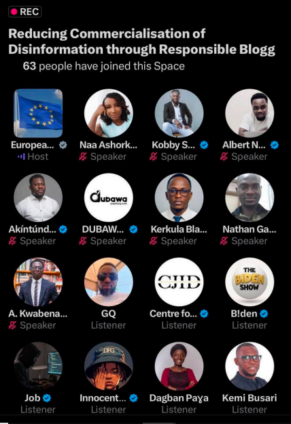
A tense but necessary conversation about truth, profit, and responsibility unfolded across West Africa’s digital space on Friday (27 February) evening as media practitioners, bloggers, and policy actors gathered for a regional webinar organised by Centre for Journalism Innovation and Development (CJID), DUBAWA, and the European Union (EU).
With over 900 people in attendance, the virtual forum, themed “Reducing Commercialisation of Disinformation through Responsible Blogging and Content Creation”, came at a moment when digital falsehoods are no longer treated as mere online nuisances but as threats to democracy, public safety, and national security.
Yet even before the first speaker logged on, the event had already ignited controversy.
At the centre of the public backlash was the inclusion of Ghanaian blogger, Nat Hyde, widely known as Bongo Ideas, whose provocative online style has often drawn accusations of Sensationalism.
Petitions circulated on social media urging organisers to drop him, who many argue is a habitual disinformer and thus the wrong person to speak on the topic of disinformation.
Rather than avoid the backlash, the organisers’ solution was to proceed with the objective firmly in mind, which was to have a conversation with a carefully selected panel.
Deputy EU Ambassador Jonas Claes opened the session by acknowledging what he called “the elephant in the room.”
He stressed that the purpose of the forum was not to reward personalities but to create space for uncomfortable yet necessary dialogue.
“We do not organise a panel like this as a reward or to showcase individual bloggers,” he
said.
“We adhere to an open debate culture involving differing, dissenting, sometimes even
uncomfortable opinions. I learn the most from those.”
He framed the passionate public response as evidence of Ghana’s democratic maturity and of the sensitivity and consequences of the monetisation of disinformation.
Guiding the conversation was broadcaster and journalist Naa Ashorkor, who reminded participants that the ethical tension between speed and responsibility predates social media.
From her journalism training, she recalled, sensational headlines may sell quickly but can permanently damage lives.
Defining the business of disinformation
The next segment grounded the discussion in research and evidence.
Maxine Danso, International Expansion Lead at CJID, broke down what experts describe as the commercialisation of disinformation: the deliberate production of misleading or false content designed primarily to generate engagement and revenue.
She explained that modern digital platforms reward virality above accuracy. The more clicks, shares, and reactions a post attracts, the more money it can generate.
This incentive structure, she said, has created an economy where outrage and fabrication often outperform careful reporting.
Her examples ranged from clickbait headlines and sensational distortions to misinformation, the malicious release of private but genuine information, and the growing use of artificial intelligence to create deepfakes that mimic faces and voices.
These tactics, she noted, follow recognisable behavioural patterns that researchers use to identify intentional harm.
Backed by a global context, legal practitioner and DUBAWA researcher, Austin Brako-Powers, pointed to international risk assessments that now rank disinformation among the most serious global threats.
When falsehoods are amplified for profit, he argued, citizens lose the ability to distinguish fact from fiction, a dangerous condition for any democracy.
But it was the lived experiences of the bloggers themselves that gave the conversation its sharpest edge.
Across West Africa’s fast-moving digital ecosystem, many creators operate without newsrooms, editors, or legal teams.
The pressure to be first to publish can be overwhelming.
Inside the blogging pressure cooker, Liberian blogger Kerkula Blama admitted that this “pressure cooker” environment has often meant sharing information without adequate verification.
“Picking and sharing, picking and sharing,” he described, recalling one incident where
prematurely reporting the death of a well-known figure nearly landed him in jail.
The scare forced him to rethink his workflow and prioritise fact-checking over speed.
Ghanaian content creator Philomena Antonio recounted a similar lesson. After publishing a story from what she believed was a reliable source, she quickly learned it was inaccurate.
She deleted the post and publicly corrected herself, choosing transparency over defensiveness to protect her credibility.
Digital strategist, Kobby Spiky Nkrumah, echoed the risks, noting that rushed posts have triggered legal threats and demands for retractions. Those moments, he said, are stark reminders that online publishing carries real-world consequences.
A dissenting voice
Yet the most anticipated intervention came from Hyde himself.
Addressing his critics directly, he acknowledged his “checkered reputation” but challenged how the term disinformation is often applied.
For him, the key element is intent. False information only becomes disinformation, he argued, when it is deliberately crafted to deceive.
“I don’t think I’ve ever put out something that I know in my heart of hearts is false,” he maintained. While he has sometimes complied with requests to retract posts, he said, he resists constant apologies, believing that excessive backtracking could damage his brand.
His remarks did not erase disagreements, but they underscored the complexity of regulating online speech where personal conviction, public impact, and commercial incentives
intersect.
Toward information integrity
As the discussion drew to a close, the focus shifted from diagnosis to solutions.
Panellists agreed that while disinformation must be curtailed, enforcement should not rely
solely on punitive sanctions that risk suppressing free expression.
Instead, they called for stronger fact-checking habits, transparent corrections, and platform systems that discourage engagement-driven falsehoods.
The forum concluded with participating bloggers and organisers all pledging to promote responsible content creation.
The commitment includes verifying information beforepublication, avoiding sensational or misleading headlines for traffic, promptly retracting inaccurate posts, and issuing public apologies when errors occur.
Speakers said the goal is to reduce the financial incentives that reward viral falsehoods while
strengthening credibility and trust with audiences.
The pledge, organisers noted, is intended as a practical first step toward raising professional standards across West Africa’s fast-growing digital media space, where independent creators now shape public discourse as much as traditional newsrooms.
The event is part of the “See the Pattern" Campaign, launched in January 2026 by the EU and DUBAWA, to strengthen information integrity in Ghana and the West African sub-region.
Latest Stories
-
Reality Zone with Vicky Wireko: International Day of the Girl, shaping today’s girl for tomorrow’s future – ZONTA Clubs lead the way
29 minutes -
Global health must be led by countries, not designed for them – Mintah Akandoh
1 hour -
Mahama honoured at 2026 World Health Summit in Berlin for global health leadership
2 hours -
Breast cancer is not a death sentence – Besease Kontire Obaapanin, Magmina Foundation lead awareness campaign
2 hours -
EcoBank invests in digital education of 4 Garisson School to mark 40 years in Africa
2 hours -
AGI urges investment in skills and raw materials to strengthen local manufacturing
2 hours -
GPL 2026/27: ‘We have to rectify our mistakes’ – Boadu reacts to Aduana FC defeat
2 hours -
No disability access, no building permit – KMA declares
2 hours -
Asantehene to lead environmental restoration effort at Jimi Land Reclamation Site
2 hours -
Poor Ghanaians are being jailed because they cannot afford justice – Crime Check Foundation
2 hours -
No conflict in appointing Emelia Agbenyo as Deputy EC Chair – NDC
2 hours -
87-year-old man jailed 20 years for defiling 9-year-old girl at Ofankor
2 hours -
Sankofa Gold targets 70kg output after 9-month shutdown
2 hours -
Tamale, Bolgatanga had just one Legal Aid lawyer between them – Kwesimintsim MP
3 hours -
PAC orders eviction of former irrigation company MD from official residence
3 hours