

Audio By Carbonatix
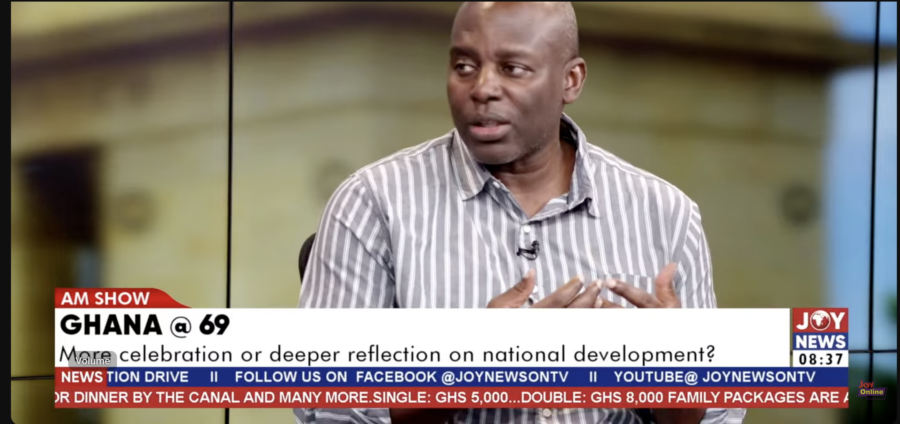
Democracy and development fellow at the Centre for Democratic Development, Ghana (CDD-Ghana), Professor John Osae‑Kwapong, says that Ghana’s democratic journey remains unfinished and must not be taken for granted, despite the country’s record of relatively peaceful elections and transfers of power.
Speaking on the AM Show on Joy News, Prof Osae-Kwapong urged citizens and political leaders to remain vigilant in strengthening democratic institutions as Ghana marks 69 years of independence and 33 years of uninterrupted multi-party governance under the Fourth Republic of Ghana.
According to the governance expert, Ghana’s democratic progress should not lead to complacency.
“Democracy is like searching for that one true love of your life. You don’t try once and stop because you got a broken heart. You have to keep at it and keep trying,” he said.
Prof Osae-Kwapong noted that Ghana has held nine generally successful national elections since the start of the Fourth Republic in 1992, with four peaceful transfers of power between political parties — a record that has often been cited as a sign of democratic maturity in the region.
However, he stressed that these achievements should not create the impression that Ghana’s democratic system has fully matured.
“The one thing I hope we would guard against is that because we’ve had 33 years of uninterrupted multi-party democracy, we don’t become complacent,” he said.
“Because we’ve had nine generally successful elections, four of which have resulted in political party turnover, we don’t rest on our laurels and think this is a done deal — because it’s not.”
His comments come as the country commemorates the anniversary of independence on March 6, marking Ghana’s break from British colonial rule in 1957.
Reflecting on the country’s democratic evolution, he described Ghana’s democratic trajectory as a continuous process that requires reforms and adaptation to new challenges.
He acknowledged that while democracy in Ghana may not have delivered all the expectations of citizens, abandoning it would not be the solution.
Instead, he expressed hope that the country would continue refining its institutions and shaping them to fit Ghana’s unique political and cultural context.
Latest Stories
-
Man City suffer as PSG masterclass sets up Champions League win
31 minutes -
Customer Service Africa CEO urges business leaders to observe staff and customer interactions
41 minutes -
On night of mayhem for Liverpool, Barcola arrives in style
42 minutes -
Muzic Mensah finds healing and renewed love in new single ‘WayƐ Late’
54 minutes -
FIFA to offer extra £2.6bn for football development
56 minutes -
Government backing is no EPA permit – Authority warns GoldBod, ministries
1 hour -
Real Madrid produce stunning late fightback to down Roma
1 hour -
EPA orders immediate halt to unpermitted reclamation and dredging nationwide
1 hour -
Afenyo-Markin’s lawsuit against Sammy Gyamfi takes focus away from development – Kpebu
2 hours -
FWSC urges media to guard against misinformation in proposed IPEC transition
2 hours -
MoMo Fest 2026: Shatta Wale to Rock Accra Stadium on October 17
2 hours -
GTEC’s letter directing public universities to reopen by October 16 is unprofessional – GAUA
2 hours -
Suspect in viral video assaulting wife jailed for 3 months
2 hours -
GAUA insists strike will end only after Fair Wages addresses market premium issue
2 hours -
Kpemka seeks compensation as he sues BOST over alleged unlawful termination
2 hours