

Audio By Carbonatix
Fuel prices may rise again soon, but what if higher prices don’t actually reduce petrol consumption in Ghana?
Discussions about rising global crude oil prices are once again dominating energy market conversations, raising concerns about higher petrol prices and increased transport costs across Ghana.
Yet the relationship between oil prices and petrol consumption may not be as straightforward as many assume. Conventional economic theory suggests that when fuel prices rise, consumers should reduce consumption. However, recent research analyzing Ghana’s petrol market reveals a more complex pattern of behavior.
The study finds that crude oil prices exhibit a positive relationship with petrol consumption, indicating that higher prices do not necessarily suppress demand as standard models predict.
This pattern reflects several structural characteristics of Ghana’s economy.
First, alleged BDC's stockpiling increases the potential for increased purchases(demand) vis a vis consumption as consumers often engage in anticipatory or hoarding behavior when price increases are expected.
Second, global crude oil price increases do not necessarily reduce petrol consumption in Ghana in the short run. Petrol is an essential input for transport, logistics, and small business operations, meaning substitution possibilities are limited. As a result, consumption may remain stable or even increase due to inventory adjustments and expectations of further price hikes
These findings also carry an important methodological implication that Traditional symmetric demand models, which assume that price increases and decreases produce equal but opposite responses in consumption, appear to misrepresent the dynamics of Ghana’s petrol market.
When asymmetric price behavior such as the Rock-and-Feathers effect interacts with structural demand constraints, consumption responses become more complex than standard theory predicts.
Using monthly national data from 2016 to 2024 and applying a nonlinear econometric approach, the study examined how crude oil prices, exchange rates, inflation, and domestic fuel taxes affect petrol consumption.
The findings show that petrol consumption in Ghana responds asymmetrically to price changes. In practical terms, this means that price increases and price decreases do not affect consumption in the same way.
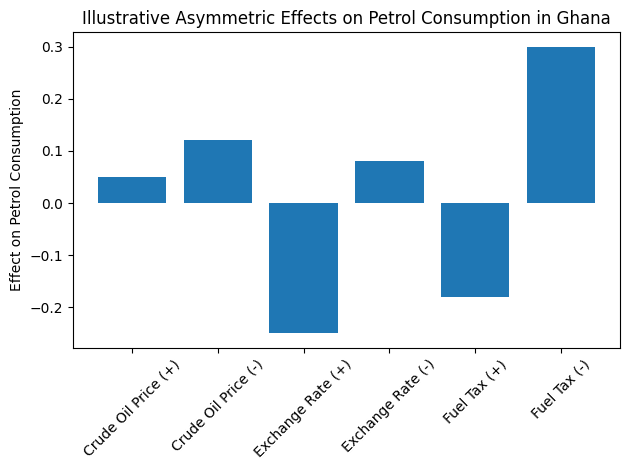
The research also highlights the importance of exchange rate movements. Because Ghana imports most of its refined petroleum products, a depreciation of the cedi significantly increases the local cost of fuel and tends to reduce consumption.
Perhaps the most influential factor identified in the study is domestic fuel taxation. Changes in taxes, levies and margins have a stronger effect on petrol consumption than movements in global crude oil prices. In particular, reductions in fuel taxes tend to stimulate consumption much more strongly than tax increases suppress it.
These findings suggest that policymakers seeking to manage fuel demand, inflation, and fiscal stability should pay close attention to domestic fuel pricing structures rather than focusing solely on international oil price movements.
As global oil markets face renewed volatility, understanding how Ghanaian consumers and businesses respond to fuel price changes will become increasingly important for economic planning and energy policy
Understanding the behavioral responses behind fuel consumption is critical for managing energy affordability, fiscal stability, and economic resilience.
The next time fuel prices rise in Ghana, the assumption that “higher prices reduce consumption” may need to be reconsidered.
In reality, the dynamics of petrol demand are shaped by behavioral responses, policy decisions, and exchange rate pressures, not just global crude oil prices. Understanding these asymmetries could be the difference between reacting to fuel price shocks and actually managing them.
Latest Stories
-
Ghana’s film industry: The Nokia of African cinema?
14 minutes -
British Council supports two Ghanaian creatives for UK cultural exchange opportunities
31 minutes -
Trump says Canada wants ‘benefits’ of being US state after trade talks collapse
2 hours -
TikTok to pay $400m to US in one of largest child privacy settlements
2 hours -
Asante Kotoko management doesn’t involve me in supporters mobilization – McBrown
2 hours -
Frustration builds in Indiana town struggling without power for 12 days
2 hours -
‘Jesus was accused; he kept quiet’ – Afenyo-Markin on Sammy Gyamfi allegation
2 hours -
NSMQ 2026: Accra High steals one-eighth ticket from Sunyani SHS in stunning final-round twist
2 hours -
Kejelcha breaks men’s half marathon world record by 29 seconds
2 hours -
Nkoko Nkitinkiti programme has failed – Afenyo-Markin claims
3 hours -
NDC yet to deliver key 2024 campaign promises – Afenyo-Markin
3 hours -
Adamus welcomes 12-month roadmap to revive mine, restore investor confidence
4 hours -
T-bills: Government records 162% oversubscription, interest rates slump
4 hours -
UPSA moves to turn student research into market-ready solutions
4 hours -
Presby SHS, Suhum honour late coordinator with dominant One-Eighth qualification
5 hours