

Audio By Carbonatix
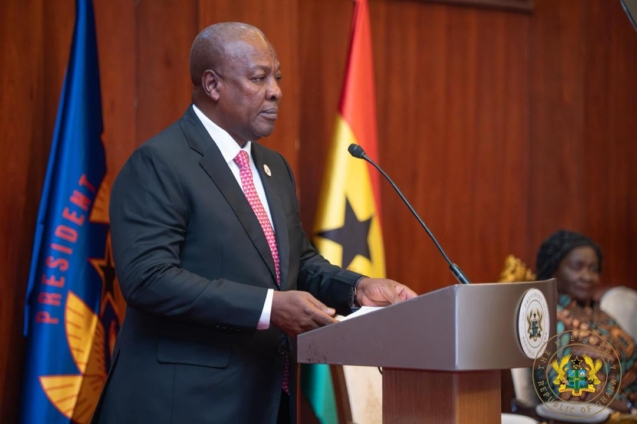
President John Dramani Mahama has described the United Nations’ adoption of a resolution declaring the transatlantic slave trade as the gravest crime against humanity as only the start of a broader global justice process.
Speaking upon his return from the United Nations on Sunday, President Mahama emphasised that while the resolution marks a historic moral victory, it must lead to concrete actions that address the enduring legacy of slavery.
“This resolution is just the beginning. It is not an end,” he stated, underscoring the need for sustained global engagement on justice, dignity, and historical accountability.
The President noted that the declaration brings long-overdue clarity at the highest international level, affirming the scale and inhumanity of the transatlantic slave trade, which affected millions of Africans over centuries.
He explained that Ghana, in collaboration with the African Union and Caribbean nations, played a key role in mobilising international support for the resolution, which was backed by over 120 countries.
According to him, the next phase will focus on translating the symbolic victory into tangible outcomes, particularly in the area of reparative justice.
President Mahama pointed to the CARICOM 10-point plan on reparations as a critical framework for advancing global discussions and said Ghana would work with partners to build a strong coalition around it.
“We will continue to engage our allies towards dialogue, education, remembrance, and ultimately reparative action,” he added.
He stressed that the resolution is not merely about revisiting history, but about confronting its lasting consequences and ensuring that the injustice of slavery is neither forgotten nor diminished.
The United Nations General Assembly has adopted a Ghana-led resolution declaring slavery and the transatlantic slave trade among the greatest injustices against humanity, while calling for reparative justice.
The measure, passed with 123 votes in favour, three against, and 53 abstentions, is seen as a major diplomatic win for Ghana and reflects growing global efforts to address the lasting impact of slavery.
The resolution recognises the centuries of suffering, violence, and exploitation endured by Africans and their descendants, and acknowledges that its legacy continues to drive systemic inequality, racial discrimination, and development challenges today.
Latest Stories
-
This is an attempt to break the Minority caucus – Patricia Appiagyei on alleged GH¢70k payment
44 minutes -
‘OSP hasn’t contacted me’ – Patricia Appiagyei assures cooporation if invited
58 minutes -
I find it strange that this memo was purportedly written by me – Patricia Appiagyei
1 hour -
Ayariga calls for stronger church partnership to tackle sanitation, environmental challenges
1 hour -
I don’t think we have an industry – Patchbay Band manager
2 hours -
Patchbay Band questions recognition of live bands in Ghana’s music industry
2 hours -
Newsfile to discuss SOEs’ GH¢19.8bn profit, dissolution of 9 boards, CJ’s visits to SOEs, GH¢70k gift rejection
2 hours -
BoG warns against spraying, defacing and using cedi notes for decorations
2 hours -
Adwumawura: Selected applicants to receive notifications from today – NEIP CEO
2 hours -
‘Fake memo’ fabricated to smear me – Patricia Appiagyei
2 hours -
ATLF2026: Culture, investment and tourism take centre stage as Africa’s tourism leaders gather in Polokwane
3 hours -
TI-Ghana and GACC demand full disclosure over alleged GH¢70,000 Appointments Committee payment
3 hours -
UN approves resolution in support of map that shows Africa’s true size
3 hours -
Spring Agro Industries urges Ghanaians to choose local rice as imports dominate market
3 hours -
Youths in Oti push for stronger policies on SRHR and gender-based violence
3 hours