

Audio By Carbonatix
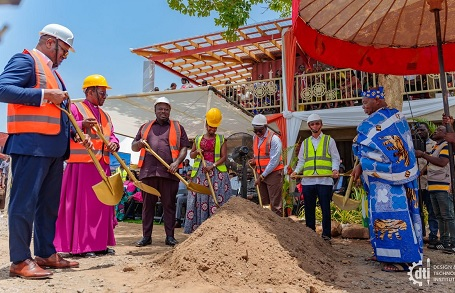
The Design and Technology Institute (DTI) has cut the sod for the construction of its DTI Berekuso Multi-Skills Campus in the Eastern Region, marking a major step towards expanding technical and vocational education and training (TVET) in Ghana.
The ceremony, which took place yesterday, heralded the beginning of an 11-acre development valued at $28 million, which would be executed in four phases.
The first phase, partially funded by a €3 million grant from the African Union Development Agency–New Partnership for Africa’s Development (AUDA-NEPAD), is scheduled for completion within 24 months and is expected to welcome its inaugural cohort for the 2028/2029 academic year.
Upon full completion, the campus will have the capacity to train up to 3,500 learners annually, positioning itself as a pan-African centre of excellence for workforce development and equipping Ghana and the broader continent for global competitiveness.
The Berekuso campus will introduce four new programmes: industrial plumbing, industrial electricals, cleaning sciences, and agricultural mechanisation, alongside existing disciplines such as welding and fabrication, design, innovation, and entrepreneurship.
The first phase of development will include two three-storey academic blocks featuring hands-on, competency-based classrooms, a two-storey administration block, a 160-booth welding and fabrication workshop, advanced non-destructive testing (NDT) labs, anchor factory spaces, which will later be developed into an industrial park, supporting infrastructure, community facilities, an amphitheatre and a student centre.
Industry Gaps
Speaking at the ceremony, the founder of DTI, Constance Swaniker, described the project as a transformational response to the skills gap she had witnessed on factory floors across the country.
She emphasised that the institution was “born not in theory, but in practice” and characterised the work as not optional but a calling.
Ms Swaniker said that DTI had 160 active industry partners supporting training, internships, and employment across seven universities, with precision quality embedded throughout.
She argued that this growth was clear evidence that Ghana and Africa were ready for a new model of education, one that was practical, relevant, and aligned with the real demands of industry.
“DTI is not a conventional school, and I am sure our learners will tell you we are an advanced industry-led institution that provides high-quality, hands-on, competency-based education, empowering youth with the practical skills employers actually need, reducing unemployment and promoting self-employment,” she stressed.
Resource
The Minister of Youth Development and Empowerment, George Opare Addo, underscored the importance of viewing young people not as a problem or a burden but as Ghana’s most significant productive resource.
He stressed that how the nation treated, trained, trusted, and invested in its youth would shape the country’s trajectory over the coming decades.
“Every year, a talented young person lost is a loss to households, enterprises, and the national economy,” he said, framing the preservation and development of youth potential as a high-stakes national priority.
He argued that institutions such as DTI were essential to preventing that loss by equipping youth with practical, certified skills that made them workforce-ready rather than leaving them waiting for uncertain jobs.
The minister affirmed the government’s commitment to creating a policy and regulatory environment that would support private investment and strengthen quality assurance for technical education, ensuring that Ghanaian certifications were trusted both domestically and abroad.
Private Sector Commitment
The Managing Director of Fidelity Bank, Julian Kingsley Opuni, gave the bank’s commitment to supporting DTI through financial literacy programmes, entrepreneurship development and improved access to financial services.
He described the support as part of a broader investment in systems that prepared young people for work and entrepreneurship, equipping them with technical ability, critical thinking, problem-solving, and a mindset for self-creation.
Vision
The Corporate Secretary of the DTI Board, Emmanuel Barima Manu, reflected on the origins of the institution, describing it as driven by restlessness and discontent.
He said the founder had looked inward, realised her capability to create better solutions, and established DTI because existing options were not fit for purpose.
He further stated that the DTI Berekuso Multi-Skills Campus represented a significant investment in Ghana’s human capital and a bold step towards reimagining technical education as a cornerstone of economic transformation.
Latest Stories
-
Power restoration fault suspected in Kumasi Central Market fire
5 hours -
The 7-foot giant of Ngleshie Amanfro: Seven-foot Ghanaian Ephraim Saawa dreams of joining the national basketball team
6 hours -
Government promises support for Kumasi Central Market fire victims
6 hours -
Vibes The Movie: Big Ghun’s Ghanaian film earns five nominations at 2026 REFFA
6 hours -
‘I’m a fulfilled man’—Justice Korbieh on missing out on Supreme Court despite two nominations
7 hours -
MamaCare CEO warns unresolved conflicts among health workers could undermine maternal and neonatal care
7 hours -
Health professionals urged to translate medical knowledge into practice to save mothers
7 hours -
Retired judge Justice Francis Korbieh charges 1,568 new lawyers to uphold integrity
8 hours -
Conflicts among care providers linked to maternal, neonatal deaths – Expert
8 hours -
GIS marks 10th TIME conference, champions improved teaching practices
9 hours -
BRICS Or Balance? What Ghana’s bid really means
9 hours -
GPRTU wants full TRAFFITECH-GH implementation to start in 2027
9 hours -
How 10-mile walks for basic education birthed a 50-year legal career for Justice Korbieh
9 hours -
Mahama announces plans to import electric wheelchairs for PWDs
9 hours -
KGL U17 Colts 2026: Western beat Prempeh Elite Academy to set up final final with Greater Accra Region
10 hours