

Audio By Carbonatix
The Member of Parliament for Abuakwa South, Dr Kingsley Agyemang, says the New Patriotic Party is not opposed to the government’s Free Primary Healthcare policy. But he insists the rollout must be backed by clear actuarial and scientific data.
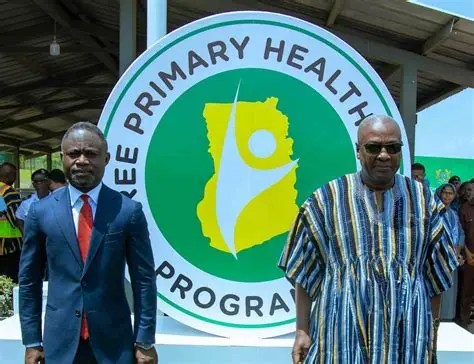
His comments come after President John Dramani Mahama launched the Free Primary Healthcare initiative. The policy is aimed at strengthening primary healthcare delivery and expanding access to preventive services across the country.
According to the government health policy direction, the programme is designed to support early detection and treatment of diseases at the community level. It will initially target about 150 under-served and less-endowed districts.
The aim is to reduce pressure on secondary and tertiary hospitals while improving health outcomes at the primary care level.
The intervention is expected to be funded through the National Health Insurance Scheme. Government estimates suggest the programme could cost about GH¢1.5 billion in its initial phase.
Ghana’s primary healthcare framework is not new.
It is anchored in long-standing national health policy, including the Community-based Health Planning and Services (CHPS) initiative and the National Health Insurance Act, 2012 (Act 852). These frameworks were designed to expand access to basic healthcare and move the country closer to Universal Health Coverage.
A 2025 update from the National Health Insurance Authority indicates that more than 20 million people are currently enrolled or actively benefitting from the NHIS. Officials say this marks one of the highest coverage levels recorded in recent years.
But speaking on JoyNews’ Pulse, Dr Agyemang questioned the basis and structure of the new rollout. He argued that while the policy direction is important, its implementation raises concerns.
“The NPP is not against the policy,” he said. “But we reject its arbitrary rollout. We need actuarial data to support it. A launch alone is not policy delivery.”
He also pushed back on claims that the initiative is entirely new. According to him, primary healthcare has long been part of Ghana’s health system and was strengthened under previous administrations.
“Primary healthcare is not new in this country,” he said. “It has existed for years, and we advanced it during our time in office. What we are seeing is not a new invention. It is an old system being repackaged.”
Dr Agyemang, a public health expert, stressed that Ghana’s push toward Universal Health Coverage must be evidence-based and structured. He warned that political branding of health interventions could weaken long-term reforms.
He further pointed to gaps in the health system, including domestic pharmaceutical production and supply chain weaknesses. He said these challenges must be addressed if Ghana is to achieve Sustainable Development Goal 3, which focuses on good health and well-being by 2030.
According to him, strengthening drug manufacturing capacity and improving health financing are just as critical as expanding access.
“We cannot focus only on access without addressing supply, cost, and sustainability,” he added.
The debate comes as the government continues to position primary healthcare expansion as a central pillar of its health sector agenda, while opposition voices call for clearer costing, sustainability planning, and technical validation.
Latest Stories
-
Government has improved sanitation in one-and-a-half years — Salaga South MP
29 minutes -
Nkwanta North Assembly to appear before Parliament over DACF sanitation spending
41 minutes -
Mourinho prints out ‘red card’ incidents after Real lose derby
1 hour -
Atletico beat 10-man Real in feisty Madrid derby
1 hour -
Twelve Tribes of Israel Ghana to mark 40 years with anniversary celebration
2 hours -
GPL 2026/27: Hearts held by Bechem as Kotoko, Samartex share spoils
2 hours -
My Story (Kwaku Antwi-Boasiako)
2 hours -
We expect growth rate to re-accelerate in second-half of 2026 – IC Insights
2 hours -
The ungodliness and unrighteousness underlying the National Cathedral mess!
2 hours -
T-bills auction: Government fails to achieve target; yield on 91-day-bill remains unchanged
3 hours -
It’s Ghana’s shame to denigrate Nkrumah when the whole world honours him as African of the Century – Asiedu Nketiah
3 hours -
No other nationalist can compare to Nkrumah – Asiedu Nketiah
3 hours -
Collateral Registry: Foreign banks accounted for GH¢19.9bn of secured credit in quarter 2, 2026
3 hours -
This government should expect scrutiny – Asiedu Nketiah
3 hours -
Two-year-old girl dies in domestic fire at Cantonments
4 hours