

Audio By Carbonatix
More than 30 percent of aspiring Ghanaian athletes have been exposed to exploitative recruitment schemes, Minister for Sports and Recreation, Kofi Iddie Adams, has said, unravelling increasing cases of human trafficking through sport.
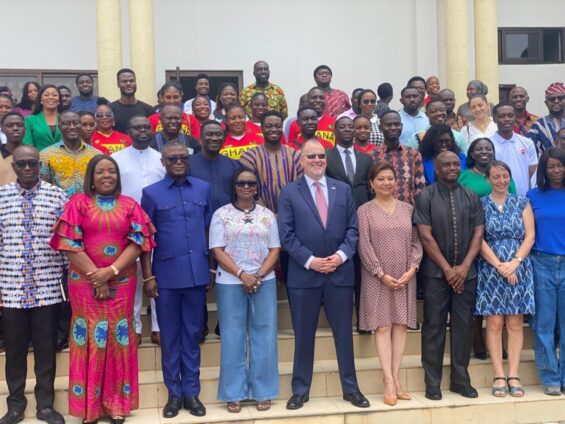
Delivering a keynote address at the National Forum on Human Trafficking Through Sports in Accra on Thursday, the minister said the problem was no longer a series of isolated incidents but a “structured informal economy” that exploits the ambitions of young athletes.
“Over 30 per cent of aspiring athletes in Ghana have been exposed to exploitative recruitment schemes, and close to 96 per cent express a strong desire to play abroad, largely driven by economic realities. This is not a random migration. This is a supply chain of vulnerability,” he said.
Mr. Adams warned that exploitation within sports was increasingly linked to organised crime, referring to the tragic case of a young Senegalese goalkeeper, Cheikh Touré, who was lured abroad with promises of a football trial only to be kidnapped and killed when ransom demands were not met.
Addressing the government’s response, the Sports Minister said the administration of President John Dramani Mahama was tackling the issue at its roots by prioritising youth protection and domestic sports development.
He explained that the separation of the former Ministry of Youth and Sports into a Ministry of Sports and Recreation and a Ministry of Youth Development and Empowerment was designed to allow focused and effective interventions.
As part of measures to stabilise the local football ecosystem, Mr Adams disclosed that the government had provided one million Ghana cedis to each Premier League club for the current season to support operations and player welfare.
In addition, the league-winning prize money would be increased from 500,000 Ghana cedis to two million Ghana cedis from the 2025/2026 season, with all clubs from first to fifteenth position receiving financial rewards.
“This is a structural intervention. We cannot continue to lose our best talents simply because the domestic system cannot sustain them,” he said.
Looking ahead to the 2026 FIFA World Cup in the USA, Canada, and Mexico, Mr Adams cautioned that risks extended beyond athletes to fans, noting that fraudulent travel schemes could also exploit supporters, potentially leading to financial losses and safety concerns for those attending the event.
“Our greatest resource is our youth. Sports talent must not be exported through exploitation. It must be developed through systems, protected through policy, and guided through credible pathways. Let us protect the dream. Let us protect the future,” he concluded.
Latest Stories
-
Black Stars: Seven years of decline while hashtagging love
14 minutes -
Today’s front pages: Thursday, October 1, 2026
15 minutes -
Gov’t to suspend GH¢1 D-Levy on diesel for October and November
47 minutes -
Fire destroys belongings in Akweteyman apartment
1 hour -
Baffour Awuah to turn himself in to EOCO today – JoyNews sources
1 hour -
Government identifies payment discrepancy holding up teachers’ strike resolution
2 hours -
BoG signals no FX intermediation for October as GoldBod plans $1bn support for banks
2 hours -
When share ownership becomes personal: The African mindset of the Dangote IPO
2 hours -
Why MFWA Legal Fund matters to Ghana’s democracy
2 hours -
Fuel prices to rise from October 1; diesel could hit GH¢19.60 – COMAC
2 hours -
Parliament must investigate how 3.9 tonnes of cocaine left Ghana undetected – Samuel Jinapor
2 hours -
Government pledges to pay striking teachers as payment dispute is resolved
2 hours -
Government cannot investigate drug exports under its own watch – Abu Jinapor
2 hours -
Government extends GH¢2 diesel subsidy for two more months
2 hours -
GTEC flags over 100 tertiary institutions as unrecognised
2 hours