

Audio By Carbonatix
Stakeholders rally for curriculum reform, practical financial education, and stronger partnerships to build wealth for future generations.
Young people across Ghana are increasingly embracing savings, investments, and insurance as financial literacy education deepens, Executive Director of the Centre for Financial Literacy Education (CFLE) Africa, Peter Asare Nyarko, has revealed.
Speaking at the 2026 National Financial Awareness and Financial Literacy Conference held on April 21 at the ISSER Conference Centre, University of Ghana, Legon, Mr Nyarko attributed this growing shift in financial behaviour to sustained education and advocacy efforts led by CFLE Africa.
“Many young people in Ghana today have learnt how to save, invest, and engage in various forms of insurance,” he noted, adding that the organisation’s interventions are equipping the younger generation with practical financial skills to secure their futures.
The conference, held under the theme “Financial Literacy for Growth; Wealth for Generations,” brought together policymakers, financial experts, educators, development partners, and students to deliberate on the role of financial knowledge in national development.
Mr Nyarko explained that CFLE Africa was established to inculcate financial literacy among Ghanaians, with a long-term vision of fostering financial independence, particularly in retirement. He emphasized that the institution’s mission goes beyond teaching people how to earn money, focusing instead on helping them understand how to manage, grow, and sustain it.
“Today is not just about speeches and presentations—it is about your future. Imagine a world where every young person understands money, not just how to earn it, but how to manage it, grow it, and use it to create opportunities for themselves, their families, and future generations,” he said.
He further stressed the need to move beyond awareness to practical empowerment, where individuals are equipped to make sound financial decisions consistently.
Chairman of the CFLE Africa Advisory Board, John Awuah, underscored the transformative power of financial literacy, describing it as “the fundamental grammar of freedom.”
“We are here to move people from survival to stability, from stability to success, and from success to legacy. Financial literacy is not just a skill—it is the bridge between being educated and being economically empowered,” he stated.
He challenged the notion that academic excellence automatically translates into financial intelligence: “Academic literacy teaches you how to work; financial literacy teaches you how to make your money work for you.”
Mr Awuah further emphasised the importance of developing a wealth mindset rooted in discipline, delayed gratification, and an understanding of compounding.
“If you have a solid financial foundation, technology can make you wealthy faster. Without it, it can make you go broke at the speed of light,” he cautioned.
Delivering a solidarity message from the United States, Valentino Sabuco described financial illiteracy as a global challenge and commended Ghana’s leadership in advancing financial education.
“Financial awareness and money management are not luxuries—they are basic human rights. By improving these skills, we uplift individuals, families, communities, and entire economies,” he said.
Also speaking at the event, Daniel Ofori Dankwa emphasised the importance of targeting young people early.
“We want to catch them young because they are the next generation. If they understand how to manage, make, and multiply money early, it will benefit the entire country,” he observed.
Panel Session Highlights
A thought-provoking panel session further enriched the conference, focusing on practical pathways for young Africans to build wealth and make informed financial decisions.
The session featured Mimi Anane Appiah, Business Development Manager at Fidelity Securities; Priscilla Ashiam, Head of Public Sector at Access Bank Ghana PLC; Sharon Acquaye, Senior Manager at KPMG Ghana; and Daniel Ofori Dankwa.
Panellists emphasised disciplined investing, financial planning, and the importance of leveraging available financial products and services. They also encouraged young people to invest in skills, build sustainable income streams, and adopt long-term wealth-building strategies.
Financial Literacy Challenge
A major highlight of the conference was the Financial Literacy Challenge, designed to test students’ ability to apply financial knowledge to real-life situations such as budgeting, saving, investing, and long-term planning.
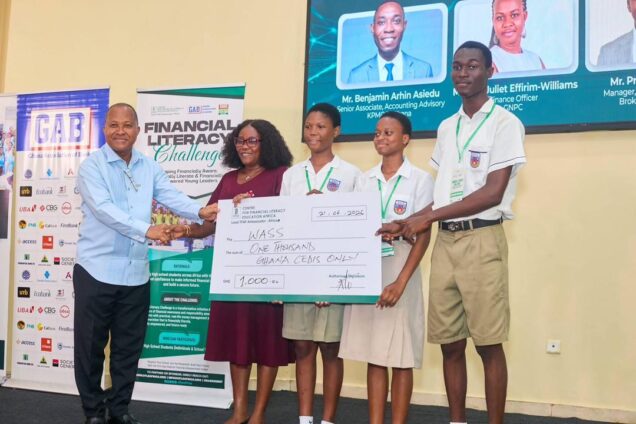
Participating schools included Presbyterian Boys’ Secondary School (PRESEC), Legon; West Africa Senior High School (WASS); and Apam Senior High School. While PRESEC and WASS competed in person, Apam SHS joined virtually via Zoom.
The competition was assessed by a distinguished panel of judges including Juliet Effirim-Williams, Prince Nyarko, Benjamin Arhin Asiedu, and Ato Ulzen-Appiah.
The judges commended the students for their depth of insight, analytical thinking, and ability to translate theory into practical solutions. After a highly competitive session, West Africa Senior High School emerged as the overall winner.
Strong Partnerships Driving Impact
The conference also highlighted the importance of collaboration in advancing financial literacy. Key partners supporting the initiative include the Ghana Association of Banks, KPMG Ghana, GhanaThink Foundation, and the Financial Awareness Foundation.
These partnerships continue to play a critical role in expanding the reach and impact of financial education across Ghana and beyond.
The conference reaffirmed CFLE Africa’s growing impact in shaping financially informed, responsible, and empowered youth, while strengthening the call for financial literacy to be treated as a national development priority.
Latest Stories
-
Barcola joins Liverpool from PSG in £123m move
1 minute -
GOIL profit rises to GH¢90.67m despite 9% revenue decline
4 minutes -
Aid system is broken, African Civil Society leaders say; 200 gather in Accra to build a new Africa-Led model
9 minutes -
TrustGH records more than 6,000 ‘scam’ numbers as TikTok emerges a major fraud channel in Accra, Ghana
9 minutes -
SIGA proposes liquidation of Ghana Railway Company and absorption of staff into GRDA
10 minutes -
Ghanaian dogs sweep top honours at West African August classic dog show
18 minutes -
YEA records GH¢110.4m surplus after turning around 2024 deficit – SIGA report
24 minutes -
Madina MP Francis-Xavier Sosu prioritises road rehabilitation, education and healthcare
30 minutes -
Valco-Kpone road turns nightmare as motorists fume, tanker drivers threaten fresh strike
30 minutes -
STC cuts net loss by 93% to GH¢5.18m despite 12% revenue decline
37 minutes -
Tanker drivers threaten strike over deplorable VALCO-TOR-Kpone road
43 minutes -
NPA surplus jumps 76% to GH¢447m in 2025 – SIGA
46 minutes -
Railway workers push for completion of Takoradi-Nsuta line by 2027
50 minutes -
Police arrest 6 suspected notorious armed robbers in Kumasi
53 minutes -
Opinion: GHS1m is welcome, but Ghana Premier League’s biggest problem remains unsolved
54 minutes