

Audio By Carbonatix
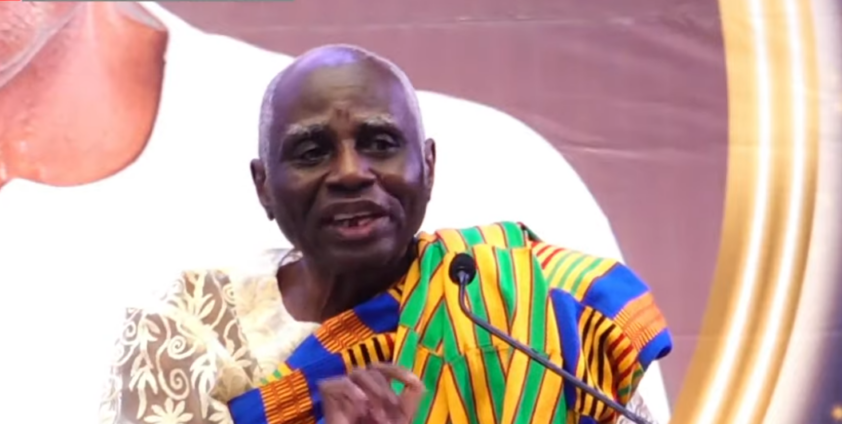
Legal luminary Tsatsu Tsikata has revealed why a path many expected him to take - joining the judiciary - never materialised, despite early ambitions to become a judge.
Speaking on Joy News’ PM Express, he said the idea of ascending to the bench faded as his professional focus shifted toward using the law as a tool for national development, particularly in the management of Ghana’s natural resources.
“I said in my Honorific Award lecture that in that December 1959 UAC interview, I boldly said, I’m going to be a lawyer and subsequently a judge, but the judge part, frankly, I never had much of an interest in that,” he disclosed.
Pressed on why he abandoned that trajectory, the veteran lawyer pointed to a turning point in his adult life when his understanding of the law evolved beyond courtroom adjudication.
“When I became an adult, I think because I moved into a different dimension of the application of law,” he explained.
Mr Tsikata said his work, particularly during his time at the Ghana National Petroleum Corporation (GNPC), opened his eyes to a broader national mission — one that demanded legal expertise not just in dispensing justice, but in shaping economic transformation.
“For instance, in relation to natural resources, what I did in GNPC and so on. So I began to see that itself as a kind of a mission, because you’re in a country blessed with natural resources and yet not always having the capabilities, technological, financial and so on, to get those natural resources out of the ground for the benefit of the people.”
That shift, he noted, ignited a deep passion for the oil, gas and extractive sectors, areas he believed offered a more impactful way to serve the country.
“So once I started getting more involved in that area -oil and gas, natural resource, extraction and so on - it really became my passion also,” he said.
Rather than presiding over individual legal disputes, Mr Tsikata said he became increasingly driven to use legal frameworks to unlock national wealth and opportunity.
“And so I saw my use of the law, not as you know, just administering justice in individual cases, but more or less enabling the country as a whole to benefit from our God-given resources.”
That conviction, he added, ultimately distanced him from any lingering ambition of becoming a judge.
“And so frankly, I lost that track a long time ago.”
Latest Stories
-
GPRTU wants full TRAFFITECH-GH implementation to start in 2027
1 minute -
Mahama announces plans to import electric wheelchairs for PWDs
5 minutes -
KGL U17 Colts 2026: Western beat Prempeh Elite Academy to set up final final with Greater Accra Region
24 minutes -
Late Solanke strike salvages 10-man Spurs draw at Man United
34 minutes -
Gender Ministry to monitor welfare of Nana Akua Addo’s children amid domestic violence case
40 minutes -
Benedict Okyere Yeboah: Ghana’s football problem goes beyond sacking a coach
50 minutes -
GPL 2026/27: Darkwah Wiafe’s winner sees All Blacks beat Kotoko
56 minutes -
ITF World Tour : Patel Wins Boys’ Singles Final at J100 Accra
1 hour -
Ghana must pursue BRICS partnership if it brings economic benefits – Kpebu
1 hour -
Success and Wright Claims J100 Accra Girls’ Doubles Championship
1 hour -
ITF J100: America’s Wright wins J100 Accra Girls’ Singles Title
1 hour -
Expedition hopes to find aviator Amelia Earhart’s plane on remote island
1 hour -
US seeks changes to rejected $109m health compact with Ghana – Mahama
2 hours -
Nine dead in mass shooting at Pennsylvania home
2 hours -
‘Time for Ukraine to get new president,’ says Trump after Zelensky condemns diesel deal
2 hours