

Audio By Carbonatix
The Automobile Assemblers Association of Ghana (AAAG) has raised serious concerns about the potential collapse of the country’s local automobile assembly industry following the removal of key tax incentives in the 2026 national budget.
According to the Association, the recent budget presented by the Finance Minister, Mr. Cassiel Ato Forson, eliminates the 20 percent VAT exemption on applicable duties for locally assembled vehicles. The AAAG warns that this decision could severely undermine the viability of Ghana’s growing vehicle assembly sector.
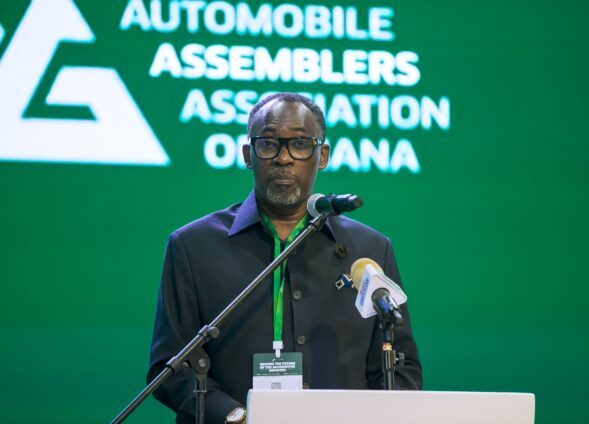
AAAG President, Mr. Jeffrey Oppong Peprah, who also serves as CEO of Volkswagen Ghana and Vice President of the African Association of Automotive Manufacturers (AAAM), expressed the Association’s deep concern in a submission to President John Mahama during a Presidential dialogue held in Accra, as well as in a post-interview with the media.
The dialogue, convened by President John Dramani Mahama on February 23, 2026, brought together key players in Ghana’s private sector to foster partnerships aimed at accelerating economic growth and national development.
The President encouraged businesses to leverage Ghana’s hosting of the African Continental Free Trade Area (AfCFTA) Secretariat to boost trade, industrialisation, and regional competitiveness, with the broader goal of positioning Ghana as a production hub in West Africa.
Mr. Peprah emphasized that sustained incentives are critical to enabling the private sector to respond effectively to this call. He noted that protecting the Ghana Automotive Development Policy would be essential for maintaining momentum in the local vehicle assembly industry.
The Ghana Automotive Development Policy
Mr. Peprah recalled that the Ghana Automotive Development Policy was introduced about five years ago with support from international consultants and subsequently approved by Parliament. The policy aimed to attract global automotive brands to establish assembly plants in Ghana through targeted incentives.
Key provisions included waivers on import duties for Semi Knocked Down (SKD) vehicles, increased duties of up to 35 percent on Completely Built-Up (CBU) vehicles, and a ban on importing vehicles older than 10 years.
Due to implementation challenges, government later introduced alternative incentives, including a 0 percent VAT exemption and a 5–10 percent duty waiver for locally assembled vehicles. According to the AAAG President, these measures created a 25–30 percent cost advantage that made local assembly commercially viable and beneficial to Ghanaians purchasing locally assembled vehicles.
“For the past three to four years, these incentives have enabled the industry to assemble vehicles competitively, reduce prices for consumers, and justify our investments,” he said.
Mr. Peprah applauded the government and recommended that it prioritise the automobile industry and ensure full implementation of the policy.
Industry at Risk
However, Mr. Peprah warned that the removal of the VAT exemption has drastically altered the landscape. “This decision has effectively pulled the rug from under our feet. The business case for local assembly is no longer viable,” he said. “If the policy is not reversed, we will be forced to halt operations. In fact, some global brands have already stopped ordering assembly kits.”
He cautioned that the consequences could be severe, including the loss of more than 400 skilled engineering jobs, the closure of seven assembly plants, and reputational damage to Ghana as an investment destination.
Euro 80 Million Investment at Risk
Adding his voice, Vice President of the AAAG, Mr. Salem Kalmoni, who also serves as Managing Director of Japan Motors Trading Co. Ltd., estimated that AAAG members have collectively invested nearly €80 million in equipment, assembly facilities, and workforce development.
Japan Motors alone assembled about 1,400 vehicles in 2025 and had plans to expand its assembly facility before the policy shift.
“It is unfortunate that just five years into this journey, our investments are under serious threat,” he said.
Call for Urgent Intervention
The Association is therefore appealing to the Ministry of Finance, through the Ministry of Trade, Agribusiness and Industry, to urgently restore the 20 percent VAT exemption or introduce a temporary 35 percent duty increase on imported vehicles as a stop-gap measure.
Mr. Kalmoni explained that local vehicle assembly naturally incurs higher costs in its early stages and requires government support until production scales up. He stressed that such support had enabled manufacturers to offer high-quality vehicles at more competitive prices.
He further noted that strengthening local assembly would significantly enhance the impact of the AfCFTA by encouraging component manufacturing and boosting intra-African trade.
Despite ongoing engagements with relevant authorities, the Association says progress has been slow while the industry edges closer to a critical breaking point. “Local assemblers are now on their knees. Once current stock is depleted, operations will cease, leading to inevitable job losses,” Mr. Kalmoni warned.
Other members of the AAAG present at the event included Ryuta Yoshikawa of Toyota Tsusho Manufacturing Ghana, Madam Yang Yang of Zonda Tec Ghana, and Mr. Kassem Odaymat of Rana Motors Ghana, among others.
Latest Stories
-
Oil extends losses on hopes for Middle East talks to ease supply woes
5 minutes -
Gov’t must put its skin in the game – Chamber of Mines demands tax, power relief for local gold refining
12 minutes -
I was suspended for defending NPP constitution, not opposing Akufo-Addo – Sammy Crabbe
23 minutes -
NPP suffered serious systemic failure in 2024 polls – Sammy Crabbe
29 minutes -
AMA arrests six drivers, mates over alleged overcharging of passengers
32 minutes -
NDC activist backs Sammy Gyamfi, calls for facts in GoldBod $1.7bn debate
35 minutes -
‘Don’t exclude us, then blame us for indiscipline’ – Catholic Bishops on GES Council removal
39 minutes -
Minority accuses Majority of wasting parliamentary time after emergency recall
44 minutes -
Catholic Bishops warn galamsey becoming source of employment for Ghanaian youth
49 minutes -
Can we give refineries more cheap power? – Chamber of Mines pushes energy solution for local gold refining
50 minutes -
Parliament to vet Zanetor Agyeman-Rawlings, Mahama Ayariga today
51 minutes -
Presby Moderator urges government to show political will to end galamsey
56 minutes -
Lower Manya Assembly supports PwDs with livelihood items
1 hour -
Legislation to regulate EV charging in the offing – Energy Minister
1 hour -
Audit Committees inaugurated to strengthen accountability at MMDAs
1 hour