

Audio By Carbonatix
In a major enforcement operation aimed at purging the Ghanaian market of hazardous consumer goods, the Ghana Standards Authority (GSA) has shut down four mattress manufacturing companies at Afienya, near Tema.
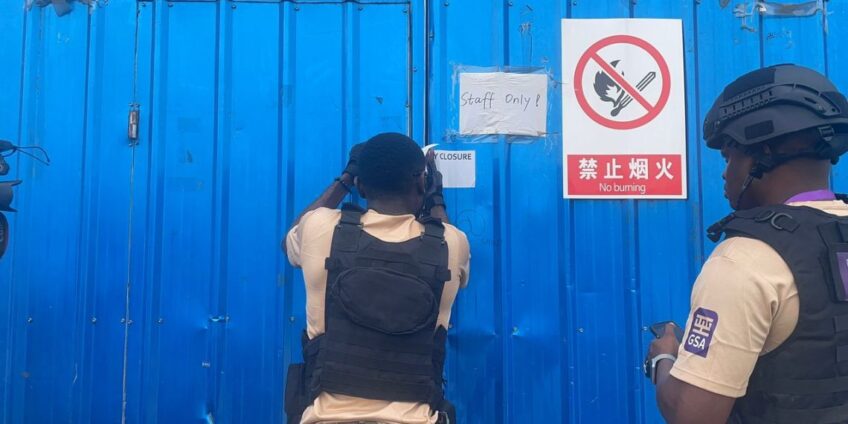
The companies—Yin Yuan Jia Limited, Mooda Limited, Hue Sheng Company (producers of Kalusini mattresses), and Asano Service—were completely sealed off by regulatory officers on Monday, 18 May 2026.
The Chinese-owned entities stand accused of systematically using substandard, unapproved, and potentially toxic chemical compounds to manufacture beds destined for the local Ghanaian market.
A routine market surveillance and subsequent laboratory analysis by the GSA exposed a dangerous production shortcut.
Instead of utilising polyurethane, the legally mandated and medically approved foam base for mattresses, the companies were found to be using polystyrene and unapproved polyethylene derivatives.
Polystyrene is a rigid, non-biodegradable polymer commercially reserved as protective shock-absorption packaging for shipping electronic gadgets and household appliances, such as refrigerators, air conditioners, ovens, microwaves, and blenders.
When manipulated into bedding, the material lacks the structural integrity required for orthopaedic support and exposes consumers to volatile chemical emissions.
Led by the GSA's Greater Accra Regional Manager, Mr Clement Kubati, an enforcement team backed by security personnel raided the factory floors in Afienya, ordering workers to halt operations immediately before placing official cease-and-desist seals on the machinery and warehouses.
Speaking directly to the press on the factory floor amidst heaps of confiscated chemical drums, Mr Kubati expressed grave concern over the blatant disregard for national manufacturing standards and consumer safety.
“This is the chemical they use in the manufacture of this substandard mattresses, polyethylene. As far as GSA is concerned, this chemical is not approved. It’s unapproved. These are non-biodegradable chemicals. They have impact on the environment, as well as human health,” Mr Kubati stated unequivocally.
According to the GSA, the unapproved chemical mixtures failed all standard quality and safety tests. Medical and environmental experts warn that sleeping on industrial packaging polymers can cause severe respiratory distress, skin allergies, and long-term spinal degradation due to inadequate body support.
Furthermore, because these synthetic polymers are entirely non-biodegradable, the scrap materials and discarded mattresses pose a permanent pollution threat to local drainage systems and landfills in the Tema enclave.
The GSA has warned that the facilities will remain closed indefinitely. The management of the affected companies will face rigorous legal sanctions, including heavy administrative fines and potential prosecution, to serve as a deterrent to other manufacturers attempting to compromise public health for corporate profit.
Latest Stories
-
It’s Ghana’s shame to denigrate Nkrumah when the whole world honours him as African of the Century – Asiedu Nketiah
6 minutes -
No other nationalist can compare to Nkrumah – Asiedu Nketiah
13 minutes -
Collateral Registry: Foreign banks accounted for GH¢19.9bn of secured credit in quarter 2, 2026
13 minutes -
This government should expect scrutiny – Asiedu Nketiah
39 minutes -
Two-year-old girl dies in domestic fire at Cantonments
1 hour -
Asiedu Nketiah urges better working conditions for journalists
2 hours -
JoyNews’ Precious Semevoh wins climate change reporting award at Bono GJA Awards
2 hours -
Kumasi Central Market phase 2 to begin in October after years of abandonment
2 hours -
Sentuo offers fuel supply reassurance as NPA sees steady output through December
3 hours -
Ghanaian smock showcased at Lesotho Tourism Summit
3 hours -
Four pupils to one desk: The painful plight of schools in New Juaben North
4 hours -
Ipswich launch investigation into racist abuse of Abdul Fatawu
4 hours -
Arrest of Techiman nurse is purely political persecution – ‘Ghana Jollof’
4 hours -
Isak nets winner as Liverpool edge Bournemouth
5 hours -
I dare gov’t of Ghana to extradite me; they can never do it – ‘Ghana Jollof’ speaks
5 hours