

Audio By Carbonatix
Few days after Ghana formally exited the International Monetary Fund's Extended Credit Facility (ECF), the country is again hearing a familiar promise: that this bailout, the 17th in its history, will be the last. It is the third time in twelve years a sitting president has made that pledge. The previous two were broken inside a single political cycle.
On 15 May, Ghana officially concluded its sixth and final review under the $3 billion ECF programme and transitioned to a non-financing Policy Coordination Instrument (PCI). Finance Minister Dr Cassiel Ato Forson assured the public that "we believe that we do not have a need to go for a bailout currently. But it does not mean we should lower our guard."
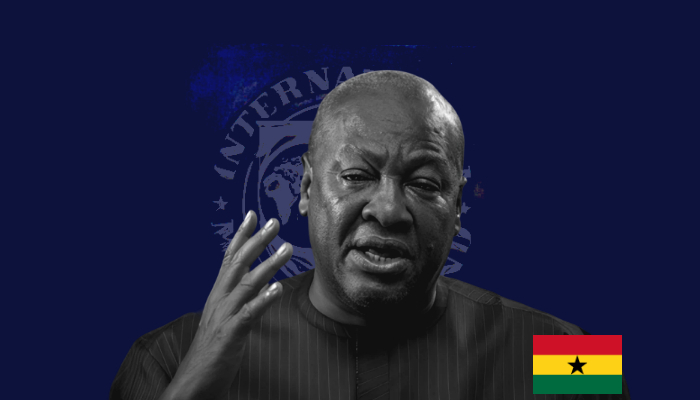
President John Dramani Mahama, only four months earlier, had been more definitive. Standing before the 77th Annual New Year School at the University of Ghana on 6 January, he declared: "It must be the 17th and the last time that Ghana goes for a bailout from the IMF."
Ghanaians have heard this song before. They have also seen the encore. In fact, Mahama's 'last bailout' vow joins a trail of failed pledges, from his own in 2014 to Akufo-Addo's 'Ghana Beyond Aid' in 2018
The recurring pledge
The recent history of presidential assurances against the IMF reads like a loop tape. In May 2014, with the cedi in free-fall and creditors circling, President John Mahama opened the National Economic Forum at Senchi-Akosombo with a categorical denial.
"I wish to take this opportunity to state, with great emphasis, that as President, I have not taken any decision to enter our country into an IMF programme," he told the assembled experts, chiefs and policymakers.
Less than three months later, on the sidelines of the US-Africa Leaders' Summit in Washington, he had U-turned. By April 2015, Ghana had signed its 16th IMF programme.
The torch then passed to Nana Addo Dankwa Akufo-Addo. From the moment he assumed office in January 2017, his administration draped itself in the doctrine of "Ghana Beyond Aid." At the Diplomatic New Year Greeting Ceremony at Jubilee House in January 2018, the new President declared: "We are determined not to go back to IMF tutelage again. We will manage our affairs properly."
In August of the same year, at a thanksgiving Mass at St. Peter's Cathedral Basilica in Kumasi, he doubled down: "We will govern ourselves correctly in the future, we'll never have any reason to return to IMF programme." His 2019 State of the Nation Address reiterated the pledge as Ghana prepared to exit the ECF it had inherited from Mahama.
His finance minister, Ken Ofori-Atta, became the most public guarantor of the promise. As recently as May 2022, he was telling Ghanaians: "We have committed to not going back to the fund... It's about validating the programme we have in place and finding other ways of handling our debt." Six weeks later, on 1 July 2022, the President directed him to commence formal engagements with the IMF. By May 2023, Ghana was signed into its 17th programme.
That brings us back to 6 January 2026, and President Mahama's "last time" declaration.
President Mahama's pledge at the 77th Annual New Year School on 6 January was unequivocal. "It is my hope that this will be the very last time we will ever go for a bailout from that international monetary institution," he told the gathering. "It must be the 17th and the last time that Ghana goes for a bailout from the IMF."
The President committed his administration to maintaining fiscal discipline into the 2028 election year, and said future engagement with the Fund would shift from financial rescue to technical collaboration under Article IV consultations and other non-financing instruments.
The next financing question for the government is the Eurobond market. Speaking alongside the IMF mission in Accra on 16 May, Finance Minister Dr Cassiel Ato Forson said the administration has no immediate plans to seek a fresh bailout or to issue new Eurobonds, but did not close the door on a return to international capital markets in the medium term.
"We are not in a hurry to go back to the international capital markets," Dr Forson said, adding that future decisions would depend on financing conditions and government priorities. Ghana has been locked out of the Eurobond market since late 2022.
The domestic bond market, however, has already reopened. In April 2026, the government raised ₵2.7 billion through a seven-year bond at a yield of 12.5%, drawing ₵3.1 billion in bids. Analysts described the oversubscribed issuance as the clearest financial signal yet that investor confidence is translating into concrete outcomes.
In place of the ECF, Ghana transitions to a Policy Coordination Instrument with the IMF, a non-financing surveillance arrangement that runs alongside a newly established Independent Fiscal Council intended to replace external conditionality with domestic oversight.
JoyNews Research checks shows each broken promise has been accompanied by an exogenous-shock narrative. For Mahama in 2014 and 2015, it was falling commodity prices, the energy crisis ("dumsor"), and a ballooning wage bill. For Akufo-Addo in 2022, the official explanation was COVID-19 and the Russia-Ukraine war.
In his 29 May 2023 national address, the President called the return to the IMF "a painful decision," explaining: "going to the IMF was not part of the economic transformation agenda I had been pursuing."
But the structural diagnoses are remarkably consistent across both administrations. Election-year spending spikes in 2008, 2012, 2016, 2020 and 2024 have reliably ballooned the fiscal deficit. Central bank financing of government has repeatedly converted political shortfalls into inflationary pressure. Commodity exposure has left the budget at the mercy of cocoa, gold, and oil prices.
The government has framed the 2026 conclusion of the formal programme as the start of a post-bailout era.
For external investors, the PCI doubles as a test. Where the ECF required the IMF to enforce reforms, the new instrument lets the Fund grade Ghana's discipline without lending money, giving creditors and ratings agencies an independent read on whether the country's recent macroeconomic gains are as solid as the government claims. The current US-Iran war, the 2028 budget cycle, and the period running up to it, will offer the first sustained verdict.
Latest Stories
-
Ghana housing finance conference adopts communiqué to improve affordable housing access
2 hours -
Special Initiatives Minister urges Wa Technical Institute to enrol more girls as EU-backed solar training lab opens
2 hours -
In the matter of my first year at the Bar
2 hours -
ActionAid Ghana calls for an end to child marriage, greater investment in girls’ rights
2 hours -
Newsfile to tackle World Cup visa scandal, beach demolitions, education strikes, BRICS bid
3 hours -
UK-Ghana Trade & Investment Summit: Trade Resource Centre to help businesses maximise UK-Ghana trade opportunities
3 hours -
Embassy of Denmark celebrates World Maritime Day
3 hours -
Linking LEAP to productive inclusion could cut extreme poverty by 2030 – UNICEF
4 hours -
Trade Ministry backs use of creative arts to rehabilitate prison inmates
4 hours -
Negotiations with government to continue despite strike suspension – GNAT
4 hours -
‘Ghana cannot afford to waste public resources; every cedi has a job’ – Ato Forson
4 hours -
Ghana expects economic boost as World Assemblies of God Congress brings 10,000 delegates to Accra
5 hours -
Joy in Nayilifong as Farouk Aliu Mahama donates 100kVA transformer to improve power supply
5 hours -
Chief Justice urges employers to tackle mental health stigma in workplaces
6 hours -
Analysis: Ghana’s yellow fever numbers reveal a gap between vaccination and protection
6 hours