

Audio By Carbonatix
In Ghana, these major El Niño events such as those of 1982-1983, 1997-1998, 2015-2016, and the recent 2023-2024 episode have been linked to prolonged dry spells, reduced rainfall, increased temperatures, and heightened risks of drought and wildfires.
These conditions have adversely affected the national economy through declines in agricultural productivity, reduced hydropower generation due to low water levels in reservoirs such as the Akosombo Dam, increased food prices, pressure on water resources, and disruptions to livelihoods that depend heavily on rain-fed agriculture.
The 1982–1983 El Niño, in particular, coincided with severe drought and bushfires in Ghana, resulting in extensive environmental degradation and substantial economic losses. Weather models project the likely occurrence of a super El Niño between the middle of 2026 and early 2027. In this article, we explain what El Niño is, the potential impacts on Ghana’s economy and people, and what could be done to reduce these impacts.
What is an El Niño event?
The climate system of the tropical Pacific Ocean naturally oscillates between warm, cool and neutral phases in a phenomenon known as the El Niño–Southern Oscillation (ENSO). ENSO is one of the most important drivers of year-to-year climate variability across the globe. It consists of two opposite phases: El Niño and La Niña.
Under normal conditions, trade winds blow westward across the Pacific, piling up warm water near Indonesia and Australia and drawing cooler water to the surface off the South American coast. When this system weakens or reverses, the result is either an El Niño (warm phase) or a La Niña (cool phase). During El Niño events, sea surface temperatures in the central and eastern equatorial Pacific Ocean become unusually warm. These warmer waters weaken the normal trade winds and alter atmospheric circulation patterns. In contrast, La Niña occurs when these same waters become cooler than average, strengthening trade winds and shifting rainfall patterns in the opposite direction.
Although ENSO originates in the Pacific Ocean, its effects are felt far beyond the Pacific through what climate scientists call “teleconnections.” Teleconnections are large-scale atmospheric links that connect weather and climate conditions in distant parts of the world. Through these atmospheric pathways, El Niño and La Niña influence rainfall, temperature, storms, droughts and even wildfire risks across Africa, Asia, the Americas and Europe. ENSO cycles typically alternate every two to seven years, though their intensity varies dramatically.
For West Africa and Ghana, El Niño events are often associated with hotter and drier conditions, especially during parts of the dry season and transition periods between the rainy and dry seasons.
What is a Super El Niño?
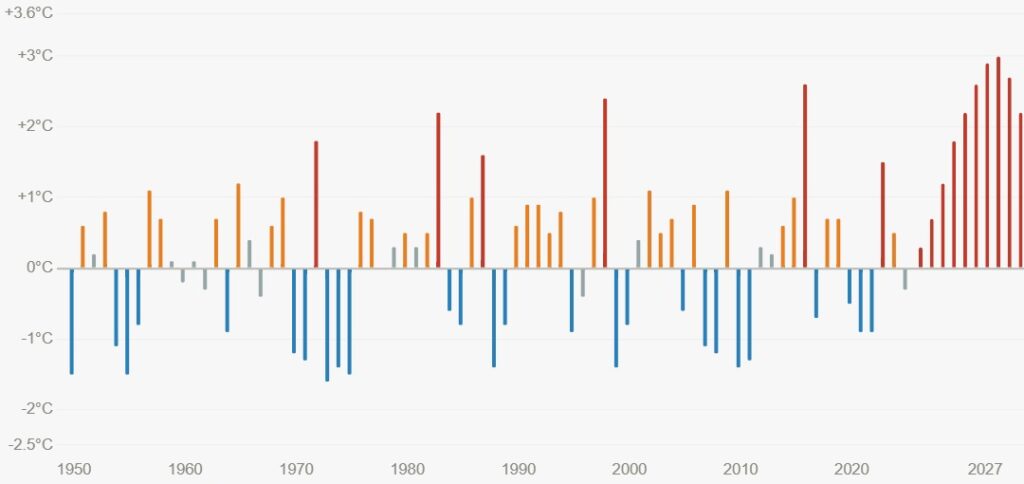
Not all El Niño events are equal. The strength of El Niño episodes are classified according to the extent of warming in the Niño 3.4 region of the Pacific Ocean The Niño 3.4 region is a rectangular zone in the central equatorial Pacific Ocean (5°N–5°S, 170°W–120°W) whose average sea-surface temperature anomaly serves as the primary benchmark for measuring and classifying ENSO events. A super El Niño is defined by sustained sea-surface temperature anomalies in the Niño 3.4 region exceeding +1.5°C above average, typically reaching +2°C to +3°C or higher at their peak. These are rare, high-impact events that occur roughly once a decade (Figure 1).
The three confirmed super El Niño events in the modern record occurred in 1982/83, 1997/98, and 2015/16. Each reshaped global weather for 12 to 18 months, triggering some of the worst droughts, floods, coral bleaching events, and food crises in recent history. The 1997/98 event remains the strongest on record by most measures, peaking at approximately +2.4°C in the Niño 3.4 index.
What makes a super El Niño so much more devastating than a moderate one is not just its magnitude but also its persistence and reach. Super events sustain their anomalies long enough and intensely enough to overwhelm regional climate systems that might otherwise recover from a weaker perturbation.
What do we know so far about the 2026/2027 Super El Niño?
Climate models and forecasting agencies are increasingly warning about the possibility of a strong or even super El Niño developing during late 2026 and peaking into early 2027. As of May 2026, NOAA's Climate Prediction Center has placed El Niño on Watch status, with an 82% probability of emergence by mid-2026 and a 96% probability of continuation through Northern Hemisphere winter 2026–27. The International Research Institute for Climate and Society (IRI) at Columbia University puts El Niño probability even higher, at 97–98% across the forecast window through early 2027.
Equally concerning is the projected strength of this event. The European Centre for Medium Range Weather Forecasts (ECMWF), National Oceanic and Atmospheric Administration (NOAA) of the US, and Australia's Bureau of Meteorology (BOM) ensemble models are now converging on anomalies potentially reaching +3°C. Such anomalies would rival or surpass the 1997/98 super El Niño record.
The additional wild card is the baseline: unlike previous super events, the 2026/27 El Niño is building on the warmest ocean temperatures in the historical record, amplified by decades of climate change. This means even if the raw SST anomaly were merely comparable to 1997/98, its absolute impacts could be substantially worse.
Historical El Niño impacts in Ghana
Ghana has felt the sting of super El Niños before — twice, with consequences that still shape the country's policy and collective memory.
1982/83 — Famine and Fire
The 1982/83 super El Niño helped trigger one of the most devastating droughts in West African history. In Ghana, rainfall deficits reached critical levels, with some coastal regions like Accra receiving barely half of their average annual precipitation. A prolonged dry season stretching from December 1982 to April 1983 left crops withered nationwide. Bushfires destroyed large areas of forest and farmland, worsening the crisis. Cocoa production — the backbone of Ghana's export economy — nearly collapsed.
Nigeria simultaneously expelled approximately 900,000 to 1.2 million Ghanaian migrants, flooding the country with returnees at the very moment food production had catastrophically failed, further compounding the crisis. The result was famine: widespread malnutrition, mass displacement, and an economy already reeling from inflation and political instability pushed to the brink.
1997/98 — Darkness across the country
The 1997/98 super El Niño brought a different kind of crisis, no less damaging. Reduced rainfall lowered water levels in the Volta Lake, significantly limiting electricity generation from the Akosombo Dam hydropower system.
At this time, Akosombo was Ghana’s primary energy production source. The reservoir fell so far that the dam was forced to drastically curtail generation, triggering severe load shedding across the country. Ghana subsequently experienced severe electricity shortages and power rationing. Businesses lost productivity, hospitals struggled, and households endured rolling blackouts for months. This crisis accelerated the construction of the Takoradi thermal power station as an emergency supplement, a reactive measure that underscored how dangerously over-reliant Ghana had become on a single, rainfall-dependent energy source.
Potential impacts of the 2026/2027 Super El Niño on Ghana
History suggests that the coming event could expose Ghana to a dangerous convergence of crises — and this time, the country enters the event in a more complex position.
Hydropower Shortfalls
Ghana's three hydroelectric dams — Akosombo, Kpong, and Bui — together supply roughly 40% of its installed electricity generation capacity. A prolonged El Niño drought that reduces inflows to Lake Volta and the Black Volta could push reservoir levels down to the critical thresholds seen in 1998, or worse. With electricity demand having grown enormously since then due to rapid urbanization, industrial expansion, digitalization, and population growth, a repeat energy crisis would hit a far larger urban and industrial economy.
At the same time, the country’s energy sector continues to face persistent structural challenges, including high operational debt, unreliable fuel supplies for thermal plants, aging infrastructure, and limited reserve margins. Critical sectors such as manufacturing, mining, healthcare, water supply systems, and small-scale enterprises would be particularly vulnerable to prolonged electricity instability. The recent dumsor related to a fire at Akosombo should serve as a reminder of the critical role that hydroelectric power plays in Ghana’s energy stability.
Reduced Agricultural Production
Ghana remains heavily dependent on rain-fed agriculture. A super El Niño typically suppresses the onset of the rainy season in West Africa, shortens its duration, and intensifies dry spells. Reduced soil moisture and erratic rainfall could devastate yields of maize, yam, sorghum, and cocoa — threatening both food security and export revenues.
Fires
As seen in 1983, prolonged drought and dry harmattan conditions dramatically increase the risk of bush fires. Forest fires destroy biodiversity and reduce carbon sinks. Market fires, already a recurrent urban hazard in Ghana, become more likely when dry winds combine with dense combustible materials in crowded market structures.
The Iran Conflict Multiplier
These climate risks arrive at a moment when global agricultural input markets are already severely disrupted. Since the outbreak of the 2026 Iran conflict, disruptions to the Strait of Hormuz have driven fertilizer prices sharply higher; urea prices alone have risen by around 50% since the war began. The UN's Food and Agriculture Organisation reports that Sub-Saharan Africa is among the hardest-hit regions, facing elevated costs and reduced availability of nitrogen and phosphate fertilizers. Ghana's farmers could be entering a potential drought season with more expensive and scarcer inputs. Higher fuel and shipping costs add further pressure to food prices and energy costs. What could have been a serious climate crisis risks becoming a compound food security catastrophe.
What Ghana can do to prepare
The 2026/27 super El Niño is not yet upon us — and that gives Ghana a window, however narrow, to act.
Continuous Monitoring and Early warning
Early warning and public education are critical first lines of defence against the coming super El Niño. To achieve this, the relevant state agencies must keep an eye on the development of the super El Niño and continuously update the public on its evolution.
For example, farmers need timely, actionable guidance: when to plant, which drought-tolerant crop varieties to prioritise, and how to conserve soil moisture through techniques like mulching and conservation tillage. Civil society organisations, district assemblies, and agricultural extension officers should work in concert to translate seasonal climate forecasts into farm-level advice that is practical and accessible, even for those without smartphones or internet access.
Alongside agricultural awareness, the National Disaster Management Organisation (NADMO) and the Ghana National Fire Service (GNFS) must begin proactive contingency planning well ahead of the event's peak. NADMO should update and pre-position emergency response resources in districts historically prone to drought and fire, while activating community disaster volunteer networks to serve as early warning relays at the local level. The GNFS, for its part, must anticipate a significant surge in bush fire incidents as prolonged dry spells and intensified harmattan winds create tinderbox conditions across the forest, Guinea-Savannah, transition zones, and beyond. The GNFS should conduct pre-season inspections of high-density markets such as Kejetia, Makola, and Kumasi Central, ensuring that fire safety infrastructure, access routes for fire tenders, and extinguisher availability meet minimum standards before the dry season sets in.
Accelerate Solar Deployment
The most urgent and practical response to the threat of hydropower deficits is an emergency expansion of solar capacity. Ghana has abundant solar resources, and rooftop solar installations on public buildings, schools, and hospitals could provide critical resilience during periods when Akosombo and Bui are operating below capacity. Distributed solar is faster to deploy than new thermal plants and avoids fuel import vulnerability — a particularly important advantage given current global fuel price instability.
Encourage Backyard and Urban Farming
If rainfall deficits threaten large-scale commercial agriculture, household-level food production becomes a critical buffer. Encouraging backyard gardens, community plots, and school farms — particularly in peri-urban areas — can reduce dependence on market food chains that will be squeezed by both drought and high import costs. Urban and semi-urban Ghanaians with access to even small plots of land could meaningfully supplement household food budgets during a prolonged dry period.
Ghana has survived super El Niños before. But 1983 left scars that took a generation to heal. The lesson is not that disaster is inevitable — it is that preparation makes the difference between a crisis managed and a crisis that manages you. The lesson of past El Niño events is that communities that received early warning and prepared accordingly fared significantly better than those who were caught off guard.
The authors Dr. Frederick Otu-Larbi (f.otu-larbi@uenr.edu.gh) and Dr. Caleb Mensah (c.mensah@uenr.edu.gh) are lecturers at the Department of Atmospheric and Climate Science, University of Energy and Natural Resources, Dormaa Campus.
Latest Stories
-
He entered at eight. He is now 16: Ghana’s children growing up in prayer camps
2 minutes -
‘Development must not always begin from Accra’ — Anwelle Foundation launched in Jirapa
4 minutes -
PKO trio eye victories at Odwira Festival
3 hours -
346 Ghana Navy recruits pass out after 26 weeks of intensive training
3 hours -
Newsfile to discuss EOCO-MP arrest, drug trafficking, speech arrests and $235m water debt
3 hours -
JoyNews gets results as listeners raise GH¢40,000 to help 17-year-old student with cerebral palsy attend SHS
4 hours -
Vice President calls for stronger local pharmaceutical production to reduce medicine imports
4 hours -
The brewing tension at KNUST; Beware the Ides of October….
4 hours -
Health Ministry moves to integrate traditional medicine into mainstream healthcare
5 hours -
550 pupils in Kintampo South get educational lifeline as ‘Seeds of Hope’ reaches farming communities
5 hours -
Opoku Mensah urges Christian Council, House of Chiefs to speak up on democratic freedoms
5 hours -
Teacher unions’ strike: Minority demands immediate payment of teacher arrears, 20% deprived area allowance
5 hours -
The Accra-Kumasi Expressway: Building it right
6 hours -
Beyond gold exports: Building value and economic resilience from Ghana’s gold
6 hours -
2027 AFCONQ: Ghana under pressure as Gambia beat Somalia 2-1
6 hours